Hi, what do you want to do?






Thoughtful Learning
Using 5-5-5 Breathing to Calm Down
Scholars calm their minds and bodies with a 5-5-5 breathing exercise. Learners breathe in for five seconds, out for five seconds, then wait five seconds to start again. The exercise takes one minute to complete.

Lions Clubs International Foundation
Introduction to Mindful Breathing
Ten minutes are all you need for a breathing exercise designed to bring calm and focus. Young scholars get their wiggles out, then shift their gaze and belly breath, paying close attention to how they physically feel.

University of California
Breathing Boards
Instill the importance of mindfulness with six breathing exercises. Scholars trace shapes using their fingers, following arrows that tell them when to breathe in and when to breathe out. Exercises increase by counts of breath in and out.

Lions Clubs International Foundation
Introduction to Mindful Breathing
Mindful breathing or belly breathing is the basis for most mindfulness exercises. Introduce mindfulness practices with a short exercise in breath awareness designed to reduce stress and increase awareness.

Lions Clubs International Foundation
Introduction to Mindful Breathing
The first of eight lessons introduces learners to Breath Awareness—an exercise that brings focus and thoughtfulness through breathing before engaging in other activities.

The New York Times
Breathing With a Pinwheel
A pinwheel encourages deep breathing to calm one's body and recenter their thoughts. Scholars breathe into a personal pinwheel with different types of breathing patterns then answer a question about how they feel.

Plum Tree
Teaching Your Child How to "Deep Breathe"
Feeling stressed, angry, or nervous? It's time to practice the exercise detailed in Deep Breathe to breathe your cares away. The activity brings the focus back to one's self and identifies the importance of...

Lions Clubs International Foundation
Mindful Self-Awareness Exercise: Identifying Feelings
Following a breathing exercise, scholars examine facial expressions and body posture to identify feelings. The exercise ends with a reflection.

Lions Clubs International Foundation
Mindful Self-Management Exercise: Managing Stress
Let it go! As part of the Mindfulness series, pupils learn a technique to manage stress and strong emotions. While doing the deep breathing exercise, they imagine a train of stressful thoughts, take a step back, and let the train pass.

Lions Clubs International Foundation
Mindful Self-Management Exercise: Responding Using S.T.O.P.
Respond rather than react! A self-management exercise teaches pupils a Mindful S.T.O.P. activity. Participants Stop their thoughts or actions, Take deep breaths, Observe how they are feeling, then Proceed with a response that will help...

Lions Clubs International Foundation
Mindful Self-Awareness Exercise: Building Self-Confidence
Encourage scholars to build self-confidence by thinking positively. Learners focus on breathing and then think of positive statements about themselves, their relationships, appearance, physical health, and so much more.

Lions Clubs International Foundation
Mindful Self-Management Exercise: Impulse Control
A coping skill helps to manage emotions. Young scholars pretend they are a remote control. When they feel strongly about something, they pause their actions, take a deep breath, reflect, and press play to get back to what they were doing.

Lions Clubs International Foundation
Mindful Self-Management Exercise: Managing Stress
Help scholars manage stress with an activity that prompts them to think of their feelings as clouds floating over their heads. Learners identify their feelings, focus on their responses, and allow them to float away.

Thoughtful Learning
Using Progressive Relaxation
Stress makes a mess of our minds and bodies. Like a vicious circle, stress causes our bodies to tense and makes it more difficult to get rid of the stress. Break the cycle for you and your students by practicing progressive relaxation....

Curated OER
Human Body Series - Respiratory System
Elementary schoolers play a respiratory relay toss in order to take in the respiratory system! They also create their own question cards based on several kid-friendly online articles about breathing and the health of the lungs. They use...

National Heart Association
Cold Weather Fitness Guide
Don't sacrifice physical activity every time cold winter weather arrives. From walking or circuit training to warm, healthy recipes and safety reminders, this resource will help encourage learners to prioritize their fitness and stay...

Primary Resources
Warm Ups & Cool Downs for Children
What makes an effective warm-up and cool-down activity? as well as tips for leading stretches. Find detailed activity plans, as well as tips for leading stretches, for elementary school, tag-based games (including one game called "Toilet...

National Park Service
Hibernation-Migration-Fascination
What's the difference between hibernation and a good nap? Find out with an engaging life science activity that compares the hibernation habits of grizzly bears and marmots. After learners read an informational passage about each mammal,...

Elementary School Counseling
The Day Jace Kelly Popped
Anger can creep inside and build up in all of us. Prepare your youngsters for this feeling by reading the story of Jace Kelly through this series of storytelling printables, and discover the strategies he would eventually...

Green Hope High School
Close Readings from The Tempest + New World Readings
What was Shakespeare's intent? That is the question at the heart of a summer assignment designed for AP English Literature. Class members focus on five scenes from The Tempest and compare the interactions of Prospero, Caliban,...

Science Buddies
Science Buddies: Breath of Life: Does Exercise Increase Vital Capacity?
When you take a deep breath, the amount of air you are capable of holding within your lungs, is known as your lung capacity. It is not the same for everyone. This lab asks you to find out if it is possible to increase your lung capacity...
Science Buddies
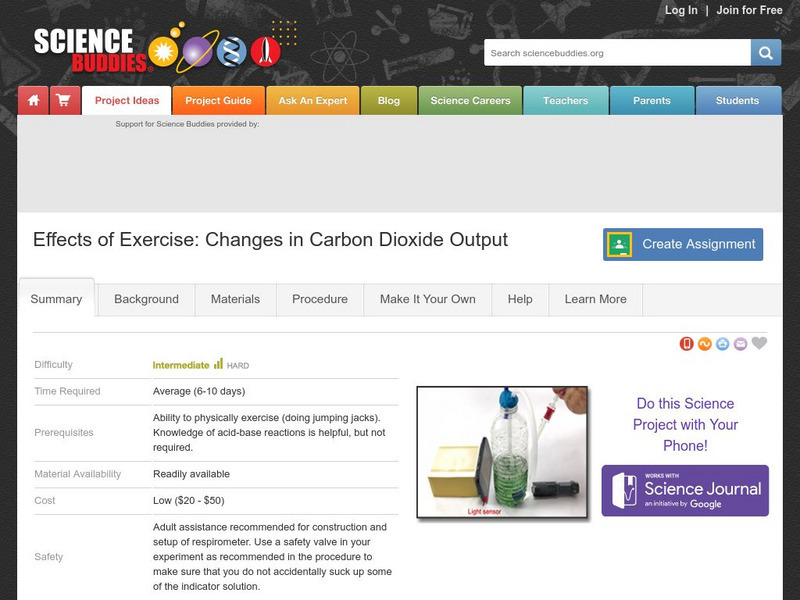
Science Buddies: Effects of Exercise: Changes in Carbon Dioxide Output
Everybody knows that your body needs oxygen to keep going, and that you breathe out carbon dioxide as waste. What happens when you exercise? You've probably noticed that you breathe faster, and your heart beats faster. What triggers your...
Science Buddies
Science Buddies: Ewww, Dog Breath! Does Active Play Take a Dog's Breath Away?
A project that requires you to play with a dog cannot be all that bad, right? This scientific experiment entails the respiratory functions of dogs. Learn the chemical and bodily processes going on within your canine companions...
TeachEngineering
Teach Engineering: Breathing Cells
Students use a simple pH indicator to measure how much CO2 is produced during respiration, at rest and after exercising. They begin by comparing some common household solutions in order to determine the color change of the indicator....