Hi, what do you want to do?






Howard Hughes Medical Institute
Stickleback Evolution Virtual Lab
How quickly do animals evolve? Can comparing different samples of the same fossil answer timeline questions? Scholars use virtual labs to examine fossils and learn about stickleback evolution. They compare pelvic morphology in lakes...

ARKive
Darwin and Natural Selection
A presentation on Darwin's theory of evolution and natural selection could be a good addition to your biology class. It provides general information about how animals adapt to their surroundings, as well as how organisms create more...

Howard Hughes Medical Institute
Lactase Persistence: Evidence for Selection
What's the link between lactase persistence and dairy farming? Biology scholars analyze data to find evidence of the connection, then relate this to human adaptation. Working individually and in small groups, learners view short video...

Smithsonian Institution
Expedition: Insects
Get up close and personal with beautiful and sometimes dangerous insects in an exciting eBook activity! Pupils practice geography skills by reading a map with the location of six different insects. Scientists read about each insect,...

New York State Education Department
Regents High School Examination: Living Environment 2003
The living environment, from the interior of a cell to the complex relationships among populations, is queried in this final examination. Learners examine air pollution maps, cell diagrams, population graphs, and drawings of cells. They...

New York State Education Department
Regents High School Exam: Living Environment 2008
The New York Regents High School Examinations are comprehensive and include various question formats, including multiple choice and graph analysis. This particular version, the 2008 Living Environment exam, surveys a variety of topics....

New York State Education Department
Regents High School Examination: Living Environment 2005
The 2005 version of the Regents High School Examination in ecology is as comprehensive as previous years' exams. It consists of 40 multiple-choice questions on topics ranging from the structure of DNA to interactions within an ecosystem....

Edinburgh UNESCO City of Literature Trust
The Lost World
Fans of Sherlock Holmes may be surprised to learn that in addition to stories of the famous deductionist, Sir Arthur Conan Doyle is also the creator of Professor Challenger. An irascible, unpredictable scientist, Challenger was featured...

Columbus City Schools
Diversity of Living Things
Here's a topic classes can really dig—the fossil record. Use the well-organized and thoughtful road map to take eighth graders back in time to unearth the answer. Learn how our climate has changed, and how organisms have...

Great Books Foundation
On the Origin of Species
How did Charles Darwin support his controversial theory of evolution with evidence? Use an excerpt from his 1859 work On the Origin of Species to reinforce the importance of making inferences within an informational text, and to...

Biology Junction
Reptiles
When crocodiles close their mouths, you still see their teeth, but when alligators close their mouths, their teeth are hidden. Learn more about these reptiles and their many evolutionary cousins in a fact-filled presentation. It...

College Board
2018 AP® Biology Free-Response Questions
The average AP Biology score dropped in 2018 with the addition of more data tables and graphs. Offer additional practice free-response questions by using the questions from the 2018 AP exam covering phylogenetic trees, cell structure and...

Columbus City Schools
Get Your Organisms Organized
From large to small, show your class how to organize them all! Included within the guide is everything you need to take their knowledge of classification from the cellular to the species level. The worksheets focus on...

Lerner Publishing
Teaching Habitats
What makes up a habitat? Use this resource to engage first graders in the exploration of desert, wetland, forest, and ocean habitats. Youngsters classify plants and animals into the four distinct habitats through drawings and cutting and...

Roald Dahl
Roald Dahl Matilda Lesson Plans
Fifty eye-catching pages contain six lessons about Roald Dahl's novel, Matilda. Each lesson has a theme and covers a different subject—literacy, social-emotional learning, science, and geography. Scholars analyze characters, examine...

Project SMART
Exploring the History of Mathematics
Learners research six different mathematicians using Internet resources. They examine the contributions of different cultures, women, and one that made a significant to geometry. They present their research to the class.
CK-12 Foundation
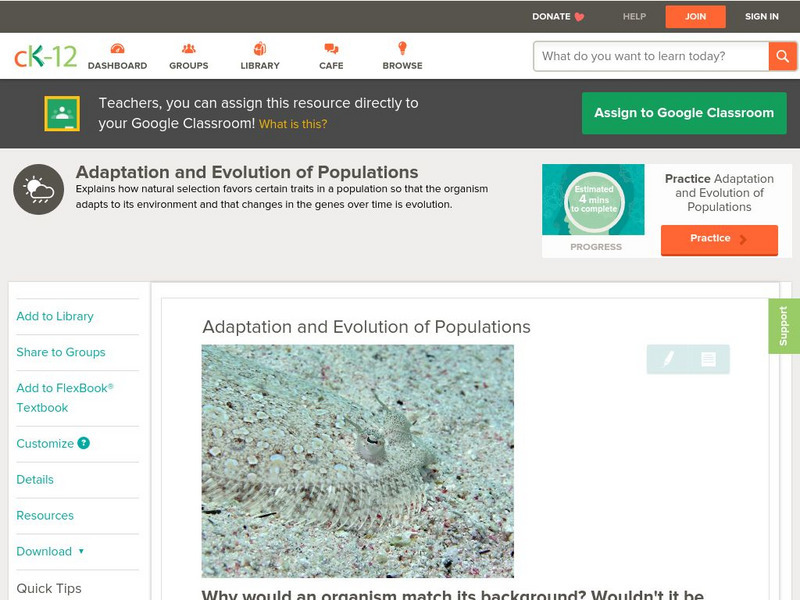
Ck 12: Earth Science: Adaptation and Evolution of Populations
[Free Registration/Login may be required to access all resource tools.] Explains how natural selection favors certain traits in a population so that the organism adapts to its environment, and that changes in the genes over time cause...
Concord Consortium
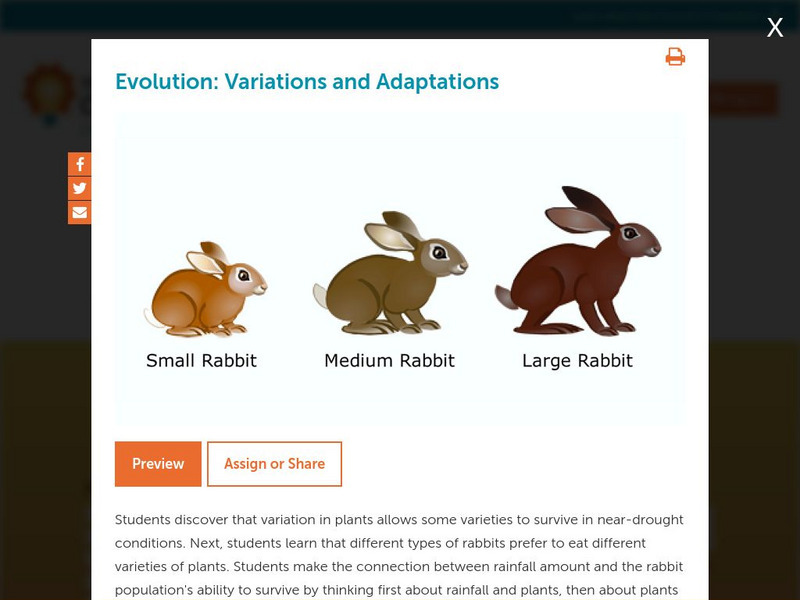
Concord Consortium: Evolution: Variations and Adaptations
Students discover that variation in plants allows some varieties to survive in near-drought conditions. Next, students learn that different types of rabbits prefer to eat different varieties of plants. Students make the connection...

BBC
Bbc Schools: Ks2 Bitesize: Science: The Living World
This landing page includes learning modules on the following topics of: animals, plants, microorganisms, life cycles and reproductions, food chains, habits, humans and the environment, adaptation, inheritance, and evolution.
Vision Learning
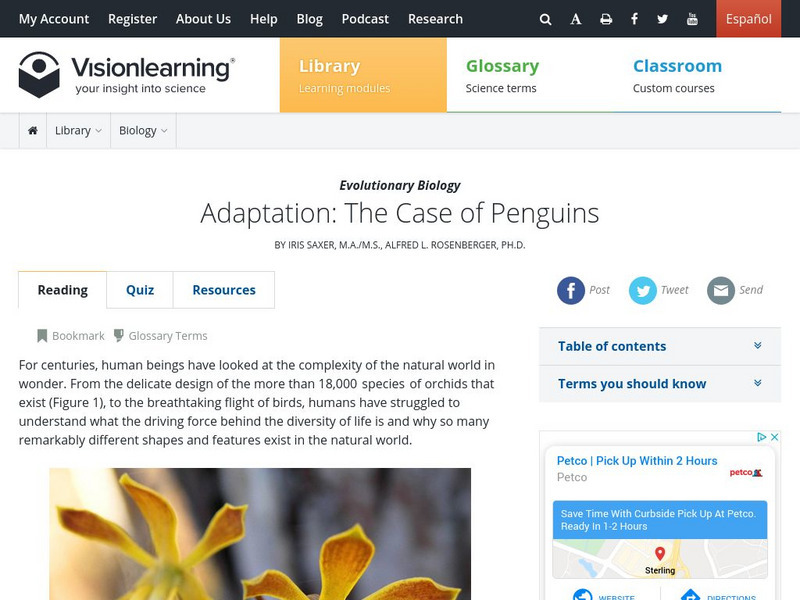
Visionlearning: Biology: Adaptation: The Case of Penguins
Instructional module focusing on why species change over time through behavioral and physical adaptations. Discusses how environmental mechanisms influence adaptive evolution. Site also includes an interactive practice quiz and links...

Concord Consortium
Concord Consortium: Stem Resources: Variations and Adaptations
Experiment with variations in grass to see which size grows best with different amounts of water. Understand that grass that can live in different levels and change to its environment has a better chance of surviving. Also, experiment...
TED Talks
Ted: Ted Ed: Evolution's Gift of Play, From Bonobo Apes to Humans
Learn about our similarity to apes, and how they solve their problems so peacefully at times but humans, the more "advanced" species, can behave so primitively. [7:02]
CPALMS
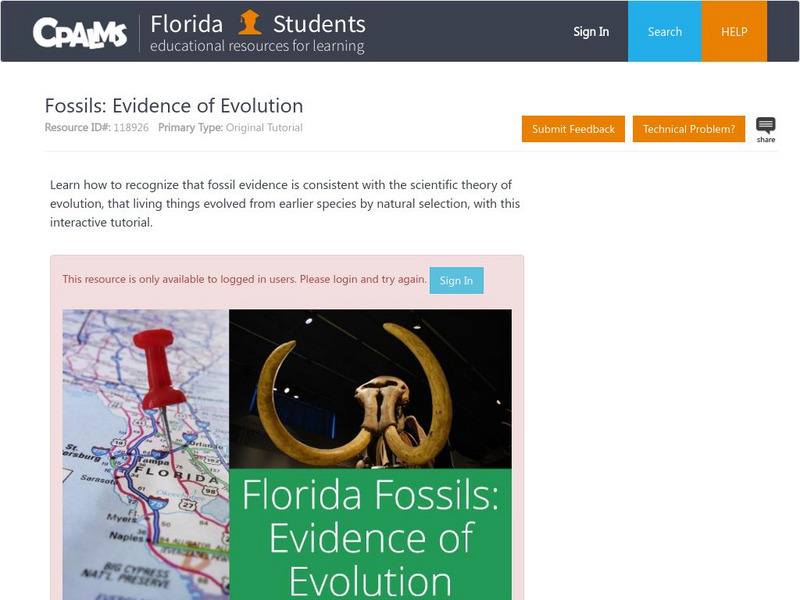
Florida State University Cpalms: Florida Students: Florida Fossils: Evidence of Evolution
See how fossils have shown evidence of evolution throughout the history of the Earth.
TED Talks
Ted: Ted Ed: The Evolution of Animal Genitalia
Genitals are the fastest-evolving organs in the animal kingdom. Menno Schilthuizen explains how the evolutionary biology of nature's nether regions uncovers a hidden world of seduction, conflict, and rivalry.