Hi, what do you want to do?






Judicial Learning Center
The Power of Judicial Review
Marbury v. Madison is arguably the most important landmark case in the history of the Supreme Court. A fact-filled lesson provides background information about the case and two others related to the concept of judicial review. Scholars...

Judicial Learning Center
Judicial Independence
Most people support the idea of an independent judiciary in theory until they hear about a court case that violates their principles. An informative resource explains why the concept is important. It also provides scholars of criminology...

iCivics
Branches of Power
Learners take on the roles of the legislative, judicial, and executive branches of government in the United States and work to develop public policy issues and ideas into laws in this engaging and well-designed online interactive.

Judicial Learning Center
The U.S. Supreme Court
How do Supreme Court justices determine which cases to consider? What happens when the Supreme Court decides not to take a case? The lesson explores important questions and others in the field of criminology. It focuses on the...

Judicial Learning Center
Why Study Landmark Cases?
Why study landmark Supreme court cases? A helpful lesson offers a brief but valuable argument for the importance of these cases in the field of criminology. It introduces scholars to some key terms necessary for studying court cases and...

Judicial Learning Center
Article III and the Courts
What's the best way to make sense of the Constitution? A helpful lesson contains both the text of Article III and annotation of each of its sections, breaking it down into easy-to-understand parts. It also includes links to a...

Judicial Learning Center
Your 4th Amendment Rights
Americans love to learn about their rights, especially those that protect them from the government's power to invade their privacy. Young people are especially engaged by this topic. An informative lesson explores four Supreme Court...

Judicial Learning Center
The Judge and the Jury
Unless you are a lawyer, you might not understand just how unrealistic Law and Order and other legal dramas actually are. Here's a great resource to help scholars of criminology gain a more realistic perspective. The lesson outlines the...

Judicial Learning Center
The Constitution
Supreme Court justices debate the meaning of the US Constitution, but we expect teachers to explain it to scholars with far less training and experience. A daunting task for sure, but it's not insurmountable with resources that simplify...

Judicial Learning Center
The Players in the Courtroom
Courtrooms are complicated. In addition to the many rules, there are a number of people whose jobs are not very clear to the casual courtroom observer. With the resource, individuals identify some of these roles and review more...

DocsTeach
U.S. v. Amistad: A Case of Jurisdiction
Just what is jurisdiction and why does it matter? A helpful activity takes academics on a journey to understand how judicial jurisdiction works. Scholars read excerpts from the Constitution and court documents to understand the process...

DocsTeach
Alfred Sinker and the Writ of Habeas Corpus in 1861
Scholars learn how the judicial system treated under-age Civil War soldiers using historical analysis. The resource uses court documents to help historians understand why Habeas Corpus was used in the case of Alfred Sinker and why he was...

Judicial Learning Center
About Federal Judges
Not just anybody can do the job of a federal judge, but according to the United States Constitution just about anybody can be appointed. The lesson outlines the process and requirements for becoming a federal judge, focusing on the...

Judicial Learning Center
Types of Court Cases
How can one court acquit someone of a crime, while another convicts the person of the same one? It's all because of the differences between civil and criminal trials. An informative resource provides scholars in the field of criminology...

Judicial Learning Center
Levels of the Federal Courts
The Supreme Court gets all the glory, but very few federal cases make it to the highest court. An interesting lesson explores the structure of the lower levels of the federal court system. In addition to outlining the organization of...

DocsTeach
Court Packing vs. Reorganizing: The Supreme Court in the New Deal
Travel back in time to understand the effects of FDR's New Deal on the Supreme Court. Academics analyze historical documents to understand FDR's attempts to pack the Supreme Court and the opposition he faced. The activity includes a...

Judicial Learning Center
The Ratification Debate
Most Americans profess their love for the US Constitution, but this was not always the case. An informative lesson overviews the debate between the Federalists and Anti-Federalists by summarizing the main arguments of each side. It...
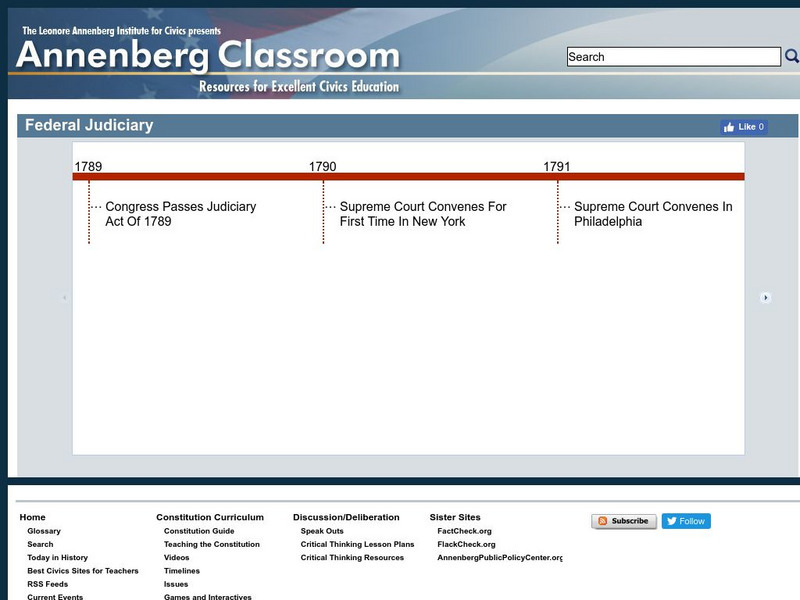
Annenberg Foundation
Annenberg Classroom: Federal Judiciary
Check out this interactive timeline on the federal judiciary in the United States.
Other popular searches
- Judicial Review Rap Lyrics
- Government Judicial Review
- Judicial Review Activity
- Judicial Review Worksheets