Hi, what do you want to do?






Curated OER
Human Body Series - Cardiovascular System
Pump up your class while studying the cardiovascular system with this pair of activities. In one, learners record heart rates during different actions. In the second, they read kid-friendly heart health articles online and then write a...

Early Childhood Learning and Knowlege Center
My Body My Senses
In a comprehensive unit of activities, learners explore the five senses. Youngsters discover the many different body parts and their functions that allow humans to have sense of sight, touch, smell, taste, and hearing. The best way to...

Tracy Pendry
Cardiovascular/Circulatory System
Explore the circulatory system with a cardiovascular pump activity that promotes discovery and discussion as class members create a functioning model of the heart. Continue the learning process through a web quest showcasing the...

Center for Math and Science Education
Pocket Solar System
How in the world can something as big as the solar system possibly fit in your pocket? Complete this simple modeling activity and find out, as young scientists gain an appreciation for the incredible scale of outer space.

Curated OER
The Digestive System
Discover how the human body's digestive system works with a brain and stomach friendly activity. Scholars taste test a variety of foods to find out how they behave once in the mouth. Class members then play a game called Move That...

Curated OER
Muscular and Skeletal Systems
How do muscles move bones? Find out using a built-in-class model. Pupils construct a hand model with paper and string, then follow a series of directions to explore the movement process. Discover additional information about the muscular...

Teach Engineering
An Inflated Impression of Mars
Help your class understand the magnitude of the distance between Earth and Mars with an activity that asks small groups to use balloons to create scale models of the Earth, Moon, and Mars. Class members figure out the distances...

Kenan
Respiratory System
Explore the respiratory system with a model. First, pupils build a set of lungs to experiment how they inflate and deflate. Then, they delve deeper into the topic with a web quest to discover new information about the nose, trachea, and...

Curated OER
A Model Solar System
If Earth is modeled by a grapefruit, what planet could be represented by a golf ball? This activity uses everyday and not-so-everyday objects to create a model of the Solar System.

Thoughtful Learning
Using 5-5-5 Breathing to Calm Down
Scholars calm their minds and bodies with a 5-5-5 breathing exercise. Learners breathe in for five seconds, out for five seconds, then wait five seconds to start again. The exercise takes one minute to complete.

Exploratorium
Cheshire Cat
Divide your field of vision in two and see what happens when your two eyes behold two different scenes! This is a way to demonstrate to body-systems buffs how the two eyes usually blend pictures to create a three-dimensional view. This...

American Museum of Natural History
Drawing Dinos
Five steps walk budding artists through the process of drawing a dinosaur. A drawing guide showcases four dinosaurs—stegosaurus, tyrannosaurus rex, triceratops, and allosaurus.

Curated OER
Nervous System
Get to know the body's central nervous system through an engaging game of nervous system telephone. But this isn't your average game of telephone. Here, pupils must find a way to communicate a message to the brain without speaking....

Scholastic
A Reading Guide to Sarah, Plain and Tall
Eliminate the hard work of creating an entire literature unit with this reading guide for the novel Sarah, Plain and Tall. From background information about the author and her motivation for writing the story to...

Exploratorium
Pupil
Give pupils a magnifier, a mirror, and a flashlight so that they can examine their own pupils. As they shine a light on their eyes, the light is shone on how this structure dilates and contracts to control how much is allowed into the...

American Museum of Natural History
Gusty: The Gut Microbiome Card Game
Build up your gut. Groups up to four play a card game to learn more about the microbiome in the gut. Learners try to build a healthy gut with their cards. The player acquiring six microbes without any pathogens wins the game.

Michigan Sea Grant
Water Quantity
It may be tricky for a young mind to conceptualize that less than 1% of all water on earth is useable for humans to drink. Simulating the amount of fresh water available on earth by removing measured amounts of water from a five-gallon...

Wilderness Classroom
Ocean Life
Our oceans are composed of many complex relationships. Young oceanographers explore relationships between organisms, understand the world ocean's currents, and discover the effects of water pollution and how it behaves. There are...

Serendip
Homeostasis, Negative Feedback, and Positive Feedback
So many bodily activities depend on homeostasis! Give learners a solid background to understand the basic process of the human body. Scholars first examine negative feedback loops contributing to body temperature regulation and then a...

Bethel School District
Health Triangle Self Assessment
Measure health as a triangle, with each side representing different aspects of health: physical, emotional/mental, and social. High schoolers complete a self-assessment of their health in all three areas before scoring their progress and...

Smarter Balanced
How the Brain Works
Cerebrum, cerebellum, brainstem, pituitary gland, and spinal cord. Prepare your class for a performance task assessment on the brain and how it works with a scripted plan that defines these terms and identifies the functions the...
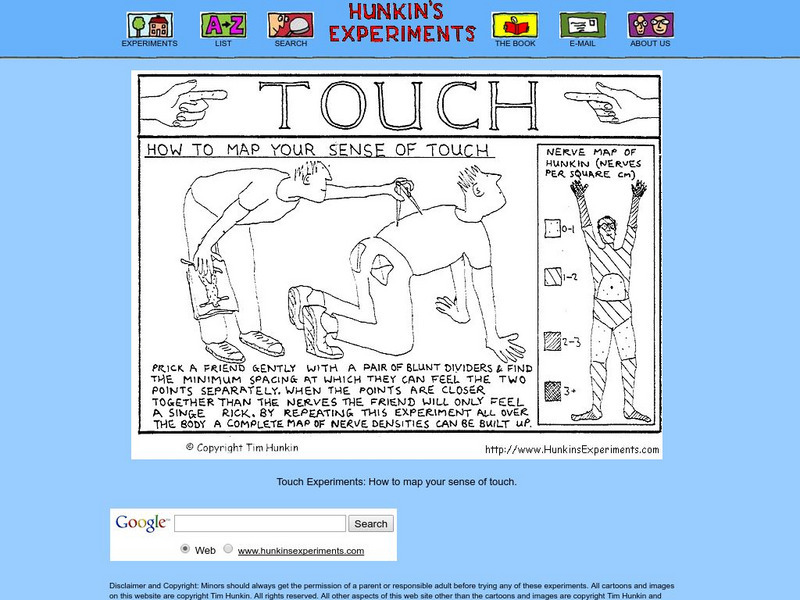
Hunkins Experiments
Hunkin's Experiments: How to Map Your Sense of Touch
Hunkin's Experiments is a group of simple cartoon illustrations of scientific principles. Some would work well in the classroom, but others have little value beyond entertaining students. All of the projects are easy to do. This would be...