Hi, what do you want to do?






Teach Learn Chem
Ions in Chemical Compounds
In this ions activity, students complete a table by combining the given ions in different combinations to make a neutrally charged chemical compound.

Royal Society of Chemistry
Common Compounds
Can your young chemists identify the most commonly used chemicals in the lab? Introduce the class to the go-to substances in most middle and high school chemistry experiments with an interactive. The resource offers timely feedback as...

National Science Teachers Association
Ionic Molecular
Twelve compounds are named and each of their chemical formulas are printed on individual cards. Chemistry pupils place each beneath an Ionic or Molecular card, depending on which type of compound is represented.

CK-12 Foundation
Chemical Bonds: Covalent and Ionic Bonding
Get back to bonding basics. Science scholars get a chance to show what they know using a simple interactive. Pupils create models of covalent and ionic bonds before answering questions about each interaction. The resource includes a...

Pingry School
Solubility Product of an Ionic Compound
How do scientists determine when a solution is fully saturated? Scholars address the topic as they observe patterns of precipitation in various concentrations of ions. Using a well plate, pipette, and common chemicals, they collect data...

Pingry School
Synthesis of an Insoluble Ionic Salt: A Stoichiometry Experiment
Challenge young scientists to design their own experimental procedures. They write the procedure for properly preparing two grams of a water-insoluble ionic salt. To finish, they perform the experiment and collect data to prove their...

Santa Monica College
Single and Double Displacement Reactions
If you aren't part of the solution, you are part of the precipitate! Young chemists learn about single and double displacement reactions including precipitation reactions, neutralization reactions, and gas forming reactions. They perform...

Royal Society of Chemistry
Some A-level Reagents
Learning names and formulas can be a daunting task for young chemists, so support their study with interactive puzzles! First, users match each formula with its correct name. Then, individuals use them to complete three logic games.

Virginia Department of Education
Finding the Formula and Percent Composition
Do you have mole problems? If so, call Avogadro at 602-2140. The lesson starts with pupils working independently to solve for molar mass of ionic compounds. Then they learn to solve for percent composition and later perform an...

Mr. E. Science
Atoms and Bonding
I don't trust atoms because they make up everything. Budding scientists learn about famous scientists connected to atomic models, chemical, ionic, and hydrogen bonds. The presentation also presents how to count atoms...

College Board
2015 AP® Chemistry Free-Response Questions
More than 80,000 scholars earned college credit for Chemistry with the AP exam in 2015. The College Board released the free-response questions covering topics, including moles, that often confuse scholars. They also released example...

College Board
2016 AP® Chemistry Free-Response Questions
The College Board published the mean score on the 2016 AP Chemistry exam as a 2.69, but a minimum of a three is required to earn college credit. Help pupils study for the upcoming exam with actual test questions, sample answers, and...

Mr. E. Science
Acids, Bases and Solutions
If you are not part of the solution, then you are part of the precipitate. The presentation covers solutions, suspensions, solubility, dissociation, and acid/base reactions. This is the 19th lesson in a series of 26.
Texas Education Agency
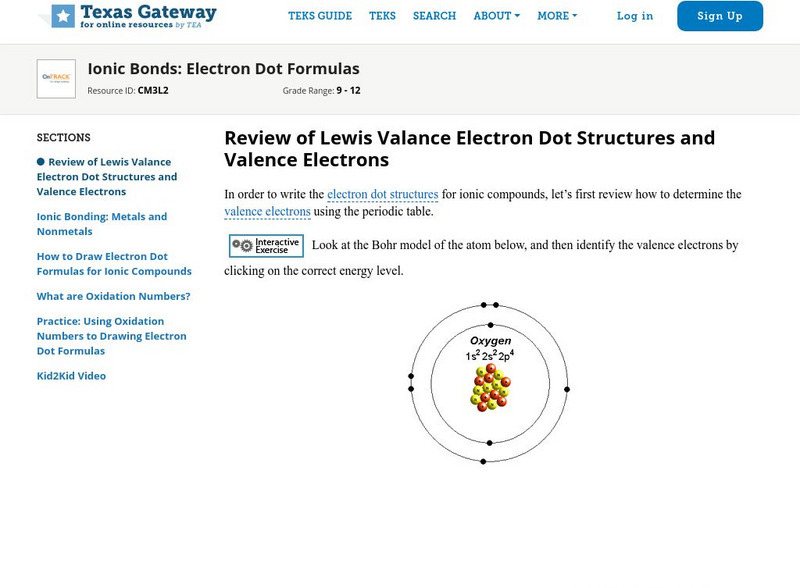
Texas Gateway: Ionic Bonds: Electron Dot Formulas
Given descriptions, diagrams, scenarios, or chemical symbols, students will model ionic bonds using electron dot formulas.