Hi, what do you want to do?






NASA
Touchdown
Just how do astronauts stay safe during moon landings? Here's an activity that allows investigators to use the engineering process to explore how shock absorbers protect astronauts during landing. Applying knowledge of gravity, force,...

Teach Engineering
Ramp and Review (for High School)
Rolling for momentum. As part of a study of mechanical energy, momentum, and friction, class members experiment rolling a ball down an incline and having it collide with a cup. Groups take multiple measurements and perform...

NASA
Make a Planetary Exploration Balloon
Balloons aren't just for parties! An inquiry-based lesson explores the idea of using balloons for space exploration. Learners become engineers as they attempt to control the ascent and descent of a helium balloon using different masses.

Anchorage School District
Roller Coaster Project
Emerging engineers work in teams to design pipe insulation roller coasters for marbles that meet specific parameters. They are required to label along the track the areas where kinetic and potential energy are highest and lowest, where...

MENSA Education & Research Foundation
Roller Coaster Mania!
Raise the energy level of your physical science class with this exciting hands-on activity. Applying their knowledge of kinetic and potential energy and Newton's laws of motion, young engineers use foam tubing and marbles to create...

NASA
Egg Drop Lander
You have to crack a few eggs to make a good engineer! Working in small groups, young scholars design, build, and test devices that protect an egg from breaking when dropped from a ladder.

Exploratorium
Momentum Machine
If you have a rotating office chair in your classroom, you can have physics pupils participate in this simple, yet effective demonstration of angular momentum. One partner sits in the chair, arms outstretched, holding heavy weights. The...

American Chemical Society
Exploring Energy
When asked to list everyday objects that require energy, most people list technology that use batteries or electricity. Through hands-on exploration, young scientists discover energy is much more than just circuitry. They play with...

Teach Engineering
Exploring Acceleration with an Android
Small groups use rubber bands to accelerate an Android device along a track of books. They collect the acceleration data and analyze it in order to determine the device's velocity.

It's About Time
Defy Gravity
Test the limits of gravity while encouraging full class participation with this thrilling lesson. Pupils investigate the meaning of work and how it is equivalent to energy. They explore the joule and apply it as a unit of work. They...

Museum of Science
Cup Drop
Create egg drop soup. Teachers first set up eggs that are held up above cups of water with a piece of cardboard and cardboard tubes. Learners try to determine a way to get the eggs to drop into the cups. Using a broom, the instructor...

Texas State Energy Conservation Office
Investigation: Conservation of Energy
By rolling marbles down a six-foot length of track, physical scientists determine how much energy is lost to heat. It is recommended that you opt for the foam pipe insulation track because more friction slows the marble, allowing...

Museum of Science
Balloon Racers
Watch those balloon cars go! Scholars build racers that run using the power of balloons and conduct races with the cars. They learn about Newton's third law of motion and how it applies to their balloon racers.

DiscoverE
Friction in Action
There's no need to have friction among instructors regarding the resource. Pupils investigate how marbles and coins slide along different surfaces which gives them information to estimate coefficients of friction.

American Museum of Natural History
Create a Compass
Historically, humans have used many methods of finding due north. Using a hands-on activity, learners create their own compasses. They then test their compasses in their neighborhood or to assist with stargazing.

DiscoverE
Pilot a Balloon
Balloons will go where you want them to. Young pilots first add paper clips to a balloon to make it neutrally buoyant. They then use cardboard to steer the balloon in different directions, taking air pressure into account.

DiscoverE
Kicking Machine
Don't kick the resource to the curb; you'll definitely regret it. Future engineers devise a kicking machine that launches a ping-pong ball toward a target. They can use a pendulum, a rubber band, or both, depending on whether they want...
Science Buddies
Science Buddies: Centripetal Force
What keeps you in your seat of a giant loop-de-loop roller coaster? Surprisingly, it is not the seatbelt but the seat. It works because of something called centripetal force and it does much more than make a great roller coaster. In this...
SRI International
Performance Assessment Links in Science: Observing Objects
This is a performance task for Grade Four students where they observe two different pendulums and compare the two types of motion. The activity is designed for a lab setting where students work at individual stations. A rubric and...

TeachEngineering
Teach Engineering: Ramp and Review (For High School)
In this hands-on activity - rolling a ball down an incline and having it collide into a cup - the concepts of mechanical energy, work and power, momentum, and friction are all demonstrated. During the activity, students take measurements...
TeachEngineering
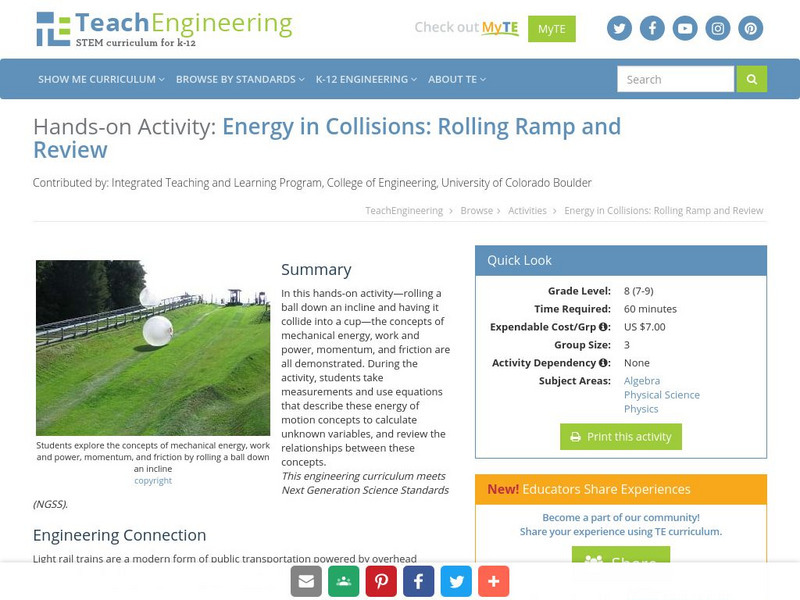
Teach Engineering: Ramp and Review
In this hands-on activity - rolling a ball down an incline and having it collide into a cup - the concepts of mechanical energy, work and power, momentum, and friction are all demonstrated. During the activity, students take measurements...
Virginia Commonwealth University
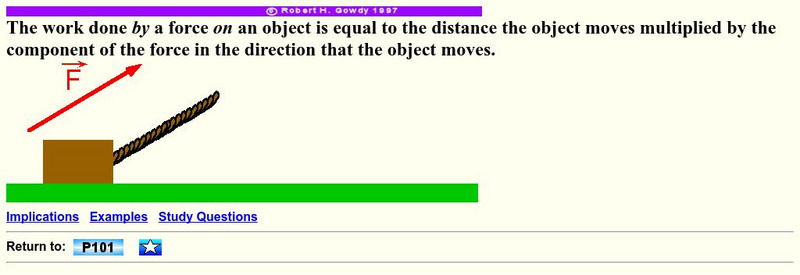
Virginia Commonwealth Univ.: Work Definitions
This site from the Virginia Commonwealth University gives good information on the definition of work using nice graphics and interactive questions. Immediate feedback on student answers is provided.
Hunkins Experiments
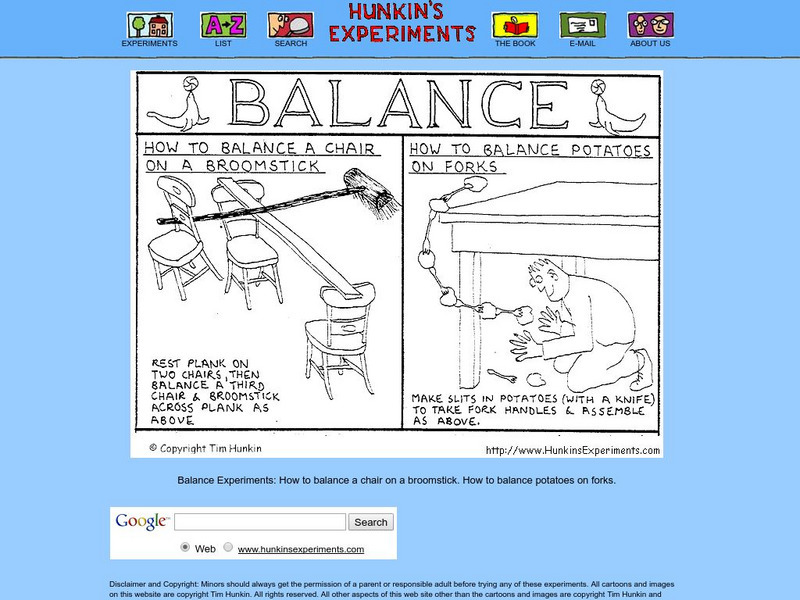
Hunkin's Experiments: Balance
Hunkin's Experiments is a group of simple cartoon illustrations of scientific principles. Some would work well in the classroom, but others have little value beyond entertaining students. All of the projects are easy to do. This pair of...
TeachEngineering
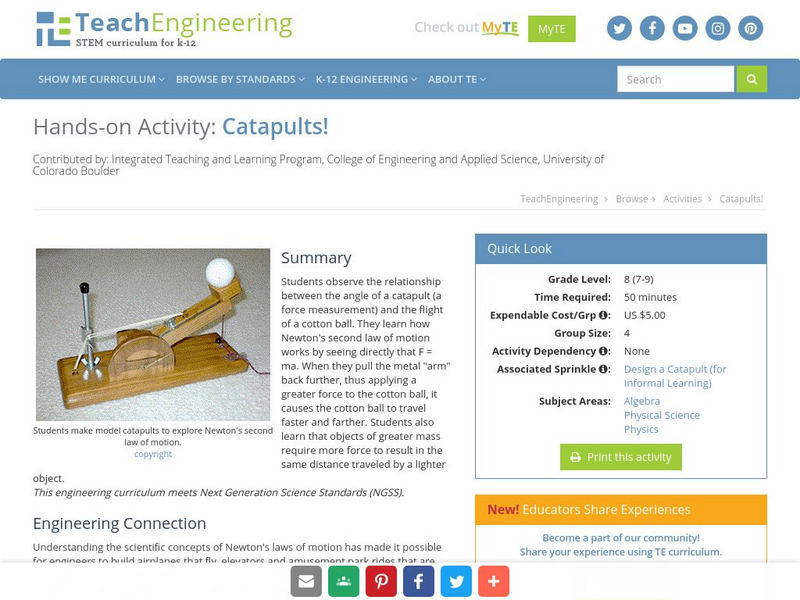
Teach Engineering: Catapults!
Students observe the relationship between the angle of a catapult (a force measurement) and the flight of a cotton ball. They learn how Newton's second law of motion works by seeing directly that F = ma. When they pull the metal "arm"...