Hi, what do you want to do?






National Library of Medicine
Your Environment, Your Health: Food Safety
Did youknow that chicken causes the greatest risk of food-borne illness. The fourth unit in a six-part series addresses food safety. Scholars research common scenarios of food causing illness through the National Institute for Health....

National Library of Medicine
Your Environment, Your Health: Air Quality
Some scientists argue that air pollution now causes more deaths than smoking. The second unit in a six-part series focuses on air quality. Scholars learn what's in the air, how clean the air around their school is, and what they can do...

Centers for Disease Control and Prevention
Talking Safety
Chances are, many of the teens in your class have jobs or want to have jobs in the near future. Educate them about the hazards and emergencies that could occur in various workplaces with a set of lessons published by the National...

National Library of Medicine
Your Environment, Your Health: Runoff, Impervious Surfaces, and Smart Development
Can a sidewalk increase the amount of pollution in local streams? Scholars learn the answer to this question though research and experimentation in the fifth unit in the six-part series. Pupils study runoff, impervious surfaces, and the...

National Library of Medicine
Your Environment, Your Health: The Great Debate—Bottled Water vs. Tap Water in Our School
Should bottled water be sold in schools, or should they only provide tap water? The summative unit in the six-part series encourages scholars debating this topic. The lessons teach how to build an argument, how to gain background...

Amnesty International
Human Rights and Service Learning (Part 1)
What better way is there to teach about human rights than by seeing them firsthand? Introduce your class or club to the spirit of service through a myriad of service project ideas. First in a series of human rights instructional...

Ready Houston
Make a Plan. Build a Kit. Stay Informed.
Help prepare your youngsters for an emergency or natural disaster by discussing important topics as where to meet, how to remain in contact, and what belongs in an emergency kit.

Ready Houston
Make a Plan. Build a Kit. Stay Informed.
What is an emergency, and how can having a plan help make emergency situations safer? Pupils are tasked with creating a short presentation that can help teach younger children about emergencies, community helpers, and first...

Flag House
Play Well with Others…Be Active Against Bullying!
Bully-free is the way every school should be! How can you help create that kind of culture in your school? A well-written teacher's guide containing lessons for grades 6-8 may be just the ticket. Each unit, separated by grade level,...

PBS
Pbs Learning Media: Pbs News Hour: Coronavirus Update: Where Things Stand Three Months Into Quarantine
As the coronavirus pandemic continues, states are balancing public health through stay-at-home orders and crowd limits with concern for jobs and the economy. Alabama was among the last states to issue a stay-at-home order on April 3rd...
Center for Innovation in Engineering and Science Education, Stevens Institute of Technology
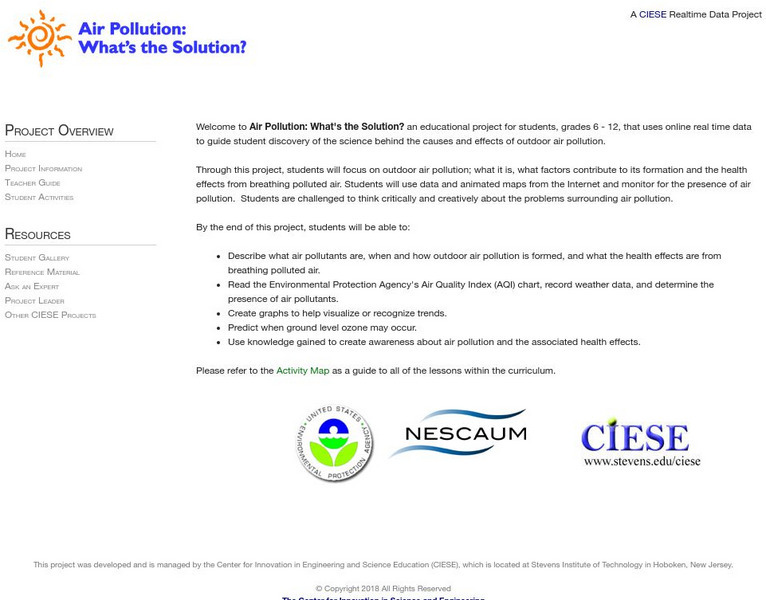
Ciese: Air Pollution: What's the Solution?
Outdoor air pollution poses a major threat to human health and threatens the ozone layer. Students will examine real time weather data in this extensive unit to learn how air quality is measured, its health impact on at-risk populations,...