Hi, what do you want to do?






Cal Recycle
Conserving Natural Resources
Trying to plan an engaging elementary science unit on natural resources? Conserve your energy! This five-part series of lessons and hands-on activities has exactly what you need to teach young scholars about the importance of conservation.

Curated OER
Sustainability and Extinction
Galapagos Penguins are the only penguins on earth that live north of the equator (in the wild). In this last lesson plan a discussion on how the Galapagos islands developed their populations and diversity sparks the introduction. Two...

Curated OER
Rock On! Featuring the Igneous, Sedimentary and Metamorphic Trio!
Get your classroom rocking with this four-lesson earth science unit. Through a series of shared reading activities and hands-on investigations, young geologists learn about the three types of rocks and the unique properties of each.

Brooklyn Children’s Museum
Rocks and Minerals in Our Lives
Young geologists discover the important role that rocks and minerals play in our everyday lives through this series of hands-on activities. Starting off with a lesson that defines the difference between plants, animals, and...

Curated OER
Artificial Selection
The second lesson in the series begins with a starter activity discussing wild versus domesticated animals. Then, scholars play a card game, with optional variations, to emphasize artificial selection. Next, they attend a field trip to a...

Lerner Publishing
Teaching Habitats
What makes up a habitat? Use this resource to engage first graders in the exploration of desert, wetland, forest, and ocean habitats. Youngsters classify plants and animals into the four distinct habitats through drawings and cutting and...

Kenan Fellows
Unit 1: Introduction to Pharmacology
Learn about the study of medications, including those found in nature and those made synthetically. The first of four lessons in a series on pharmacology includes lectures, hands-on experiments, research, and more.

Kenan Fellows
Unit 2: Chemistry Review
What exactly goes into the medications people take every day? Scholars learn about the chemistry of medications in the second of a four-part series on Pharmacology. Over the course of two weeks, class members complete seven experiments,...

Core Knowledge Foundation
A Time for All Seasons - Spring
Celebrate the arrival of spring with this fun primary grade science unit. Engaging young scientists with a variety of hands-on activities and inquiry-based investigations, these lessons are a great way to teach children about...

Curated OER
Hedgerows
Hedgerows prevent soil erosion, capture pollutants running off fields, store carbon to help combat climate change, and provide homes for predators of many pest species. The biodiversity lesson begins with an activity that...

Montana Natural History Center
Studying Grassland Ecosystems
At first glance, grassland ecosystems might seem dull and uninteresting, but once you start to explore it's amazing the things you'll find! Through this series of engaging lessons, activities, and experiments, elementary students examine...

Kenan Fellows
Unit 3: How Drugs Enter/Exit the Body
The third of a four-part series on Pharmacology teaches scholars how drugs enter and exit the body, how they act inside the body, how they affect the brain, and more. Over the course of the unit, groups complete two labs and one...

Teach Engineering
Service-Based Engineering Design Project
Do some good for the community while learning about engineering. Groups complete a service-based engineering design project over the course of five weeks. The resource provides guidance on how to conduct the project and help pupils get...

Calvin Crest Outdoor School
Survival
Equip young campers with important survival knowledge with a set of engaging lessons. Teammates work together to complete three outdoor activities, which include building a shelter, starting a campfire, and finding directions in the...

CK-12 Foundation
Ck 12: Third Grade Science: Life Science: Adaptation and Natural Selection
[Free Registration/Login may be required to access all resource tools.] Describes how characteristics of plants and animals are inherited and how some characteristics can be affected by the environment.
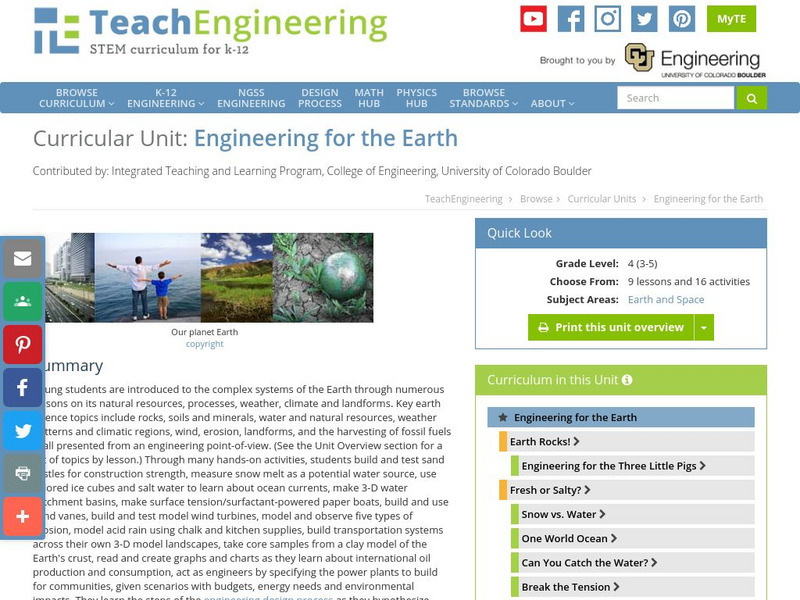
TeachEngineering
Teach Engineering: Engineering for the Earth
Young students are introduced to the complex systems of the Earth through numerous lessons on its natural resources, processes, weather, climate and landforms. Key earth science topics include rocks, soils and minerals, water and natural...
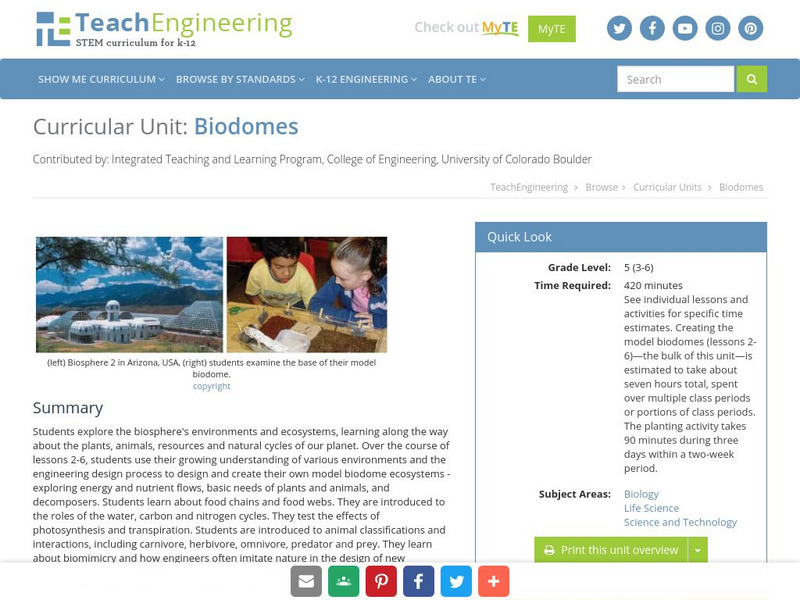
TeachEngineering
Teach Engineering: Biodomes
Students explore the biosphere's environments and ecosystems, learning along the way about the plants, animals, resources and natural cycles of our planet. Over the course of lessons 2-6, students use their growing understanding of...
NOAA
Noaa: Estuaries 101 Curriculum: Survival in an Estuary
This activity introduces students to the nature of estuaries, estuarine environmental factors, and four important abiotic factors-pH, temperature, dissolved oxygen, and salinity-and how they vary in estuaries. A PowerPoint presentation,...
CK-12 Foundation
Ck 12: Life Science: Habitat Destruction
[Free Registration/Login may be required to access all resource tools.] From a human point of view, a habitat is where you live, go to school, and go to have fun. Your habitat can be altered, and you can easily adapt. Most people live in...

CK-12 Foundation
Ck 12: Life Science: Cloning
[Free Registration/Login may be required to access all resource tools.] Cloning is the process of creating an exact replica of an organism. The clone's DNA is exactly the same as the parent's DNA. Bacteria and plants have long been able...