Hi, what do you want to do?






Speak Truth to Power
John Lewis: Non-Violent Activism
After comparing and contrasting non-violent and violent social movements, your young historians will take a closer look at the work and influence of John Lewis on the civil rights movement. They will then choose a current social...

DocsTeach
Analyzing a Letter to Congress About Bloody Sunday
The brutality of Bloody Sunday—when non-violent protesters who supported voting rights for African Americans were beaten by police—captured a nation. Young historians examine the letter of one horrified American to Congress to consider...

DocsTeach
The Suffrage and the Civil Rights Reform Movements
It's the American way to put one foot in front of the other and march. Using images of protests from the civil rights and women's suffrage movements, young historians analyze similarities between the two watershed moments of social...

US Institute of Peace
Effectiveness of Nonviolent Civic Action Simulation on Colombia
With new leadership comes new hope! After years of violence, the people of Colombia elect a new president ... could this mean an end to conflict? Civics scholars take part in a large group role-playing exercise designed to illustrate the...

DocsTeach
Martin Luther King, Jr. and the Fight for Civil Rights
Find clues to the past with photos! Young historians use a photo from one of Martin Luther King Jr.'s peaceful protests to practice photo analysis. Academics look at the image to gain clues about what is happening and why. To finish,...

DocsTeach
The Impact of Bloody Sunday in Selma
Who is to blame when a peaceful protest turns deadly? Scholars research the impact of the civil rights march in Selma, better known as Bloody Sunday. The activity uses files from the FBI's investigation to help academics understand the...

DocsTeach
Examining Rosa Parks's Arrest Record
There aren't a lot of details on the document, but Rosa Parks's arrest is now a legendary story of the civil rights movement. Class members examine the record—with Parks's names blotted out—to see if they can tell who this document...

iCivics
Students Power Elections
A Learners Power Elections resource guide provides would-be voters with the guidance they need to become voters. Included in the packet is information about voter registration and voting, how to research candidates and ballot measures,...

DocsTeach
The Path of Justice: Selma and the Voting Rights Act
The civil rights movement: An ongoing battle for change. The activity focuses on President Johnson's speech in response to the massacre at the Selma March. Academics study the speech, complete a hands-on-activity, and discuss President...

DocsTeach
Debating Monuments, Memorials and Statues
An illustrative activity explores images of monuments, statues, and memorials in the US to decide whether they should be kept or removed. Scholars place images in a keep or remove pile, then complete a worksheet online. The resource...
Read Works
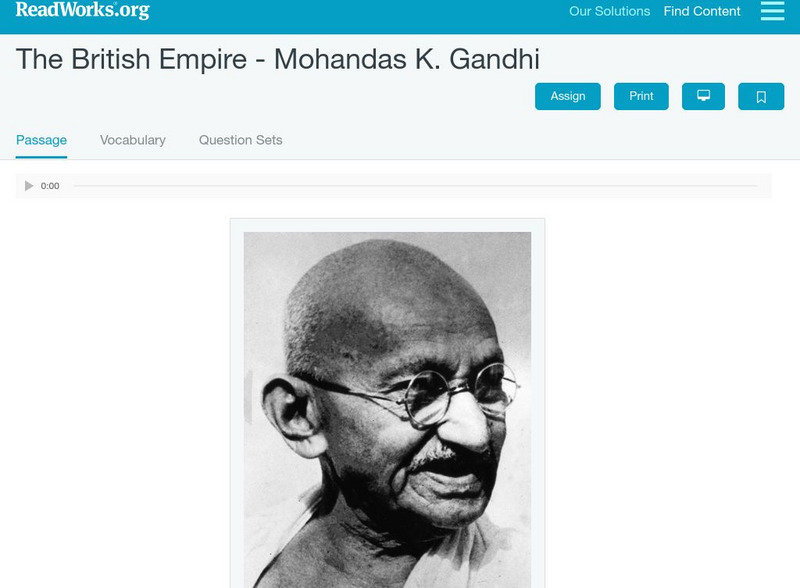
Read Works: The British Empire Mohandas K. Gandhi
[Free Registration/Login Required] An informational text about Mohandas Gandhi and his work to gain independence for India without violence. A question sheet is available to help students build skills in reading comprehension.
Read Works
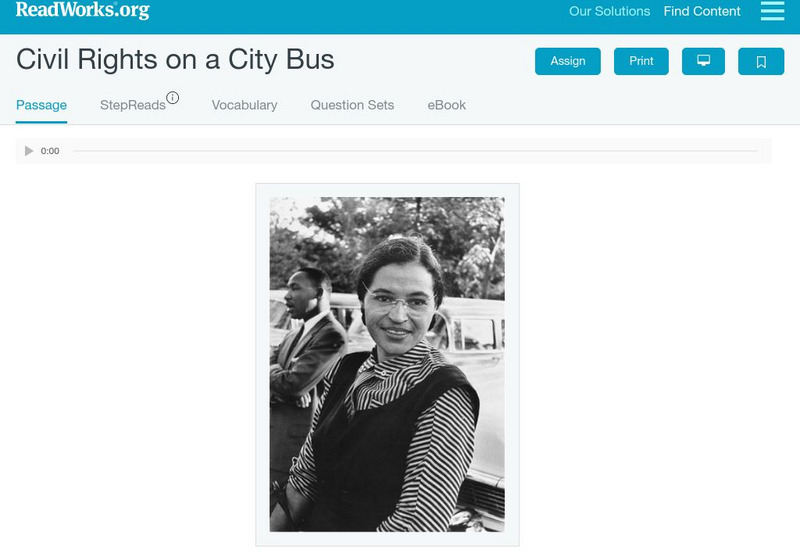
Read Works: Civil Rights on a City Bus
[Free Registration/Login Required] Students read about Rosa Parks and her non-violent protest of segregation laws in the South. A question sheet is available to help students build skills in reading comprehension.
Library of Congress
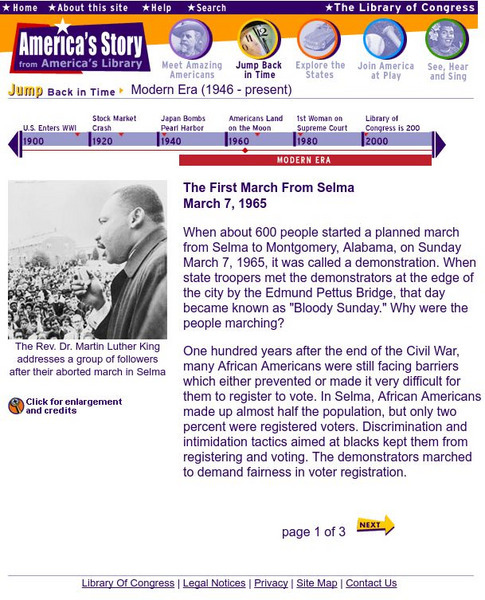
Loc: America's Story: The First March From Selma
This article details a key event in the civil rights struggle--the demonstration organized by the Rev. Martin Luther King in Selma, Alabama on March 7, 1965, when 525 people met a police blockade on the Edmund Pettus Bridge.