Hi, what do you want to do?






University of Saskatchewan
Using Conservation of Energy to Determine Average Impact Force
Explore the center of gravity with your science class as they create a deadfall trap with common materials. They research the concepts of energy conservation and gravitational force before dividing into small groups to create a model of...

Teach Engineering
The Great Gravity Escape
Groups simulate an orbit using a piece of string and a water balloon. Individuals spin in a circular path and calculate the balloon's velocity when the clothes pin can no longer hold onto the balloon.

It's About Time
Defy Gravity
Test the limits of gravity while encouraging full class participation with this thrilling lesson. Pupils investigate the meaning of work and how it is equivalent to energy. They explore the joule and apply it as a unit of work. They...

Teach Engineering
Design a Flying Machine
Wrap up the unit in one final design. Pairs use their knowledge of aviation to design new flying machines and record how their designs take into consideration the forces that act upon airplanes. The pupils determine whether their designs...

NASA
Touchdown
Just how do astronauts stay safe during moon landings? Here's an activity that allows investigators to use the engineering process to explore how shock absorbers protect astronauts during landing. Applying knowledge of gravity, force,...

DiscoverE
Slinky® Science
Toys are great for learning about physics. Scholars use Slinky® toys to study Newton's laws of motion and types of energy. After a little play, they then model longitudinal and transverse waves with the Slinky® toys.

Curated OER
Mass vs. Weight
Why do you weigh more in space? Each individual in your class explores this question and others as they determine the mass and weight of different objects using two types of scales. They perform conversions and discuss their...

Teach Engineering
What a Drag!
Stop and drop what is in your hand! Pupils investigate how form effects drag in the 12th part of a 22-part unit on aviation. Groups create equally weighted objects and determine which one falls the fastest by collecting data.

Teach Engineering
Adapatations for Bird Flight - Inspiration for Aeronautical Engineering
It's a bird, it's a ... device made to mimic birds. The eighth installment of a nine-part module has pupils read various articles to learn about bird flight. They consider the implications for aeronautical engineering.

Curated OER
Exploring the Water Cycle
The water cycle is one of earth's most easily observable processes, but demonstrating each step within classroom walls can be a challenge. Through a series of videos and quick demonstrations, cover each aspect of the hydrologic cycle in...

New Mexico State University
Lab 6: Kepler's Laws
A 15-page package thoroughly teaches your physics or astronomy learners about Kepler's three laws of planetary motion. Each one is stated and explained. Class members answer questions, solve problems, and participate in the classic...

NASA
Make a Planetary Exploration Balloon
Balloons aren't just for parties! An inquiry-based lesson explores the idea of using balloons for space exploration. Learners become engineers as they attempt to control the ascent and descent of a helium balloon using different masses.

DiscoverE
Pipe Maze
Here's a lesson that is simply a-MAZE-ing! Introduce science scholars to pipeline systems through a hands-on project. Partnered pupils participate in the design, construct, and test a PVC pipeline maze. Reusable materials and clear...

Teach Engineering
Magical Motion
Make solutions to projectile motion problems magically appear using equations. Pupils watch a clip from a Harry Potter movie and find the length of time it takes for a remembrall to fall into Harry's hands. They use a projectile motion...

National Nanotechnology Infrastructure Network
The Pinch Test
Test your pupils' understanding of the scale from macro to atomic. While displaying images of different materials, learners identify what they would need to make that material visible. Their choices range from the human eye to an...

University of Colorado
University of Colorado: Ph Et Interactive Simulations: Gravity and Orbits
An interactive simulation that teaches about gravitational force, circular motion, and astronomy by manipulating the sun, earth, moon, and a space station to observe the effects of gravity and orbital paths. This simulation can either be...
University of Colorado
University of Colorado: Ph Et Interactive Simulations: Gravity Force Lab
An interactive simulation that teaches about gravitational force, Newton's Third Law, and force pairs by varying properties affect the gravitational force exerted between two objects. This simulation can either be downloaded or played...

University of Colorado
University of Colorado: Ph Et Interactive Simulations: My Solar System
An interactive simulation that teaches about motion, acceleration, and velocity by allowing students to build their own solar system and watch the effects of gravitational pull and how that changes with initial position, velocity, and...
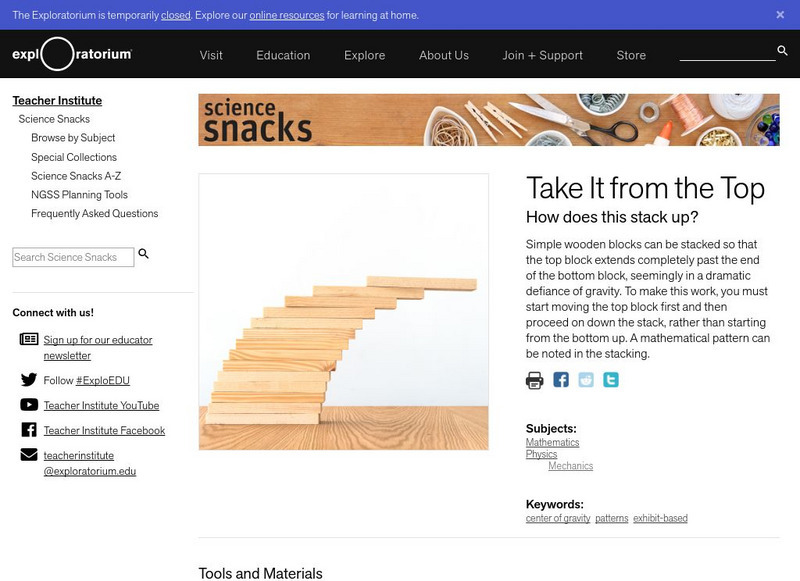
Exploratorium
Exploratorium: Science Snacks: Take It From the Top
Students defy gravity by stacking blocks in different ways in this exercise. Other projects are linked to this lesson as well.
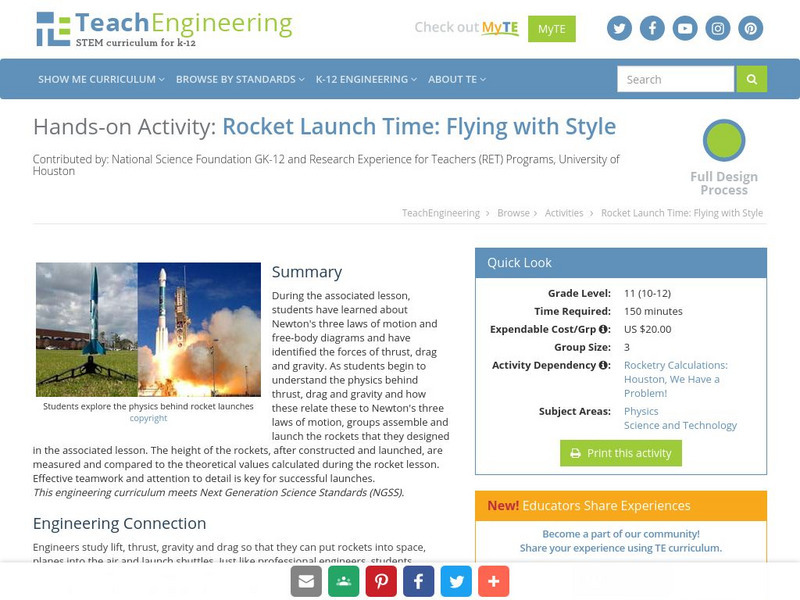
TeachEngineering
Teach Engineering: Flying With Style
As students begin to understand the physics behind thrust, drag, and gravity and how these relate these to Newton's three laws of motion, groups assemble and launch the rockets that they designed in the associated lesson.