Hi, what do you want to do?






Classroom Law Project
What is a class hearing and youth summit and what do they have to do with the presidential election?
After researching the presidential election process, class members develop questions and interview voters about their choice of candidate and the issues that concern them.

Classroom Law Project
What do cartoonists see in this election?
Cartoons from the 2008 Presidential election provide the text for a lesson designed to help learners understand how political cartoonists use persuasive techniques to present a point of view.

C-SPAN
2016 Electoral College Map
The electoral college can be confusing for citizens of any age. Clear up misconceptions with a handy printable map that details how many electoral votes are allotted to each state, as well as a history of modern elections, complete with...

Classroom Law Project
What does the Constitution say about voting? Constitutional Amendments and the Electoral College
As part of a study of voting rights in the US, class members examine Constitutional amendments connected with voting and the role of the Electoral College in the election process.

Classroom Law Project
Who are the major candidates and where do they stand?
Who were the candidates in the 2008 US Presidential election and where did they stand on important issues? Use a resource that offers an opportunity to go back in time and examine candidates and issues involved in that election year.

Classroom Law Project
What should I watch for in the debates?
Prepare your classes for election year debates with a series of activities that model how to watch televised debates and how to evaluate the moderators as well as the debaters.

Classroom Law Project
What are some of today’s voting issues? Voting in Oregon, youth vote, and technology
The youth vote. Rock the Vote. Vote-By-Mail. Electronic voting. Class members investigate issues facing today's voters, and the ways they have adapted over the years to optimize voter turnout.

Middle Tennessee State University
Fights, Freedom, and Fraud: Voting Rights in the Reconstruction Era
As part of a study of post Civil War era, young historians investigate the changes in voting rights during the Reconstruction Era (1863-1876), the fraud involved in the Hayes-Tilden presidential election of 1876, and efforts by Pap...

ProCon
Electoral College
The Electoral College's role in elections is sometimes confusing and controversial. Pupils use a debate topics website to research the pros and cons of the practice to debate whether the United States should still use the Electoral...

Maryland Department of Education
The Concept of Identity Lesson 8: Propaganda in Visual Media
Visual and print propaganda are featured in a instructional activity that asks readers of A Separate Peace to examine the techniques used in propaganda from World War I, World War II, presidential elections, and in the novel.

Classroom Law Project
How do we hire a President?
What are the job requirements for the office of president of the United States? What attributes should a candidate possess? Are the qualities needed to govern the same as those needed to win? What can an analysis of the...

ProCon
Voting Machines
Does technology always mean advancement? Scholars take a close look at the use of voting machines. Does using a machine make voting more effective? Readers consider the advantages and disadvantages of the current voting process. They...

Street Law
The Challenge of Selecting an Ideal Supreme Court Nominee
Nearly every president has had the opportunity to name a nominee to the United States Supreme Court. But what makes someone an ideal candidate to become a Supreme Court justice? High schoolers test their prior knowledge about the...

University of California
The Civil War: Secession of the South
Was the Southern states' decision to secede from the Union protected by the United States Constitution? Eighth graders discuss the constitutionality of the South's justification for secession, particularly the secession of South...

Deliberating in a Democracy
Voting
Young scholars read about voting rights and compulsory voting in democracies. For this voting rights lesson plan, young scholars analyze the reasons for supporting and opposing compulsory voting and discuss whether compulsory voting is...

Classroom Law Project
Should we believe everything we read? Becoming a discerning consumer of media
Class members investigate the role media should play in a healthy democracy. As part of this study, groups analyze political advertising, use FactCheck to assess not only the veracity of but the persuasions techniques used in candidates'...

ProCon
President Ronald Reagan
At 69 years old, Ronald Reagan was the oldest man ever to be elected president in the United States. After reviewing a thorough history of Reagan's presidency, pupils read the main pro and con arguments to determine if he was a good...

ProCon
Voting Age
Should age matter when it comes to voting? Scholars read an article discussing the pros and cons of lowering the voting age to 16. They then consider both the advantages and disadvantages of having younger voters. After thinking about...

Film Education
Glory
If you are previewing the film Glory for your young historians, this packet may help you spark ideas for discussion and offer some interesting facts and quotations that may add to your presentation of this Civil War narrative. It...

Hands On Network
Passion into Action
Find your passion. Find service opportunities. Decide how to serve. An instructional packet offers step-by-step directions for getting involved in community service. The practical suggestions and helpful worksheets make what may...

ProCon
Cuba Embargo
President John F. Kennedy bought 1,200 Cuban cigars the night before he enacted the Cuban trade embargo in 1962. Should the United States maintain the embargo? Using the website, pupils explore the topic to prepare for a class debate or...
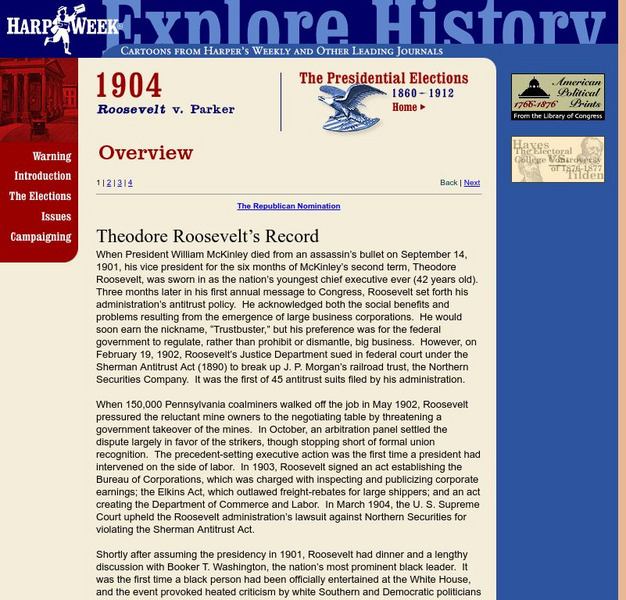
Harp Week
Harp Week: The Presidential Elections: 1904 Roosevelt v. Parker
Examines Theodore Roosevelt's role as chief executive after President McKinley's assassination in 1901, his policies during that time, his campaign to win the Republican nomination for the presidential election, the Democratic...

Duke University
Duke University Libraries: Election of 1968
Comprehensive information on the election of 1968 which was a three party race with no incumbent. Content includes the candidates, the issues, the vote, and what happened as a result of the election.
Harp Week
Harp Week: The Presidential Elections: 1888 Harrison v. Cleveland Biographies
Find the biographies of the presidential and vice-presidential candidates in the election of 1888.
Other popular searches
- Election Day
- Presidential Elections
- Election Day for Kids
- 2008 Presidential Election
- Voting and Elections
- Election of 1860
- Election 2008
- 2nd Grade Election Day
- Mock Election
- Election Day Activities K 3
- Abraham Lincoln Election
- 2008 Elections