Hi, what do you want to do?






Illustrative Mathematics
What is a Trapezoid? (Part 1)
Challenge your class to construct a definition for trapezoids. Looking at four examples and four non-examples, young scholars individually create definitions and use them to classify an unknown shape. Allow for small group and...

New South Wales Department of Education
Is it Alive?
Interestingly enough, movement is not a characteristic of living things. The first activity in a series of 20 introduces learners to the concepts of living versus non-living things and then focuses on biologists and what they study....

Howard Hughes Medical Institute
Viral Lysis and Budding
How do some viruses spread so quickly, and why do they make us feel terrible? Answer these (and many more) questions through a simple yet impactful lessons. Pupils observe demonstrations that show the two methods viruses use to escape...

Perkins School for the Blind
The Three Basic States (Phases) of Matter
There are three basic states of matter: Solid, liquid, and gas. Help your learners with visual impairments to understand the chemical nature of each state of matter with tactile elements. Marbles are used to model the particles in each...

Illustrative Mathematics
Right Triangles Inscribed in Circles II
So many times the characteristics of triangles are presented as a vocabulary-type of lesson, but in this activity they are key to unraveling a proof. A unique attack on proving that an inscribed angle that subtends a diameter must be a...

Novelinks
Tuck Everlasting: Similes, Metaphors, and Personification in Imagery
Poetic language is abundant in Natalie Babbitt's beautiful novel, Tuck Everlasting. Learners note the examples of similes, metaphors, and personification they find as they read, and illustrate how the language creates a sensory...

Busch Gardens
Create an Invertebrate
What better way for young biologists to learn about invertebrates than by creating their very own? Here, students are assigned a set of invertebrate characteristics and are asked to invent an imaginary ocean animal...

Teach Engineering
Better By Design
Which modification is the best? Using the scientific method, pairs determine the effects of each control surface on the distance of a glider's flight. The activity, section 16 in a 22-part unit on aviation, allows pupils to gain a better...

Curated OER
Sum and Difference angle formulas
Learners use the sum angle formula for sine to derive the sum and difference formulas for cosine and tangent. The level of difficulty is quite high. Learners must be familiar with trigonometric identities as well as the characteristics...

New South Wales Department of Education
Plant Groups
Bryophytes can grow in temperatures just above zero degrees. This 17th installment in a series of 20 introduces learners to the five groups of plants: algae, bryophytes, pteridophytes, gymnosperms, and angiosperms. Classes then explore...
Texas Instruments
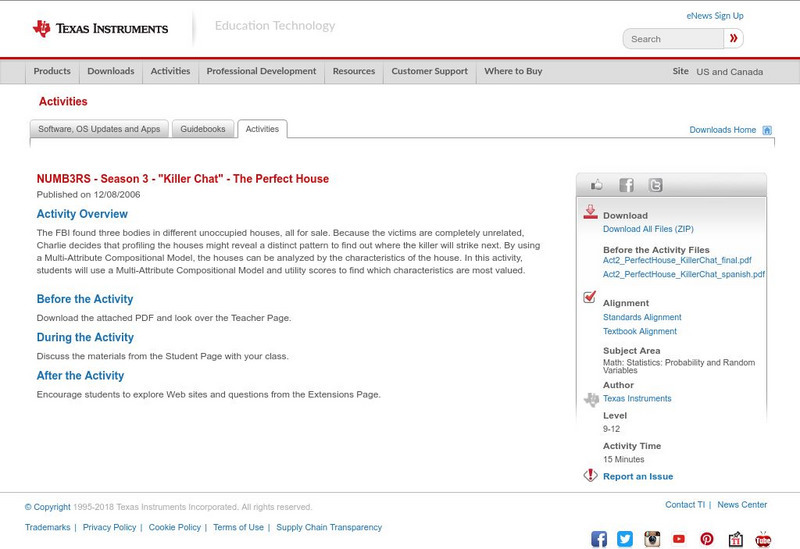
Texas Instruments: Numb3 Rs: The Perfect House
Based off of the hit television show NUMB3RS, this lesson introduces students to the concept of Multi-Attribute Compositional Models, in which market experts determine what features are most in demand for a given product. The lesson is...