Hi, what do you want to do?






Towson University
Berries...With a Side of DNA? (High School)
Is DNA still present after picking fruit or cooking vegetables? Biology scholars extract and collect DNA strands in an impactful lab. Working groups prepare their samples and compare their results to negative and positive standard...

Towson University
Berries...With a Side of DNA?
Sometimes science lab can be ... delicious! Middle school science scholars extract DNA from strawberries and other fruits in an engaging lab activity. The teacher's guide includes pacing, materials list, and worksheets with answer keys.

Towson University
Case of the Crown Jewels
Can your biology class crack the Case of the Crown Jewels? Junior forensics experts try their hands at DNA restriction analysis in an exciting lab activity. The lesson introduces the concept of restriction analysis, teaches pipetting and...

Towson University
Chestnut Tree Lab
What will your class learn in a curious tale of a fungus, a virus, and a chestnut tree? Biology scholars discover the world of viral biocontrols through a DNA restriction lab. Groups research the decline of the American chestnut tree at...

Towson University
The Wildlife Forensics Lab
Can science put an end to the poaching of endangered species? Show your young forensic experts how biotechnology can help save wildlife through an exciting electrophoresis lab. Grouped pupils analyze shark DNA to determine if it came...

National Institute of Open Schooling
Aldehydes, Ketones and Carboxylic Acids
Although their name makes them sound dangerous or toxic, carboxylic acids are found throughout nature in things such as citric acid, vinegar, and even in your DNA. Through detailed readings, discussions, and answering questions...

Towson University
Transformation Lab
Transform your class' understanding of genes and antibiotic resistance with the Transformation Lab. Junior geneticists create and observe their own resistant strains of E. coli through research, discussion, and experimentation. The...

MENSA Education & Research Foundation
Peas in a Pod: Genetics
Can peas have grandparents? Learn about inherited traits and heredity with a set of activities focused on Mendelian genetics. As your class learns about the process of passing traits along in Punnett squares, they take on the role of...

Rensselaer Polytechnic Institute
Molecules to the Max!—Teacher's Discovery Guide
Molecules to the Max! refers to a movie released in 2009 about the world of atoms and molecules. A helpful discovery guide provides five posters on science topics typically covered at the middle school level. It also explains the...

National Institute of Open Schooling
Biomolecules
An informative lesson has learners read about, discuss, and study the classification, structure and importance of the following biomolecules: carbohydrates, proteins, lipids, nucleic acids, and enzymes.

Curated OER
Cell Phone Radiation
Should people be more worried about cell phone radiation? Scholars read extensive background information about the issue to prepare for a class discussion or debate. As they explore the website, they learn the main arguments for and...
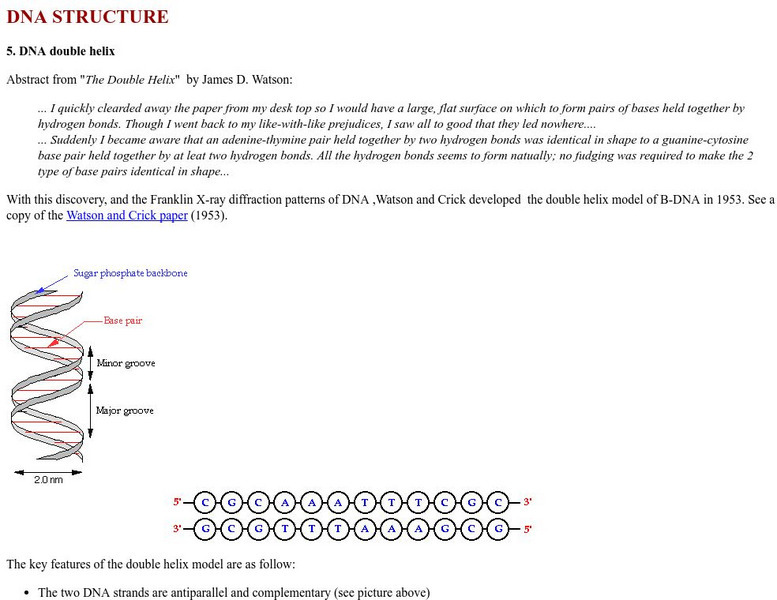
University of Southern California
University of Southern California: Dna Structure
A really nice web page devoted to the structure of DNA. Simple information but nice use of graphics to show the molecule. Uses the CHIME plug-in to show the 3-D nature of the helix.

PBS
Pbs Learning Media: How Dna Evidence Works
In this article by An Meeker-O'Connell, discover how DNA evidence is processed before it goes to court.
PBS
Pbs Learning Media: Dna Fingerprint Photos
These photographs supplied by Genelex Corporation depict actual DNA fingerprints and show the types of information that can be gleaned from them.
PBS
Pbs Learning Media: Journey Into Dna
Travel deep into the human body to see exactly where your DNA resides. From the NOVA: Cracking the Code of Life Web site.
PBS
Pbs Learning Media: Forensics and Dna Profiling
Find out how DNA profilers analyze bits of tissue to identify human remains. From the NOVA: "Lost on Everest" Web site.
Other
Univ. Of Copenhagen: Centre for Ice and Climate: Preserved Fossil Dna in the Ice
Discusses how fossil DNA data that is collected from ice cores is used by scientists to reconstruct the composition of past ecosystems and their biodiversity, as well as climates. There is a great deal of other information on the website...
National Institutes of Health
National Library of Medicine: Genetics Home Reference: Mitochondrial Dna
A thorough overview of mitochondrial DNA.
PBS
Nova: Journey Into Dna
Investigate the structure and function of DNA using this animated presentation.
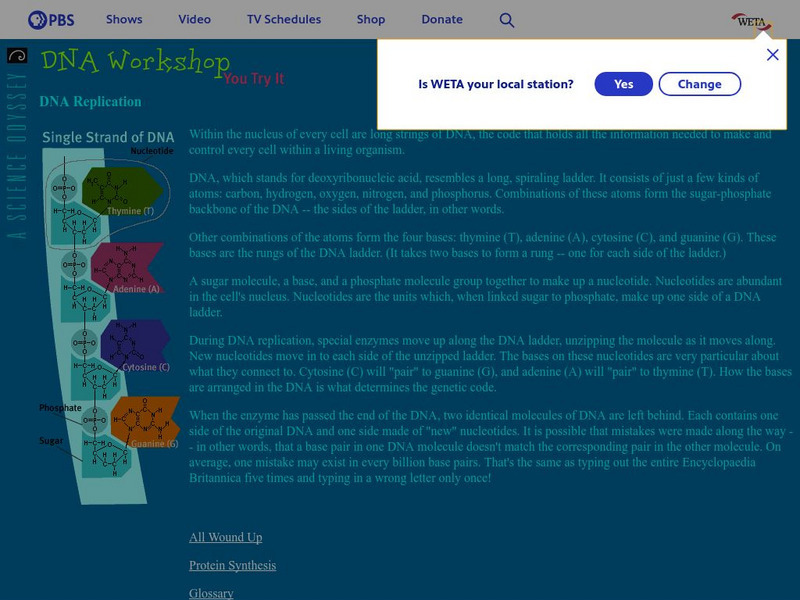
PBS
Pbs: Dna Replication
PBS provides a very good explanation with graphics of the basics of DNA replication.
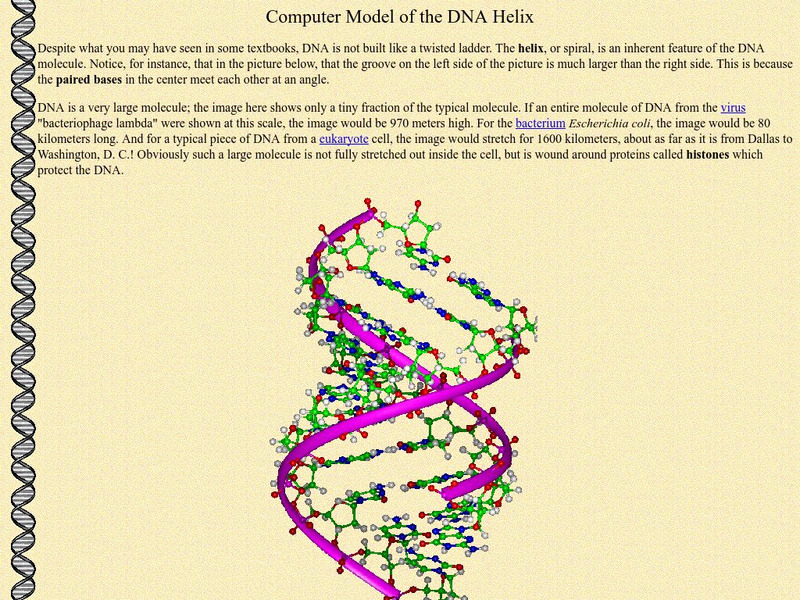
University of California
Ucmp: Computer Model of Dna
A slight departure from the classic view of DNA showing that the molecule is not exactly a twisted ladder. Good image and explanation to go with it.
Other
University of Cincinnati: Dna Structure and Function
This site explores the history and the science of DNA. Content also examines and considers the possibilities of genetic engineering and mutation.
Oregon State University
Oregon State University: Linus Pauling and the Race for Dna
A great resource for the history of the discovery of DNA! This website includes over 300 documents, photographs, audio clips, and video excerpts that documents how the double helix structure was discovered.
National Institutes of Health
U.s. National Library of Medicine: What Is Dna?
Scientific information about the hereditary material in all living things, DNA. Also includes links to fact sheets for quick reference.
Other popular searches
- Dna Replication
- Dna Structure
- Dna Fingerprinting
- Dna Models
- Dna Replication Worksheet
- Dna Sequencing
- Dna Extraction
- Dna Technology
- Recombinant Dna
- Dna Mutations
- Dna Structure Worksheet
- Mitochondrial Dna