Hi, what do you want to do?






University of Notre Dame
Safe Science Lab Safety Awareness
Prepare young scientists for the ins and outs of lab safety with a thorough list of symbols, icons, and rules about staying safe during experiments. Additionally, the resource provides several assessment pages for kids to reflect on what...

Concord Consortium
Electrostatics: Maze Game
Ready to have an a-MAZE-ing time teaching electrostatics? Introduce physical science superstars to an engaging resource that tests their knowledge of attractive and repulsive forces. Pupils change the charge of a ball to guide it through...

PHET
Mapping the Field of Multiple Dipole Magnets
So you built a magnetometer, now what? High school scientists use their magnetometer made in a previous lesson to map the union of magnetic fields of dipole magnets. They experiment with different alignments and draw conclusions about...

PBS
NOVA Sun Lab Lesson Plan
Looking for a sun-sational multi-lesson plan full of videos, simulations, and discussion? Introduce your young scientists to all things solar with a four-part hands-on adventure. Pupils learn the basics of solar anatomy, space weather,...

LABScI
The Separation Lab: Candy Colors
There's no better motivator than candy! An engaging activity has pupils explore methods for separating mixtures. A two-part lab first explores methods of separation based on size and magnetism. The second activity introduces learners to...

Concord Consortium
Opposites Attract
Whether they pull together or push away from one another, magnets are sure-fire pupil pleasers! Take their study of magnetism to a new level with a fun interactive. Individuals control the polarity of two spheres to observe attractive or...

Concord Consortium
Direction of Force on Charged Objects
Make your unit on magnetism a force to be reckoned with! Physical science scholars examine the direction of force on charged objects through a simple interactive. Pupils control the charge of the stationary object, then observe how it...

Cornell University
Glued into Science—Classifying Polymers
Explore the unique characteristics of polymers. A complete activity begins with a presentation introducing polymers. Following the presentation, young scientists develop a laboratory plan for creating substances using polymers. They...

Cornell Lab of Ornithology
Amazing Birds
What's so amazing about birds? Find out just how amazing birds are with a physics of animal behavior unit created by Cornell Lab of Ornithology. Have learners explore and tap into their observational skills and notice how birds fly, what...

Concord Consortium
Non-Bonding
What makes helium so Noble, anyway? Explore the bonding properties of helium versus those of hydrogen using an interactive resource. Science scholars manipulate atoms of each element and observe changes in potential energy as the atoms...

Rice University
College Physics for AP® Courses
Take a look at an organized physics course. The 34-section electronic textbook covers material in AP® Physics 1 and 2. Teachers use the text to supplement lectures and have the class work through the labs. Each section contains...

Concord Consortium
Direction of Force Around a Van de Graaff—Negatively Charged
Learn about the direction of magnetic force with a very attractive interactive! Young physicists move a positively charged object around a negatively charged Van de Graaff generator and observe the direction of the forces present. A...

Santa Monica College
Flame Tests of Metal Cations
Scientists used flame tests to identify elements long before the invention of emission spectroscopy. Young chemists observe a flame test of five metal cations in the fourth lesson of an 11-part series. Individuals then work...

Concord Consortium
Visualizing Electric Fields and Forces
Shock your class with an exciting interactive about electric fields! Physical science superstars visualize the transparent world of electric fields by changing the charge on a stationary object. They then observe changes in the resulting...

Concord Consortium
Charge Intensity and Electric Force
Looking for a quick way to supercharge your electricity and magnetism unit? Assign a very responsive interactive designed to illustrate the relationship between charge, electric field, and the resulting forces. Learners experiment with...

Concord Consortium
Direction and Strength of Force in Electric Fields
Finally, a helpful tool for modeling electric fields! Young physicists explore the unseen world of magnetism via a simple interactive. Individuals move a charged object around a stationary object and see the strength and directions of...

Concord Consortium
Energy of Bond Formation
Show your chemistry class that there's much more to covalent bonding than sharing electrons! Pupils manipulate atoms of hydrogen, oxygen, and carbon to observe the energy of bond formation using a well-rounded interactive. The resource...

Concord Consortium
Forming a Molecule
What does it look like when two atoms bond? Mol-e-COOL! Aspiring chemists observe the interaction between two atoms forming a bond in an easy-to-use interactive. Individuals move atoms closer together and observe changes in attraction...

Concord Consortium
Conversion of Electric Potential Energy
Here is a resource that is full of potential energy! Learners manipulate charged objects to convert electric potential to thermal energy using a savvy simulation. The resource includes a variety of charge settings and helpful potential...

Concord Consortium
Concentrating Charge and Electric Fields
How did Rutherford determine that the nucleus was the center of an atom? Take a look inside the famous Gold Foil Experiment with an interesting interactive. Learners fire a beam of alpha particles at a nucleus containing variable...
American Chemical Society
American Chemical Society: Science for Kids: Characteristics of Materials
Engaging hands-on science lessons for grades 2-6 on the properties of different materials.
Lawrence Berkeley National Laboratory
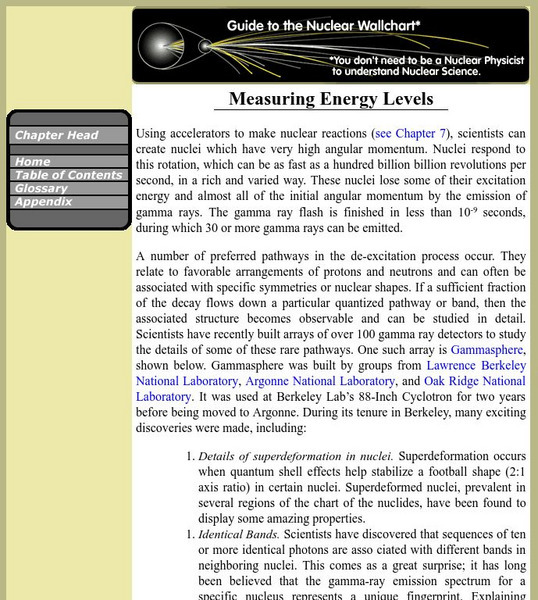
Berkeley Lab: Measuring Energy Levels
This Guide to the Nuclear Wallchart is an online textbook geared to teachers. Each topic related to nuclear energy is isolated into various topics. This particular chapter explains how to measure nuclear energy levels.