Hi, what do you want to do?






New York State Education Department
TASC Transition Curriculum: Workshop 11
You'll C-E-R a difference in classroom achievement after using a helpful instructional activity. Designed for economics, civics, government, and US history classes, participants practice using the CER model to craft arguments about...

New York State Education Department
TASC Transition Curriculum: Workshop 5
Are video games sports? Pupils investigate this question as well as various nonfiction selections to learn more about claims and the support that defines them. All of the selections mimic the rigor on state tests and encourage close...

EngageNY
TASC Transition Curriculum: Workshop 15
What do a cheetah, Audi commercial, and air have in common? They're all topics of an engaging inquiry-based, hands-on workshop for educators about background knowledge, reading strategies, the CER model, and argumentative writing. The...

EngageNY
TASC Transition Curriculum: Workshop 6
Is a college education necessary for success in today's world? The class investigates the question, along with others at the end of the sixth workshop in a 15-part series. The instructional activity has four parts with multiple...

New York State Education Department
TASC Transition Curriculum: Workshop 10
How have educational standards evolved? Educators of adults examine expectations in the 10th workshop out of 15 to better determine how standards have grown. Participants respond to a variety of sample questions to determine how they...

EngageNY
TASC Transition Curriculum: Workshop 12
How can opinions slant facts? Workshop participants learn how to examine primary and secondary sources and identify the author's point of view. They also examine how visual art impacts the meaning and rhetoric of sources. Full of...

Other
Warren County Schools: Citing Textual Evidence
Well-organized and in-depth lesson on citing textual evidence and understanding inferences. Many examples are included, as well as exercises for the students to practice what they have learned. [PDF]
Thinkport Education
Thinkport: Citing Textual Evidence: Changing Oceans
Learn how to cite evidence to support ideas presented in a science article about oceans.
Other
Prezi: Prove It! (Using Textual Evidence)
Slideshow explains textual evidence and how to use the I.C.E. method when citing it.
Sophia Learning
Sophia: Critical Reading as a Learning Strategy
This tutorial focuses on critical reading using a downloadable PowerPoint presentation, "Critical Reading 101," which includes separating fact from opinion, 6 propaganda techniques, and 6 common fallacies in reasoning. Also provided is...
Texas Education Agency
Texas Gateway: Understanding Drama
You will learn how to make complex inferences in a play and use textual evidence to support your understanding.

Texas Education Agency
Texas Gateway: Themes in Literary Texts (English 6 Reading)
Learn how to infer the implicit theme in a work of fiction, distinguish theme from topic, and make complex inferences using textual evidence.
Better Lesson
Better Lesson: Collaborative Booktalk: Sharing and Writing Development
Are dark themes in young adult novels harmful or helpful to teens? Students will explore this question and will create an argumentative writing piece based on textual evidence. Videos of the lesson in action, examples of student work,...
Other
Daniel J. Kurland: Critical Reading: Inference: Reading Ideas as Well as Words
This college instructor offers his insights into critical reading and how to develop skills to interpret as well as comprehend the written word. RL.9-10.1, RL.11-12.1, RI.9-10.1 textual evidence and inference.
Thinkport Education
Thinkport: Research Simulation Task
Engage in a research process by analyzing a variety of print and non-print texts on the subject of bullying, identifying evidence regarding the topic, and using this new information to respond to questions about the text and the topic.
Other
Critical Reading: Inference and Analysis
This site defines inference and analysis. It explains how analysis works, goals of analysis, levels, bases, and how to analyze text. RL.9-10.1, RL.11-12.1, RI.9-10.1 textual evidence and inferences, RI.11-12.1 textual evidence and...

AdLit
Ad lit.org: Classroom Strategies: Inferential Reading
Teaching students to "read influentially" helps them learn how to read more strategically. This technique is derived from the teaching model that learners develop knowledge via the process of interpreting new information in light of past...
Texas Education Agency
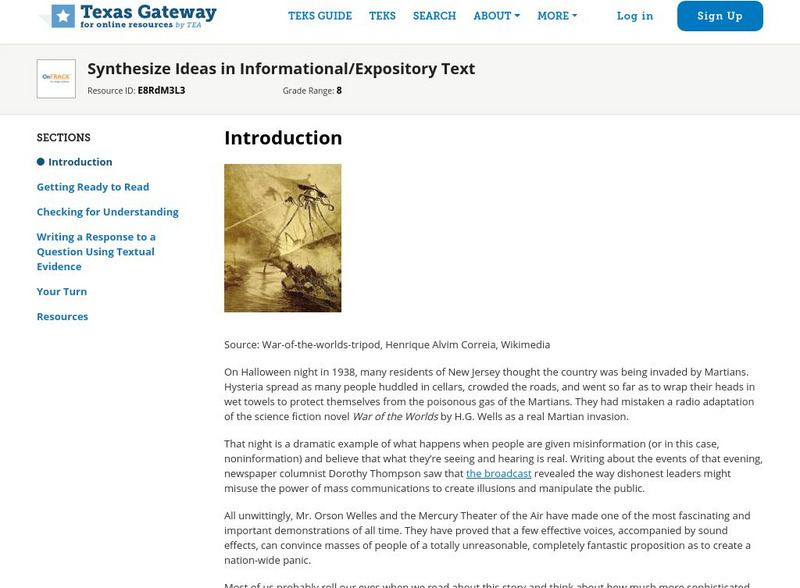
Texas Gateway: Synthesize Ideas in Informational/expository Text
[Accessible by TX Educators. Free Registration/Login Required] In this lesson, you will expand on your ability to read texts, synthesize them, and make choices based on the information you read. Finally, you will learn how to use textual...
CPALMS
Cpalms: Stand Tall: Using Evidence to Support Your Answers
This learning module has a series of screencast videos and practice exercises designed to teach students how to support their answers with details from the text.
Sophia Learning
Sophia: Answering Based on Context
In this slideshow tutorial lesson, students will review how to answer questions based on context clues. Definitions and short examples are provided related to how to find context clues and then apply the textual evidence to reading...
Texas Education Agency
Texas Gateway: Annotate and Analyze a Paired Passage: Practice 2
Read and annotate paired texts in order to make inferences, draw conclusions, and synthesize ideas and details using textual evidence.
Texas Education Agency
Texas Gateway: Annotate and Analyze a Paired Passage: Practice 1
Read and annotate paired texts in order to make inferences, draw conclusions, and synthesize ideas and details using textual evidence.
Texas Education Agency
Texas Gateway: Make Connections Between and Across Literary Texts
Make connections between and across texts, including other media (e.g., film, play), and provide textual evidence.
Other
Laflemm.com: Reading Resources: Inference
This page has reading tips and exercises that explain inferences. There is an answer key for students to check their work. RL.9-10.1, RL.11-12.1, RI.9-10.1 & RL.11-12.1 textual evidence and inferences