Hi, what do you want to do?






Serendip
Golden Rice – Evaluating the Pros and Cons
More than half the world's population eats rice as a daily staple ... imagine if that rice could prevent illness. Scientists genetically engineered rice to include vitamin A for just that purpose. However, room for debate still exists....

Teach Engineering
Incoming Asteroid! What's the Problem?
Oh, no! An asteroid is on a collision course with Earth!. Class members must rise to the challenge of designing a shelter that will protect people from the impact and permit them to live in this shelter for one year. In this first lesson...

DiscoverE
Design a Folding Solar Panel
Solar energy is an amazing alternative ... but, not always particularly portable! Challenge young scientists to a folding solar panel build-off with an easy-to-execute activity. Scholars brainstorm around specific design needs, construct...

Teach Engineering
Get the Word Out at McDonald's!
To get the word out that the Great Pacific garbage patch (GPGP) contains millions of pounds of non-biodegrading plastics, individuals research the GPGP and write an article for a newsletter. Researchers present their facts in a...

Teach Engineering
How Big? Necessary Area and Volume for Shelter
Teams must determine the size of cavern needed to house the citizens of Alabraska to protect them from the asteroid impact. Using scaling properties, teams first determining the number of people that could sleep in a classroom and then...

Teach Engineering
Egg Drop
Don't drop the ball on the resource ... drop an egg instead! A teacher-led demonstration has the class consider how to drop eggs into glasses when a tray is in the way. Hint: If you've ever seen a magician pull a tablecloth off a table,...

Teach Engineering
A Good Foundation
It takes a strong foundation to build a house and a stronger one for a bridge. This resource presents the effects of geology and soil on bridge foundations. Working in groups, the class investigates the interaction of shallow and deep...

Teach Engineering
Energy Sources Research
Turn your pupils into teachers! Here is a lesson that requires groups to research an energy source with the provided handout, create a poster, and present their information to the class. Connections are made to practical aspects of...

DiscoverE
Paper Recycling
Paper is made from paper, right? Future scientists take bits of paper and produce sheets of recycled paper. The only drawback? It has to dry overnight.

Teach Engineering
Solving Energy Problems
Here's your chance to save the world. The eighth lesson in a 25-part Energy Systems and Solutions unit has young scientists come up with ideas for individual or group projects. They identify ways to solve the energy crisis. Hope they...

DiscoverE
Make Your Own Glue
You won't regret being stuck with this activity. By mixing a variety of household items, pupils create their own glue. They test the tensile strength of their glue and compare it to that of other adhesives.
TeachEngineering
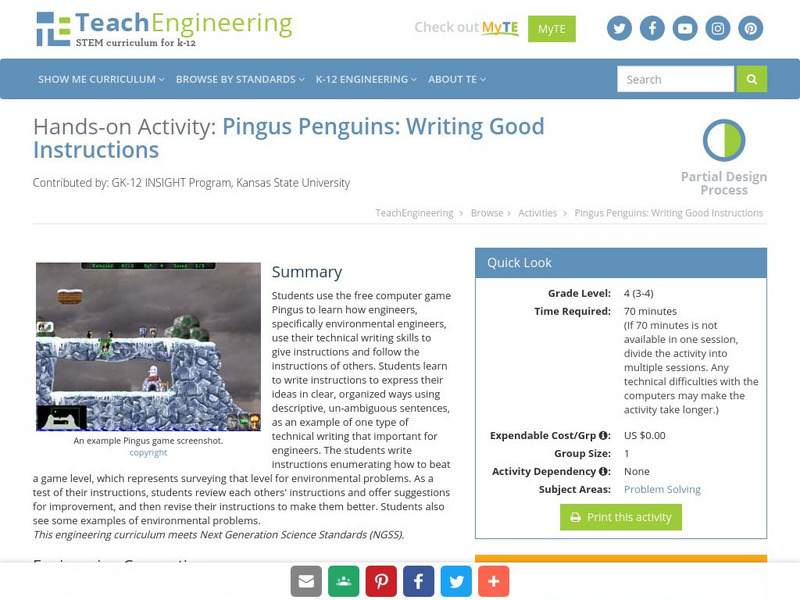
Teach Engineering: Pingus Penguins: Writing Good Instructions
Students use the free computer game Pingus to learn how engineers, specifically environmental engineers, use their technical writing skills to give instructions and follow the instructions of others. Students learn to write instructions...
TeachEngineering
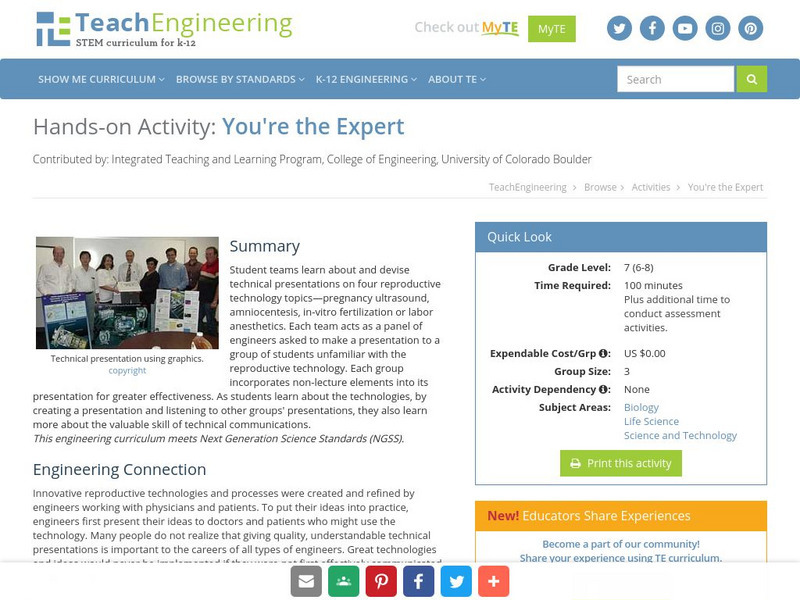
Teach Engineering: You're the Expert
Student teams learn about and devise technical presentations on four reproductive technology topics pregnancy ultrasound, amniocentesis, in-vitro fertilization or labor anesthetics. Each team acts as a panel of engineers asked to make a...
TeachEngineering
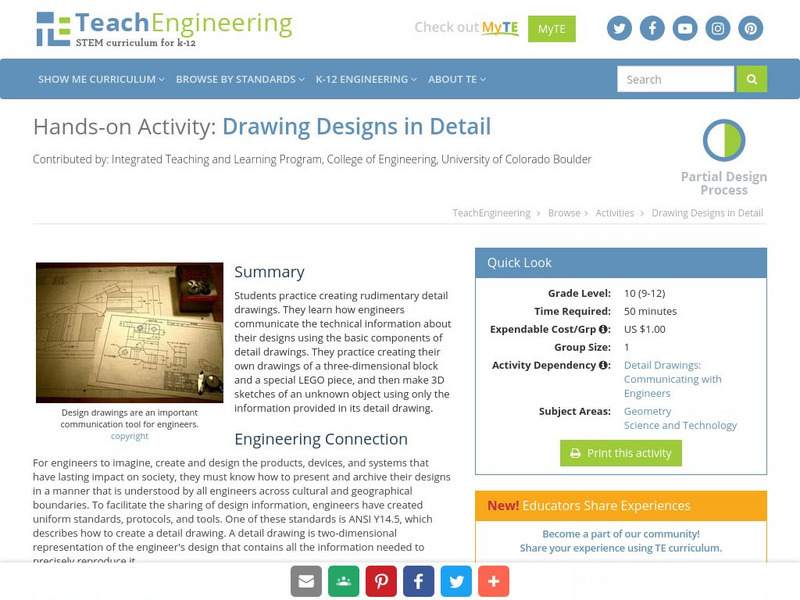
Teach Engineering: Drawing Designs in Detail
Students practice creating rudimentary detail drawings. They learn how engineers communicate the technical information about their designs using the basic components of detail drawings. They practice creating their own drawings of a...
TeachEngineering
Teach Engineering: Solving Energy Problems
The culminating energy project is introduced and the technical problem solving process is applied to get students started on the project. By the end of the class, students should have a good perspective on what they have already learned...
TeachEngineering
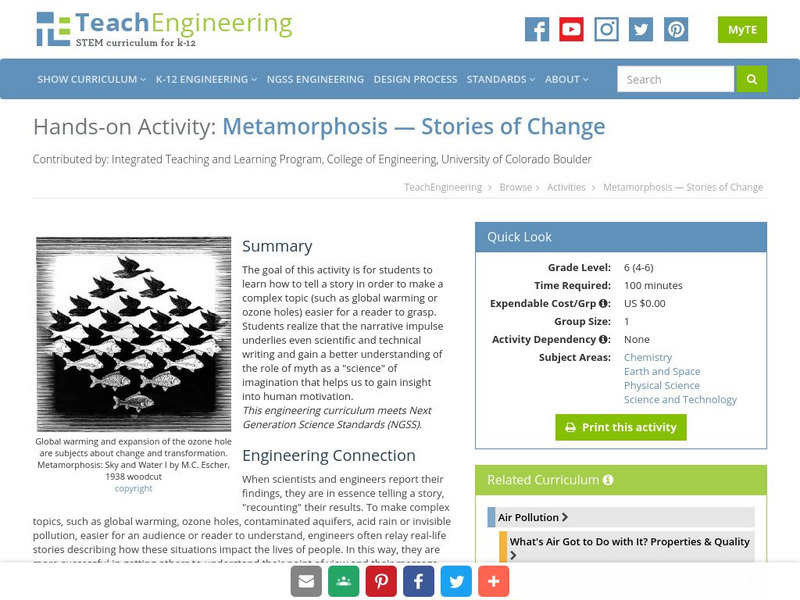
Teach Engineering: Metamorphosis Stories of Change
The goal of this activity is for students to learn how to tell a story in order to make a complex topic (such as global warming or ozone holes) easier for a reader to grasp. Students realize that the narrative impulse underlies even...
TeachEngineering
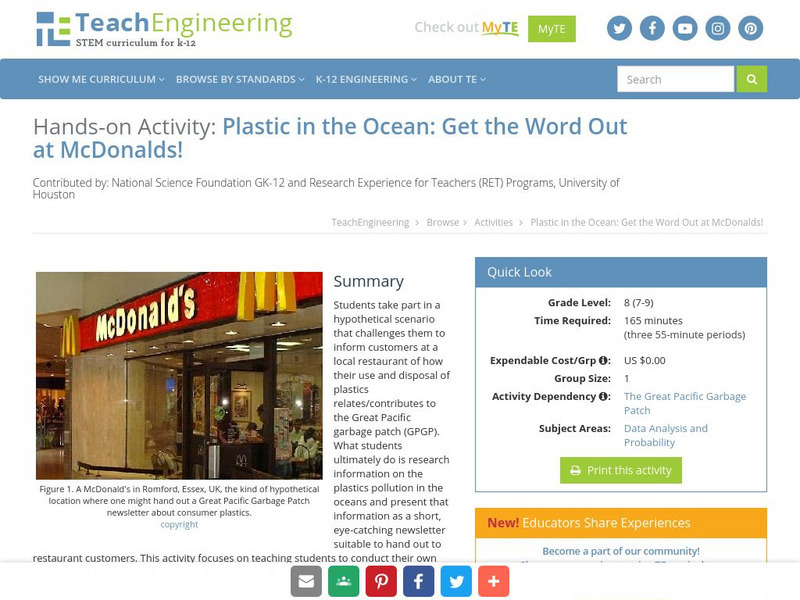
Teach Engineering: Get the Word Out at Mc Donalds!
Students take part in a hypothetical scenario that challenges them to inform customers at a local restaurant of how their use and disposal of plastics relates/contributes to the Great Pacific garbage patch (GPGP). What students...
TeachEngineering
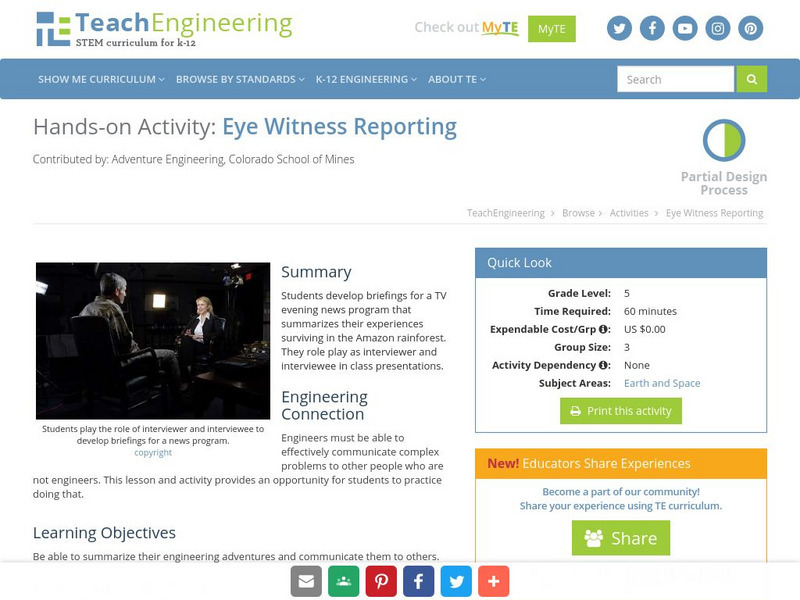
Teach Engineering: Eye Witness Reporting
In this activity, the students will develop a briefing for a T.V. evening news program that summarizes their experiences surviving in the Amazon rainforest. The students will have the opportunity to role play as interviewer and...
TeachEngineering
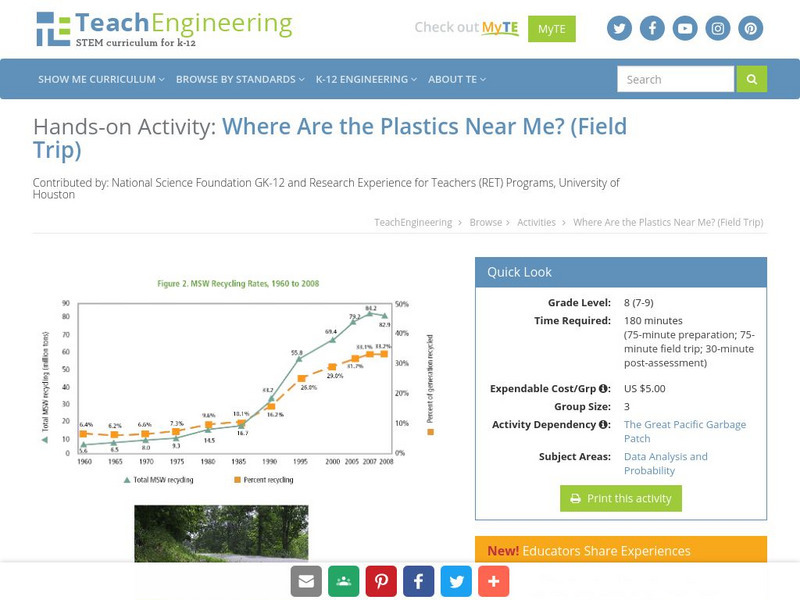
Teach Engineering: Where Are the Plastics Near Me? (Field Trip)
An adult-led field trip allows students to be organized into investigation teams that catalogue the incidence of plastic debris in different environments. These plastics are being investigated according to their type, age, location and...
TeachEngineering
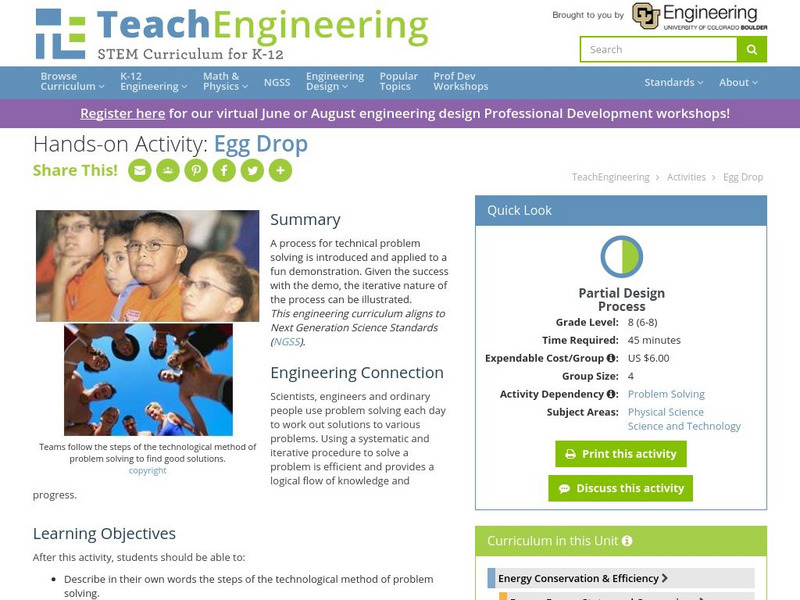
Teach Engineering: Egg Drop
Students are challenged to use the technical problem solving to dump radioactive material (eggs) into water without touching them. Lesson plan includes timeline, student handout and discussion questions.
TeachEngineering
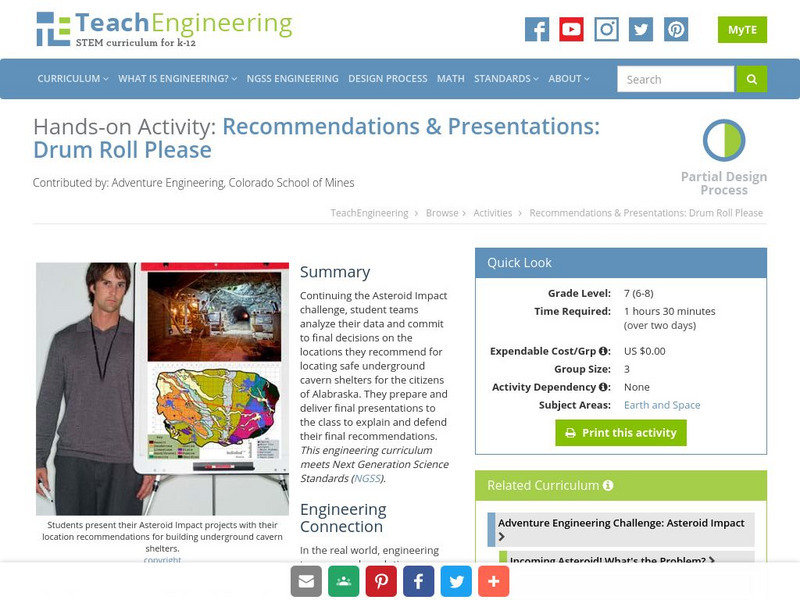
Teach Engineering: Drum Roll Please
Student teams commit to a final decision on the location they recommend for safe underground cavern shelter for the citizens of Alabraska. They prepare and deliver final presentations to defend their final decisions to the class.

Technovation
Curiosity Machine: Challenges: Make Drawings of Three Dimensional Objects
Using the Glass Box Theory, students will make scaled technical drawings of 3D objects. This site includes the challenge, tips, a lesson plan, and a place for students to document their engineering design process.

Read Works
Read Works: Inventions: Then and Now
[Free Registration/Login Required] Students read about how the telephone, calculator, television, and clock have changed since they were invented. A question sheet is available to help students build skills in comparing and contrasting.