Hi, what do you want to do?






Core Knowledge Foundation
The U.S. Civil War Tell It Again!™ Read-Aloud Anthology
Over three weeks, second graders listen to stories about the United States Civil War. Informational texts explore the war, slavery, Harriet Tubman, Abraham Lincoln, Robert E. Lee, Clara Barton, the Emancipation Proclamation, and Ulysses...

Core Knowledge Foundation
Colonial America Tell It Again!™ Read-Aloud Anthology
A read-aloud anthology explores Colonial America. Third graders listen to informational texts, discuss what they heard, and participate in extension activities and writing. Take-home materials, assessments, and remediation opportunities...

Annenberg Foundation
Contested Territories
United States expansion into Western territories impacted much more than just lines on a map. The seventh installment of a 22-part series about America's history puts scholars into the lives of those making the journey westward as well...

Livaudais-Baker English Classroom
Kindred
This first in a series of four resources is designed for instructors to use Octavia E. Butler's Kindred in their classes. The packet includes an overview of the unit, a day-to-day calendar, links to background articles, and reading...

Student Achievement Partners
You've Been Lied To: The REAL Christopher Columbus
Looking for resources that explore alternative perspectives of the Christopher Columbus story? Check out the images, videos, cartoons, primary source documents, and other texts in a packet designed to spark...

Annenberg Foundation
Colonial Designs
The adventures of the New World came at a cost for Native Americans. Scholars investigate the economic side of settling the European colonies. Using video clips, statistical evidence, and primary sources, they create hypotheses and...

Annenberg Foundation
Spirit of Nationalism
What were the virtues and values that helped form America? Pupils watch and discuss a video, read biographies of early Americans, chart the differences between early American religious movements, write journals and letters, draw, and...

Annenberg Foundation
Antebellum Reform
Scholars investigate the Antebellum period in the United States in an engaging lesson. Groups analyze technological, religious, economic, and social changes occurring during the time period prior to the Civil War. Using their new...

Annenberg Foundation
Social Realism
Many American writers in the late nineteenth century wanted their writing to reflect real life. Individuals watch and discuss a video, read and explore author biographies, write a journal entry and a poem, and complete a multimedia...

Jamestown-Yorktown Foundation
Colonial Tobacco Economy
Tobacco as money? Middle schoolers investigate how eighteenth-century Virginia farmers used tobacco as a cash crop to buy tools, livestock, and household goods. They also examine the connection between tobacco production and the slave...

Annenberg Foundation
Gothic Undercurrents
Terror, mystery, excitement. American writers of the 19th century, including Nathaniel Hawthorne, Herman Melville, and Emily Dickinson, used these elements to create morally ambiguous tales that challenged the prevailing belief in...

Curated OER
The Presidents of Mount Rushmore
Students understand the importance of Mount Rushmore as a national symbol. In this Mount Rushmore lesson, students locate Mount Rushmore on the map and investigate each of the four Presidents on Mount Rushmore. Students understand how...

Odell Education
Reading Closely For Textual Details: Grade 8
Only a thorough understanding of history can save us from repeating it. Practice close reading skills with an eighth grade unit that focuses on 19th century America, including European immigration into Ellis Island and Frederick...

Curated OER
A Collage of American Icons: Presidents and Symbols
Students use KWL charts, stores, news, books, and movies to learn about the Presidents and symbols of America. In this Presidents and symbols lesson plan, students participate in many activities that introduce them to the leaders and...
PBS
Pbs: Cet: Africans in America: The Growth of Slavery in North America
Discusses the economics of slavery in South Carolina and its importance to the profitable growing of rice. It continues with ways the slaves were controlled and punished in South Carolina and Georgia. Click on Teacher's Guide for teacher...

Mariners' Museum and Park
Mariners' Museum: Captive Passage: The Transatlantic Slave Trade
Online exhibition from the Mariners' Museum chronicles the plight of African slaves from the beginning of their journey when they are torn from their homeland all the way to the shores of the Americas. Caught up in the lucrative...
Annenberg Foundation
Annenberg Learner: America's History in the Making: Reconstruction
This wonderful unit from Annenberg Media examines Reconstruction through three themes: reintegrating the former Confederate states in to the Union; the freedom of blacks and what that entailed socially and economically; and the economic...
PBS
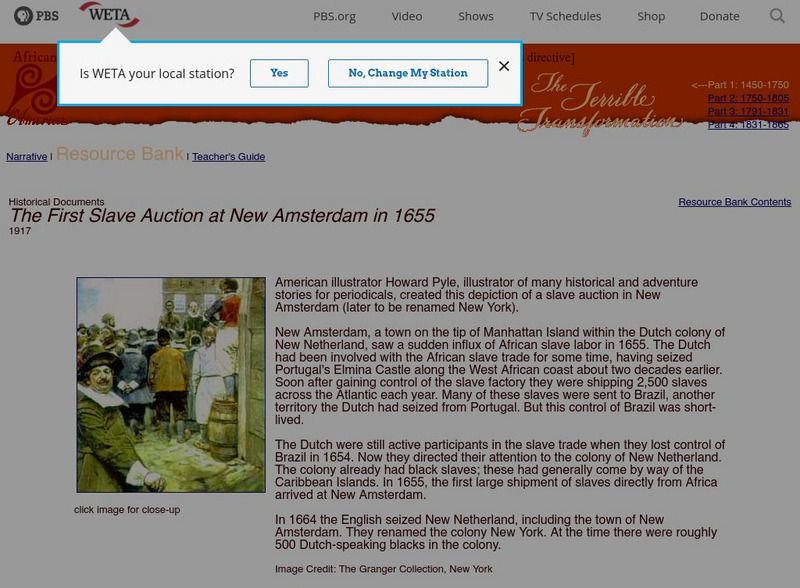
Pbs: Cet: Africans in America: The First Slave Auction at New Amsterdam in 1655
This website contains a general description of the time and reason for the first large slave auction held in the Dutch colony of New Amsterdam. Click on Teacher's Guide for teaching resources.
National Endowment for the Humanities
Neh: Edsit Ement: Life in North & South 1847 1861: Before Brother Fought Brother
The five lessons in this unit are designed to help students develop a foundation on which to understand the basic disagreements between North and South through the investigation of primary source documents, photographs, and census...
Annenberg Foundation
Annenberg Learner: American Passages: Race and Identity in Antebellum America
This unit features authors of Antebellum America and how they portray the American identity through their literature. Click on the tabs to explore the various resources available to enhance this unit.
Harp Week
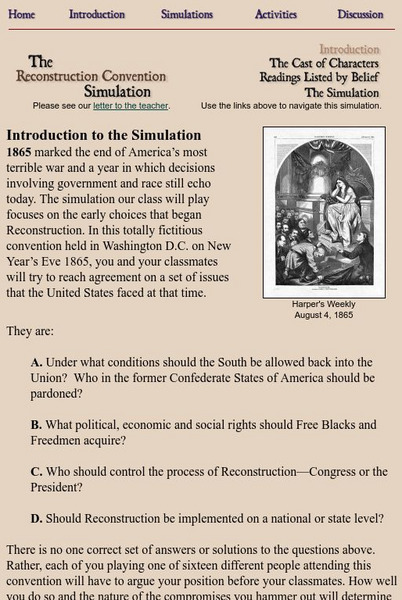
Education at Harp week.com: The Reconstruction Convention Simulation
A simulation activity where students participate in a convention at the end of the American Civil War that never actually took place. Together they grapple with the issues that faced America in 1865 in dealing with the demise of slavery...
PBS
Pbs Learning Media: Writing in u.s. History: The Emancipation Proclamation
Assess how the Emancipation Proclamation expanded ideas of freedom and liberty, looking at the antislavery debate that led to the proclamation, the influences on Lincoln's decision, and the provisions of the document. In this interactive...
Annenberg Foundation
Annenberg Learner: American Passages: Slavery and Freedom: Frederick Douglass
This concise biography presents author/journalist Frederick Douglass, who was groundbreaking in his slave narratives and establishing "The North Star" abolitionist periodical in mid-nineteenth-century America. See "Frederick Douglass...
National Humanities Center
National Humanities Center: Toolbox Library: Prosperity, American Beginnings: 1492 1690
Four original source accounts, and four related maps, of successful English, French, and Spanish settlements in North America and the Caribbean that explain the qualities of these settlements and their reasons for permanence and prosperity.