Hi, what do you want to do?






Concord Consortium
Electrostatics: Maze Game
Ready to have an a-MAZE-ing time teaching electrostatics? Introduce physical science superstars to an engaging resource that tests their knowledge of attractive and repulsive forces. Pupils change the charge of a ball to guide it through...

PHET
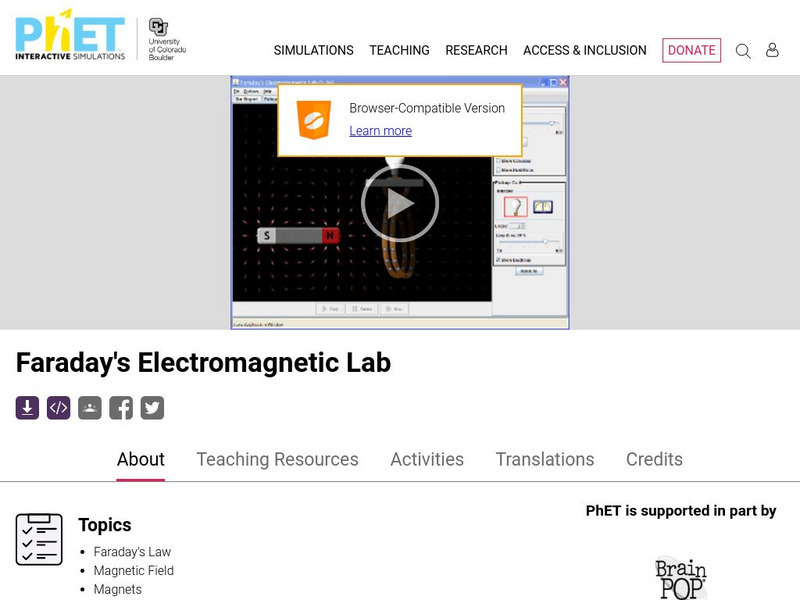
Faraday's Electromagnetic Lab
"But still try, for who knows what is possible." - Michael Faraday. Faraday's advice features in a simulation that permits pupils to play with a bar magnet in order to make a light bulb glow connecting electromagnetic induction to...

Laboratory for Atmospheric and Space Physics
The Solar Wind Tunnel
The winds of change are blowing in our very own solar system! But what makes some heavenly bodies more affected by solar winds than others? Pupils discover the concept of magnetic forces at work in space in this...

Concord Consortium
Opposites Attract
Whether they pull together or push away from one another, magnets are sure-fire pupil pleasers! Take their study of magnetism to a new level with a fun interactive. Individuals control the polarity of two spheres to observe attractive or...

Concord Consortium
Direction of Force on Charged Objects
Make your unit on magnetism a force to be reckoned with! Physical science scholars examine the direction of force on charged objects through a simple interactive. Pupils control the charge of the stationary object, then observe how it...

Concord Consortium
Non-Bonding
What makes helium so Noble, anyway? Explore the bonding properties of helium versus those of hydrogen using an interactive resource. Science scholars manipulate atoms of each element and observe changes in potential energy as the atoms...

Concord Consortium
Direction of Force Around a Van de Graaff—Negatively Charged
Learn about the direction of magnetic force with a very attractive interactive! Young physicists move a positively charged object around a negatively charged Van de Graaff generator and observe the direction of the forces present. A...

Concord Consortium
Visualizing Electric Fields and Forces
Shock your class with an exciting interactive about electric fields! Physical science superstars visualize the transparent world of electric fields by changing the charge on a stationary object. They then observe changes in the resulting...

Concord Consortium
Charge Intensity and Electric Force
Looking for a quick way to supercharge your electricity and magnetism unit? Assign a very responsive interactive designed to illustrate the relationship between charge, electric field, and the resulting forces. Learners experiment with...

Concord Consortium
Direction and Strength of Force in Electric Fields
Finally, a helpful tool for modeling electric fields! Young physicists explore the unseen world of magnetism via a simple interactive. Individuals move a charged object around a stationary object and see the strength and directions of...

Concord Consortium
Energy of Bond Formation
Show your chemistry class that there's much more to covalent bonding than sharing electrons! Pupils manipulate atoms of hydrogen, oxygen, and carbon to observe the energy of bond formation using a well-rounded interactive. The resource...

Concord Consortium
Forming a Molecule
What does it look like when two atoms bond? Mol-e-COOL! Aspiring chemists observe the interaction between two atoms forming a bond in an easy-to-use interactive. Individuals move atoms closer together and observe changes in attraction...

Concord Consortium
Target Game—Free Play
Challenge your classes to use electric fields to hit a target. Scholars place positively and negatively charged particles on a game board to direct a charged particle to a target. They can choose to view the electric field and force on...

Concord Consortium
Conversion of Electric Potential Energy
Here is a resource that is full of potential energy! Learners manipulate charged objects to convert electric potential to thermal energy using a savvy simulation. The resource includes a variety of charge settings and helpful potential...

Concord Consortium
Concentrating Charge and Electric Fields
How did Rutherford determine that the nucleus was the center of an atom? Take a look inside the famous Gold Foil Experiment with an interesting interactive. Learners fire a beam of alpha particles at a nucleus containing variable...
University of Colorado
University of Colorado: Ph Et Interactive Simulations: Faraday's Electromagnetic Lab
This interactive lab in electromagnetics effectively illustrates how Faraday's law works.
Math Science Nucleus
I. Science Ma Te: Integrating Science, Math and Technology
This site offers a wealth of online textbook-related materials that encourage the discovery of science in the world around us. Enter the site to access material on specific topics. Each section contains reading material (complete with...