Hi, what do you want to do?






Mathematics Vision Project
Module 5: Modeling with Geometry
Solids come in many shapes and sizes. Using geometry, scholars create two-dimensional cross-sections of various three-dimensional objects. They develop the lesson further by finding the volume of solids. The module then shifts...

Intel
Plugging into the Sun
What's cooking? A sizzling STEM unit challenges scholars to build a solar cooker that can successfully cook an egg. The unit opens with a study of Earth's rotation, the sun's energy, and shadows. Pupils use a compass and thermometer to...

Radford University
A Change in the Weather
Explore the power of mathematics through this two-week statistics unit. Pupils learn about several climate-related issues and complete surveys that communicate their perceptions. They graph both univariate and bivariate data and use...

Radford University
Sleep and Teen Obesity: Is there a Correlation?
Does the number of calories you eat affect the total time you sleep? Young mathematicians tackle this question by collecting their own data and making comparisons between others in the class through building scatter plots and regression...

National Library of Medicine
Your Environment, Your Health: Runoff, Impervious Surfaces, and Smart Development
Can a sidewalk increase the amount of pollution in local streams? Scholars learn the answer to this question though research and experimentation in the fifth unit in the six-part series. Pupils study runoff, impervious surfaces, and the...

Mathematics Vision Project
Module 7: Modeling with Functions
The sky's the limit of what you create when combining functions! The module begins with a review of transformations of parent functions and then moves to combining different function types using addition, subtraction, and...

Smithsonian Institution
Smithsonian In Your Classroom: The Music in Poetry
Take poetry off the page and put it into terms of movement, physical space and, finally, music with this series of three lessons from the Smithsonian Institution. This resource introduces students to two poetic forms that originated as...

National Library of Medicine
Your Environment, Your Health: The Great Debate—Bottled Water vs. Tap Water in Our School
Should bottled water be sold in schools, or should they only provide tap water? The summative unit in the six-part series encourages scholars debating this topic. The lessons teach how to build an argument, how to gain background...

National Library of Medicine
Your Environment, Your Health: Food Safety
Did youknow that chicken causes the greatest risk of food-borne illness. The fourth unit in a six-part series addresses food safety. Scholars research common scenarios of food causing illness through the National Institute for Health....

National Library of Medicine
Your Environment, Your Health: Air Quality
Some scientists argue that air pollution now causes more deaths than smoking. The second unit in a six-part series focuses on air quality. Scholars learn what's in the air, how clean the air around their school is, and what they can do...

Curated OER
Spatial Connections
Students use maps, scales, and describe locations in order to learn about spatial sense. In this spatial sense lesson plan, students participate in many activities for this spatial sense unit that should last throughout the year.
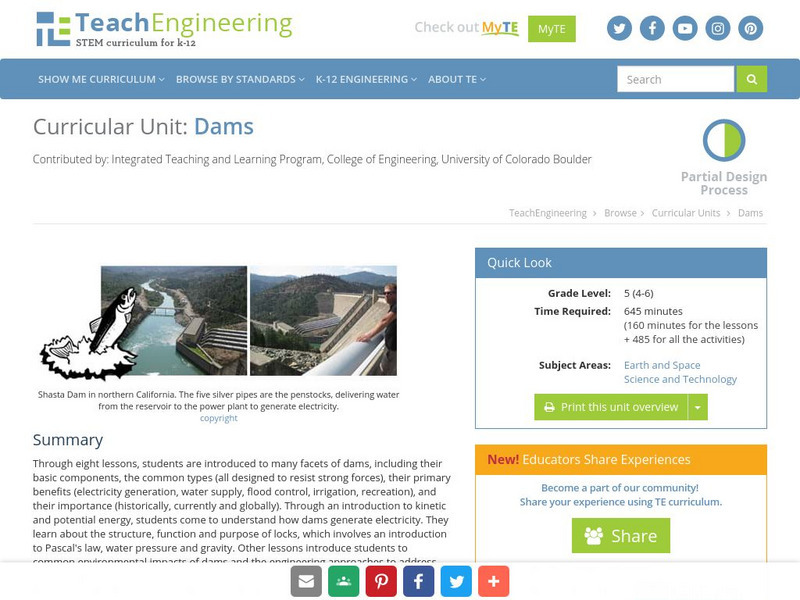
TeachEngineering
Teach Engineering: Dams
Through eight lessons, students are introduced to many facets of dams, including their basic components, the common types (all designed to resist strong forces), their primary benefits (electricity generation, water supply, flood...