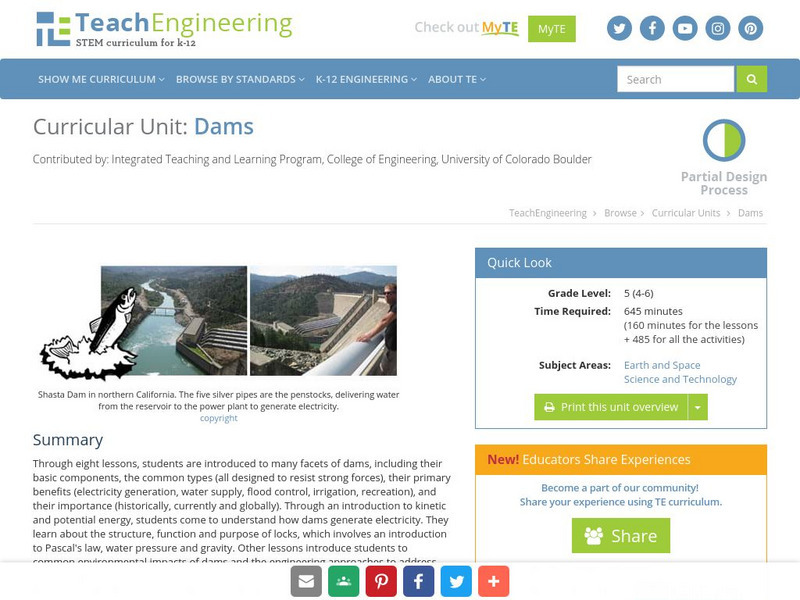
Through eight lessons, students are introduced to many facets of dams, including their basic components, the common types (all designed to resist strong forces), their primary benefits (electricity generation, water supply, flood control, irrigation, recreation), and their importance (historically, currently and globally). Through an introduction to kinetic and potential energy, students come to understand how dams generate electricity. They learn about the structure, function and purpose of locks, which involves an introduction to Pascal's law, water pressure and gravity. Other lessons introduce students to common environmental impacts of dams and the engineering approaches to address them. They learn about the life cycle of salmon and the many engineered dam structures that aid in their river passage, as they think of their own methods and devices that could help fish migrate past dams. Students learn how dams and reservoirs become part of the Earth's hydrologic cycle, focusing on the role of evaporation. To conclude, students learn that dams do not last forever; they require ongoing maintenance, occasionally fail or succumb to "old age," or are no longer needed, and are sometimes removed. Through associated hands-on activities, students track their personal water usage; use clay and plastic containers to model and test four types of dam structures; use paper cups and water to learn about water pressure and Pascal's Law; explore kinetic energy by creating their own experimental waterwheel from two-liter plastic bottles; collect and count a stream's insects to gauge its health; play an animated PowerPoint game to quiz their understanding of the salmon life cycle and fish ladders; run a weeklong experiment to measure water evaporation and graph their data; and research eight dams to find out and compare their original purposes, current status, reservoir capacity and lifespan. Woven throughout the unit is a continuing hypothetical scenario in which students act as consulting engineers with a Splash Engineering firm, assisting Thirsty County in designing a dam for Birdseye River.