Hi, what do you want to do?






CK-12 Foundation
Natural Selection: Peppered Moths
Can human activity influence the colors of moths? The simulation explains how pollution changed the color of tree bark, which led to the survival of a different variation of moths. It also discusses the shift back as air quality improves.

Cold Spring Harbor Laboratory
Evolution Begins with the Inheritance of Gene Variations
Connect Mendelian genetics with Darwinian theories. An interactive lesson lets pupils explore how George Shull used research from other scientists to explore genetic variation. The resource outlines the statistical analysis of genetic...

CK-12 Foundation
Natural Selection: Natural Disasters
Can natural disasters alter natural selection? The interactive explores this concept with mice living through a forest fire. As the environment changes, the camouflage also changes. How does this one disaster impact future generations?

CK-12 Foundation
Natural Selection: Of Seasons and Species
Do predators look for different things in different seasons? The quick interactive shows how some species survive longer in one season than another based on the conditions. The challenge questions encourage pupils to demonstrate that...

Cold Spring Harbor Laboratory
Genes Come in Pairs
Mendel was the first to look at individual traits within a species. Step in his shoes as an interactive lesson takes users through his journey. An animation describes the design of his experiments and how he isolated individual traits to...

NOAA
Subduction Zones
Sink into an interactive learning experience about subduction zones! Junior oceanographers examine the earth-shaking and earth-making effects of subduction in the fourth installment in a 13-part series. Hands-on activities include...

American Museum of Natural History
Light, Matter and Energy
Let Einstein's work shine the way. Pupils read about Einstein's iconic equation, E=mc^2, using a remote learning resource and see how ideas from other scientists such as Kepner, Curie, Galilei, and Newton led to its discovery. They...

American Museum of Natural History
Theodore Roosevelt's Outdoor Adventures
Time for a virtual sightseeing trip. Pupils explore the Grand Canyon, Devil's Tower, and Yosemite Valley in an interactive online experience. They answer questions about the organisms in each location and draw conclusions based on their...

NOAA
Hurricanes
Here's a hurricane lesson that's sure to catch your eye! Pupils learn about the unique balance of conditions required to form one of nature's most destructive forces. The interactive illustrates how hurricanes form, grow, and affect...

Shodor Education Foundation
Algebra Four
Everybody wins when you play Algebra Four. Players solve linear and quadratic equations to earn pieces on the Algebra Four game. Make a row of four pieces and you win the game. But everyone gets practice with solving equations, so really...

Shodor Education Foundation
Rabbits and Wolves
A change in a parameter can end in overpopulation. The resources gives pupils the opportunity to control the parameters of rabbits and wolves in a natural setting. Using the set parameters, the simulation runs and displays the population...

Concord Consortium
Forming a Molecular Bond
They say two's company, but three's a crowd... unless you're talking about molecular bonding! Chemistry scholars experiment with two- versus three-atom bonding in an engaging simulation. Learners must place the third atom in a location...

Curated OER
Concerning the Principles of Morals Quiz
In this online interactive reading comprehension worksheet, learners respond to 14 multiple choice questions about Hume's Concerning the Principles of Morals. Students may submit their answers to be scored.

Curated OER
Temperature Coefficient of Resistance
In this resistance learning exercise, high schoolers solve 10 problems about the changes in resistance as the temperature changes in resistors.

Curated OER
Thoreau, Emerson, and Transcendentalism
Tackle Transcendentalist literature with these questions. This resource provides 14 essay questions that cover different works by Thoreau and Emerson. Class members may also access an online quiz on the selection using the link at the...

Curated OER
The New Organon
In this online interactive history worksheet, students respond to 10 short answer and essay questions about Francis Bacon's The New Organon. Students may check some of their answers on the interactive worksheet.

Curated OER
Max Planck Study Questions
In this online interactive history worksheet, students respond to 10 short answer and essay questions about the accomplishments of Max Plank. Students may check some of their answers on the interactive worksheet.

Curated OER
Breaking News English: Common Cold
In this common cold worksheet, students read the article, answer true and false questions, complete synonym matching, complete phrase matching, complete a gap fill, answer short answer questions, answer discussion questions, write, and...

Curated OER
Euthyphro, Apology, Crito, and Phaedo - Essay Questions
In this online interactive reading comprehension worksheet, students respond to 35 multiple choice questions about Plato's "Euthyphro," "Apology," "Crito," and "Phaedo."
Quia
Quia: Nature of Science Scientific Method Flashcards
Review the nature of science with on-line flash cards.

Quia
Quia: Nature of Science Scientific Method Concentration
Play a game of concentration by matching terms used in the scientific method to their proper description.
American Museum of Natural History
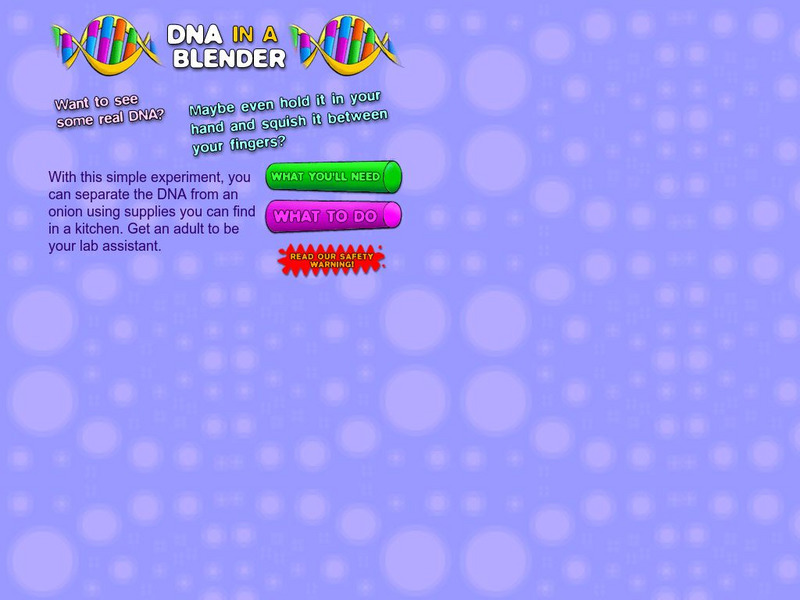
American Museum of Natural History: O Logy: Stuff to Do: Dna in a Blender
Follow these illustrated instructions to conduct a simple experiment in separating DNA from an onion!
Harvard University
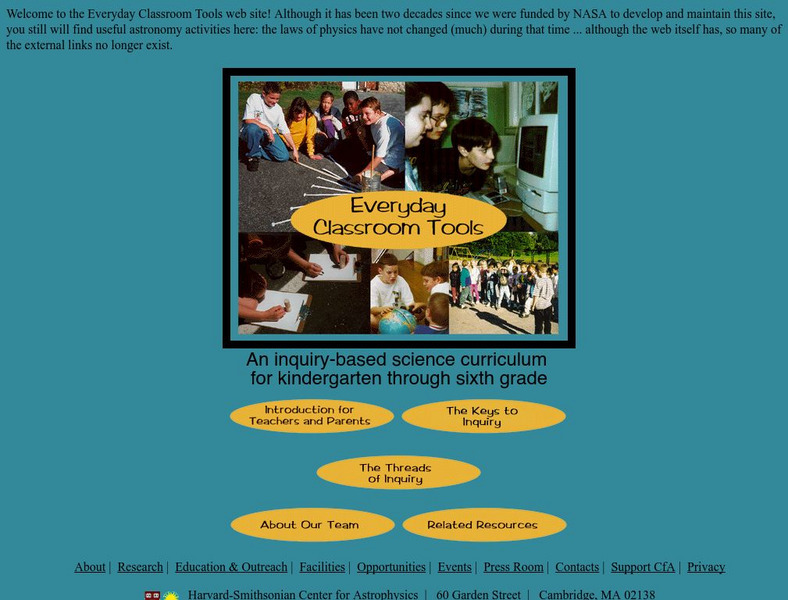
Harvard Smithsonian: Everyday Classroom Tools
The focus of this series of lessons is to engage students in an exploration of the world around them. The emphasis is on inquiry as students learn about the earth, sun, light, shapes and more.

Museum of Science
The Atoms Family
Let this classic family of monsters guide you as you learn about energy. Interactive exercises, experiments, and demonstrations help to build knowledge and raise questions.