Hi, what do you want to do?






Concord Consortium
Polarization
This is one cool resource for teaching about polarity! Chemistry scholars observe electron distribution and molecular shape as they select different non-metals and form bonds. The interactive offers two views, surface charge and electron...

Concord Consortium
Boiling Point of Polar and Non-Polar Substances
Go to extremes to illustrate boiling point! Junior chemists explore the effects of heating and cooling on polar and non-polar substances. The interactive allows users to raise and lower the temperature, set specific temperatures, and...

Concord Consortium
Molecular Sorting
Can scientists sort molecules based on their interaction with oil and water? The simulation demonstrates how this is possible. Pupils decide when to insert a molecule and observe how they sort themselves based on polarity.

Concord Consortium
Elements and Polarity
Take a look at some molecules that are so cool, they're polar! Scholars examine the effect polarity has on a molecule's shape and charge. Change up the view and choose between an opaque or transparent molecular surface, complete with...

Concord Consortium
Making Molecules
It's molecule magic! Skillful scholars explore the effects of different atoms on molecular polarization using an intuitive interactive. The resource displays the charge at different locations on the molecule, then adapts as the user...

Concord Consortium
Factors Affecting London Dispersion Attractions
How can non-polar molecules be attracted to one another? Introduce the phenomenon of London dispersion forces to young chemists through an entertaining interactive. Pupils choose from a variety of molecular shape combinations, then pull...

Concord Consortium
Boiling Point
Is it getting hot in here? Observe boiling from inside a beaker in an engaging interactive. Chemistry scholars heat and cool polar and non-polar solids and observe how molecules react to temperature changes. Your class' misconceptions...

Concord Consortium
Exploring Hydrophobic Core
How do the hydrophobic and hydrophilic regions of a protein affect its shape? Science scholars explore the molecular properties of protein molecules using a detailed interactive. The resource allows the user to rotate the protein, view...

Spark Notes
Review of Chemical Bonding: Review Test
This is an online exercise in which chemistry learners answer a series of multiple choice questions about bonding. Topics addressed include ionic and covalent bonds, electronegativity, ions, valence electrons, resonance structure, and...

Concord Consortium
Intermolecular Attractions and Boiling Point
Why do different substances have different boiling points? Through an interactive lesson, learners explore how intermolecular attractions affect boiling points. They interact with molecules through an animation and make conclusions about...

Chiral Publishing
Chiral Publishing: An Introduction to Chemistry: Predicting Molecular Polarity
This section in the online textbook describes how to tell if a molecule is polar or non polar. Detailed steps and examples are good references. Also find links to presentations and chapter maps for other chemistry topics.

Concord Consortium
Concord Consortium: Molecular Workbench Showcase: Chemistry, Chemical Bonds
Simulations to show students the nature of chemical bonds. Simulations include an explanation of stereochemistry, atomic orbitals, chemical polarity, formation of an atom, and a summary quiz.

Concord Consortium
Concord Consortium: Stem Resources: Molecular Self Assembly
A series of science simulations exploring how molecules assemble themselves and how scientists are learning to engineer their structure. Students will discover what patterns molecules form with interactive lessons. At the end there is a...
Concord Consortium
Concord Consortium: Elements and Polarity
Explore how polarity affects molecular shape and charge.
Concord Consortium
Concord Consortium: Molecular Workbench: Water and Polar Substances
Adjust amounts of ionic charges in this simulation to see how water molecules react to polar substances in solution.
Concord Consortium
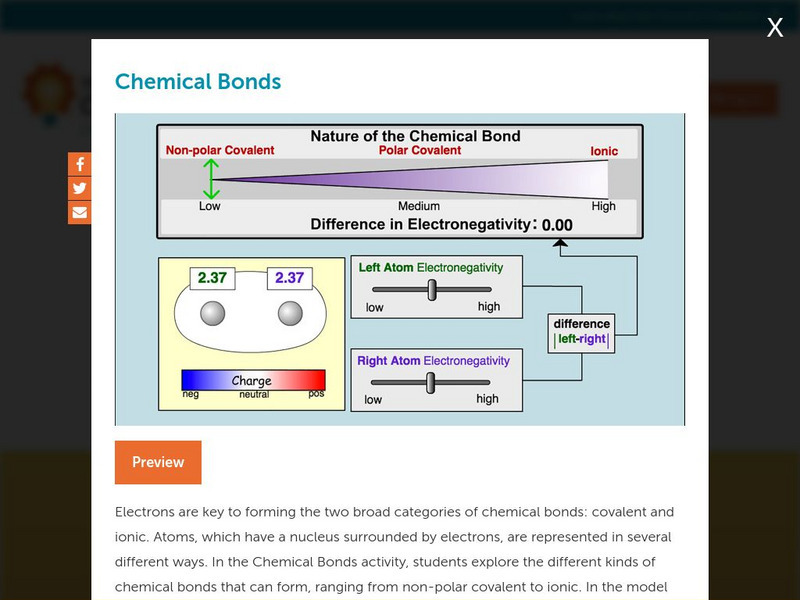
Concord Consortium: Stem Resources: Chemical Bonds
By working through this web-based activity, students differentiate between ionic, non-polar covalent, and polar covalent bonds. Specifically, distinctions are made between bonding types based on orbital shapes and electronegativity...
Concord Consortium
Concord Consortium: Polar and Nonpolar Interface
Observe how molecules with hydrophilic and hydrophobic regions move in a mixture of oil and water, and pay attention to changes in potential energy over time. Move and rotate the molecules to see how they interact with their surrounding...
Concord Consortium
Concord Consortium: Protein Folding
Generate all polar, all nonpolar, or random proteins and observe how the protein folds in response to these molecular properties. Explore how the potential energy of the system changes over time to draw conclusions about how proteins...
Concord Consortium
Concord Consortium: Oil and Water
Mix polar and nonpolar molecules together and observe changes in potential energy.
Concord Consortium
The Concord Consortium: Molecular Workbench: Hypocycloid
View a hypocycloid being created in this simulation.
Concord Consortium
Concord Consortium: Mixing Liquids
Experiment with mixing liquids and observing the volume they take up.
Concord Consortium
Concord Consortium: Micelles
Select an oil or water environment for molecules and observe how they are affected by interactions with their environment and each other.
Concord Consortium
Concord Consortium: Protein Folding Exploring
Discover how peptides fold into stable conformations.