Hi, what do you want to do?






Illustrative Mathematics
The Locker Game
Here is a learning activity that incorporates a classic puzzle in mathematics. Young mathematicians are guided through a series of statements that describe rounds of pupils opening and closing lockers. The first person opens all 20...

Inside Mathematics
Marble Game
Pupils determine the theoretical probability of winning a game of marbles. Individuals compare the theoretical probability to experimental probability for the same game. They continue on to compare two different probability games.

Curated OER
20 Tickets
A great hands-on activity involving adding and subtracting, beginner mathematicians determine how many games can be played with 20 tickets. Instead of tickets, youngsters use 20 counters or linking cubes to represent the amount of...

Curated OER
Number Rods
Working in a math center or an "I finished early" work station, young mathematicians will match in sequence pre-set-up rods of unifix cubes to numbers on a number line. To help differentiate tens from ones, use different colors to...

Curated OER
Five by Two
Help young mathematicians read and interpret numbers from 1 to 10 and sequence them correctly with this card game. Using a deck of cards and two to three classmates, have one player hand out ten cards to each gamer and then put the extra...

Illustrative Mathematics
Teen Go Fish
Kindergartners play the classic game Go Fish as they practice identifying numbers in the teens. A fun and engaging activity that develops number recognition skills in young learners. As added support, provide cards that include both the...

EngageNY
Ordering Integers and Other Rational Numbers
Scholars learn to order rational numbers in the seventh lesson in a series of 21. Reasoning about numbers on a number line allows for this ordering.

Inside Mathematics
Winning Spinners
Winning a spin game is random chance, right? Pupils create a table to determine the sample space of spinning two spinners. Individuals determine the probability of winning a game and then modify the spinners to increase the probability...

Illustrative Mathematics
Counting by Tens
With this daily counting activity, your kindergartners will master counting in sequence automatically from 0 to 100, and will count in multiples of ten to 100. With the whole class, count to 100. With each number, learners will whisper...

Mathematics Assessment Project
Lottery
A probability activity presents a lottery game as an idea for a fundraiser. Pupils analyze the game to determine the number of possible outcomes, then determine whether the game would be a good way to raise funds and to support...

California Education Partners
Four Square Wars
Obviously, four is the perfect number when you're playing Four Square. Scholars first use multiplication and division to solve a set of problems on the number of balls needed, the number of games, and the number of players required for a...

EngageNY
Estimating Probabilities by Collecting Data
Take a spin to determine experimental probability. Small groups spin a spinner and keep track of the sums of the spins and calculate the resulting probabilities. Pupils use simulated frequencies to practice finding other probabilities to...

EngageNY
Chance Experiments
Class members are introduced to probability using terms such as impossible, unlikely, likely, and certain. Numbers between zero and one are associated with the descriptions of probability. Pupils find the likelihood of chance experiments...
Primary Resources
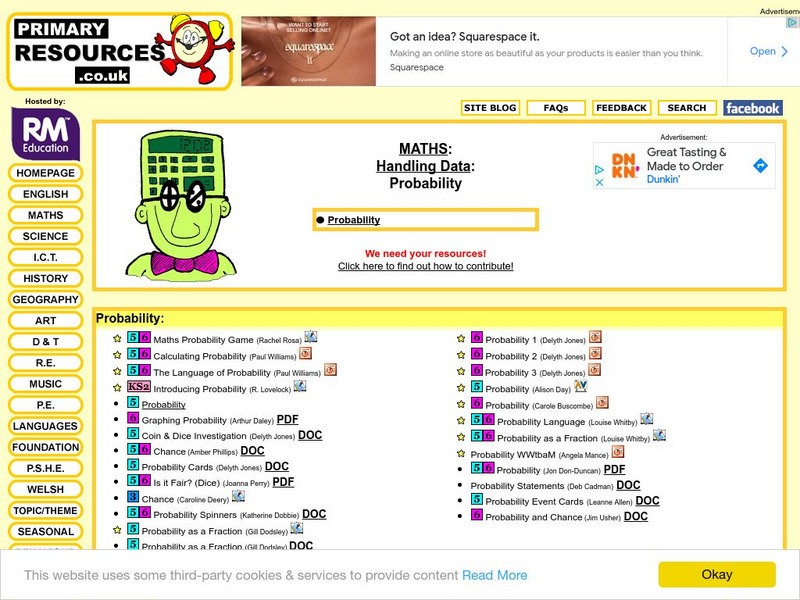
Primary Resources: Handling Data, Probability
Here's what you need to help you teach probability. Games, helpful hints, worksheets, PowerPoints, and presentations will help you make probability more "hands-on."