Hi, what do you want to do?






Illustrative Mathematics
The Geometry of Letters
Use the alphabet as a tool for teaching your class about geometric figures. Break apart capital letters into line segments and arcs. Classify angles as right, acute, or obtuse. Identify parallel and perpendicular lines. An excellent...

Curated OER
A Rectangle in the Coordinate Plane
A quadrilateral is drawn on the coordinate plane, and eighth grade geometers find the length of each side and the diagonals by applying the Pythagorean theorem.

Curated OER
Point Reflection
Use this task as an exit ticket for your eight graders during the geometry unit. All they need to do is identify the coordinates of a point reflected over y=2000.

Curated OER
Tangent Lines and the Radius of a Circle
Your Geometry learners will collaboratively prove that the tangent line of a circle is perpendicular to the radius of the circle. A deliberately sparse introduction allows for a variety of approaches to find a solution.

EngageNY
Three-Dimensional Space
How do 2-D properties relate in 3-D? Lead the class in a discussion on how to draw and see relationships of lines and planes in three dimensions. The ability to see these relationships is critical to the further study of volume and...

Illustrative Mathematics
Do Two Points Always Determine a Linear Function?
Your learners can approach this task algebraically, geometrically, or both. They analyze the building of a linear function given two points and expand the concrete approach to the abstract when they are asked to find the general form of...

EngageNY
Geometry Module 5: End-of-Module Assessment
The lessons are complete. Learners take an end-of-module assessment in the last installment of a 23-part module. Questions contain multiple parts, each assessing different aspects of the module.

EngageNY
Distance and Complex Numbers 2
Classmates apply midpoint concepts by leapfrogging around the complex plane. The 12th lesson in a 32 segment unit, asks pupils to apply distances and midpoints in relationship to two complex numbers. The class develops a formula to find...

Concord Consortium
Shooting Arrows through a Hoop
The slope makes a difference. Given an equation of a circle and point, scholars determine the relationship of the slope of a line through the point and the number of intersections with the circle. After graphing the relationship, pupils...

Noyce Foundation
Granny’s Balloon Trip
Take flight with a fun activity focused on graphing data on a coordinate plane. As learners study the data for Granny's hot-air balloon trip, including the time of day and the distance of the balloon from the ground, they practice...

EngageNY
Mid-Module Assessment Task - Geometry (Module 2)
Challenge: create an assessment that features higher level thinking from beginning to end. A ready-made test assesses knowledge of dilations using performance tasks. Every question requires a developed written response.

Noyce Foundation
Percent Cards
Explore different representations of numbers. Scholars convert between fractions, decimals, and percents, and then use these conversions to plot the values on a horizontal number line.

EngageNY
Similarity
Use the coordinate plane to show two figures are similar. The lesson incorporates congruence transformations and dilations to move a figure on to another figure. Pupils determine that if a similarity transformation exists...

Mathematics Assessment Project
Square
Don't be a square! Young mathematicians determine the slope and length of a line segment. They then prove whether four given coordinate points form a square.

Inside Mathematics
Graphs (2006)
When told to describe a line, do your pupils list its color, length, and which side is high or low? Use a worksheet that engages scholars to properly label line graphs. It then requests two applied reasoning answers.

EngageNY
Modeling Video Game Motion with Matrices 2
The second day of a two-part lesson on motion introduces the class to circular motion. Pupils learn how to incorporate a time parameter into the rotational matrix transformations they already know. The 24th installment in the 32-part...

Illustrative Mathematics
Slopes and Circles
An upper-level treatment of what is often presented as a basic concept (the right angle of an inscribed circle on the diameter), this activity really elevates the mathematical thought of the learner! Expected to develop formulas...

Mathed Up!
Mixed Transformations
Viewers learn how to identify and perform a variety of transformations with a video that provides seven items on transformations. Pupils demonstrate their understanding of dilations, reflections, rotations, and translations. The video...

Curated OER
Why Does SAS Work?
Your geometry learners are guided by questions that help them use the language of reflections to explain the Side-Angle-Side congruence between two triangles in this collaborative task. Given a sample solution, declaring the...

Noyce Foundation
Snail Pace
Slow and steady wins the race? In the assessment task, scholars calculate the rates at which different snails travel in order to find the fastest snail. Hopefully, your class will move much more quickly in finishing the task!
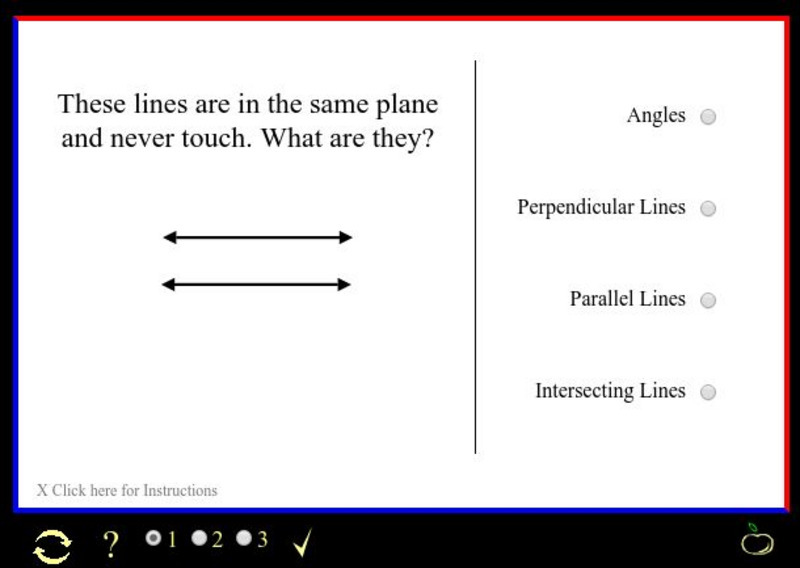
Mr. Martini's Classroom
Mr. Martini's Classroom: Basic Geometry: Points, Lines, and Angles
Students can review basic geometric terms using these self-check, multiple choice questions. Three levels of questions are provided.
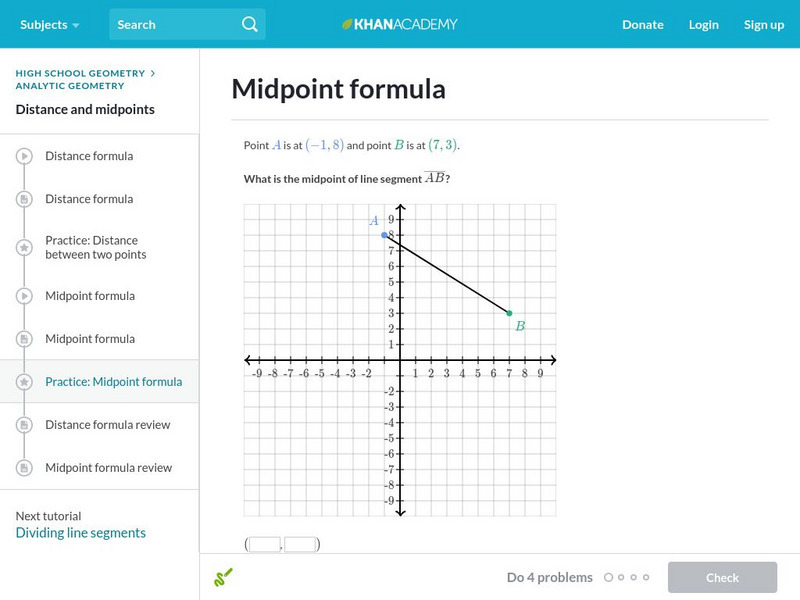
Khan Academy
Khan Academy: Midpoint Formula
Find the midpoint of a segment on the coordinate plane, or find the endpoint of a segment given one point and the midpoint. Students receive immediate feedback and have the opportunity to try questions repeatedly, watch a video or...