Hi, what do you want to do?






Texas State Energy Conservation Office
Investigation: Kinetic and Potential Energy
A well-developed lab sheet guides physical science learners through an investigation of kinetic and potential energy. In small groups, collaborators discover whether or not the ramp height or mass of an object has an effect on the...

Teach Engineering
Energy Storage Derby and Proposal
Small groups use the engineering design process to build and test a vehicle capable of carrying 250 grams a distance of five meters. The design must allow for the storage of potential energy and turn it into motion,...

Texas State Energy Conservation Office
Investigation: Conservation of Energy
By rolling marbles down a six-foot length of track, physical scientists determine how much energy is lost to heat. It is recommended that you opt for the foam pipe insulation track because more friction slows the marble, allowing...

Teach Engineering
Energy Forms and States Demonstrations
Does a tennis ball have energy? What about a bowling ball? Demonstrate concepts of different forms of energy forms and states with a variety of objects. Using the equations for potential and kinetic energy,...

American Chemical Society
Exploring Energy
When asked to list everyday objects that require energy, most people list technology that use batteries or electricity. Through hands-on exploration, young scientists discover energy is much more than just circuitry. They play with...

Teach Engineering
Ramp and Review (for High School)
Rolling for momentum. As part of a study of mechanical energy, momentum, and friction, class members experiment rolling a ball down an incline and having it collide with a cup. Groups take multiple measurements and perform...

Savvas Learning
Let's Get Moving
Scholars examine, cut, paste, and sort 12 images featuring different types of movement in order to show what they know about energy—potential and kinetic.

It's About Time
Defy Gravity
Test the limits of gravity while encouraging full class participation with this thrilling lesson. Pupils investigate the meaning of work and how it is equivalent to energy. They explore the joule and apply it as a unit of work. They...

James Dyson Foundation
Challenge Cards
Can you build it? Yes you can! This interactive game includes four design challenges presented on separate cards. The cards outline the challenges with limited restrictions but with an end goal in mind. The competitions include building...

TeachEngineering
Teach Engineering: Renewable Energy Living Lab: Power Your School
Students use real-world data to calculate the potential for solar and wind energy generation at their school location. After examining maps and analyzing data from the online Renewable Energy Living Lab, they write recommendations as to...
TeachEngineering
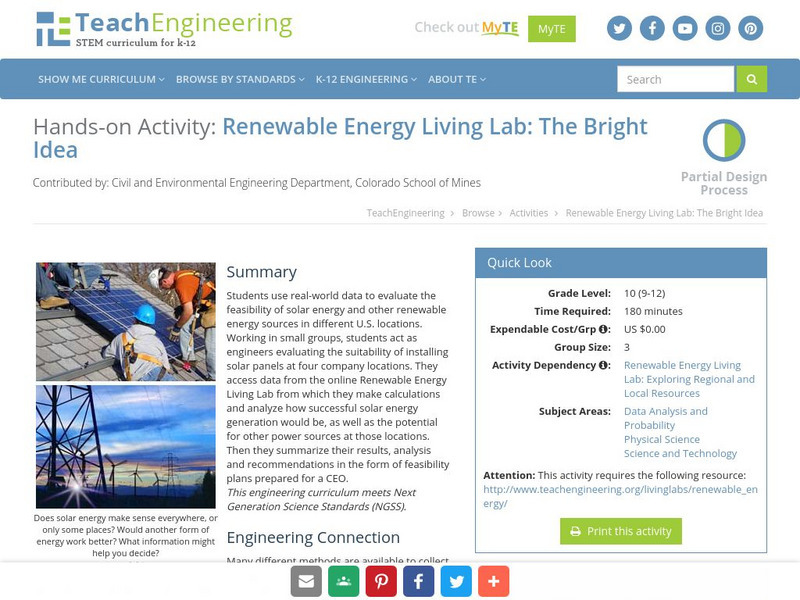
Teach Engineering: Renewable Energy Living Lab: The Bright Idea
Students use real-world data to evaluate the feasibility of solar energy and other renewable energy sources in different U.S. locations. Working in small groups, students act as engineers evaluating the suitability of installing solar...
TeachEngineering
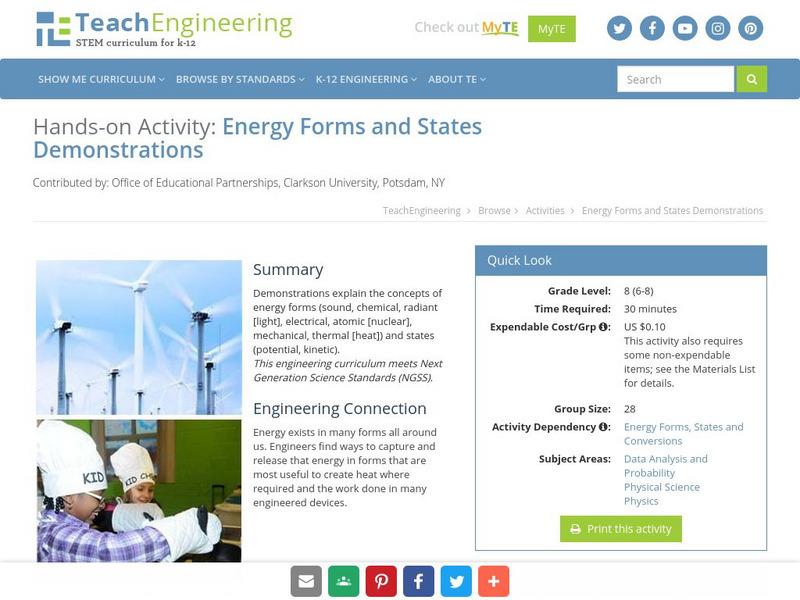
Teach Engineering: Energy Forms and States Demonstrations
Demonstrations explain the concepts of energy forms (sound, chemical, radiant [light], electrical, atomic [nuclear], mechanical, thermal [heat]) and states (potential, kinetic).
Science Buddies
Science Buddies: The Height Limits and Linearity of Bouncy Balls
You might think that plants and animals have little in common with batteries, springs, or slingshots, but they actually do have something in common. Both living and non-living things store and transfer energy from one form to another. In...
TeachEngineering
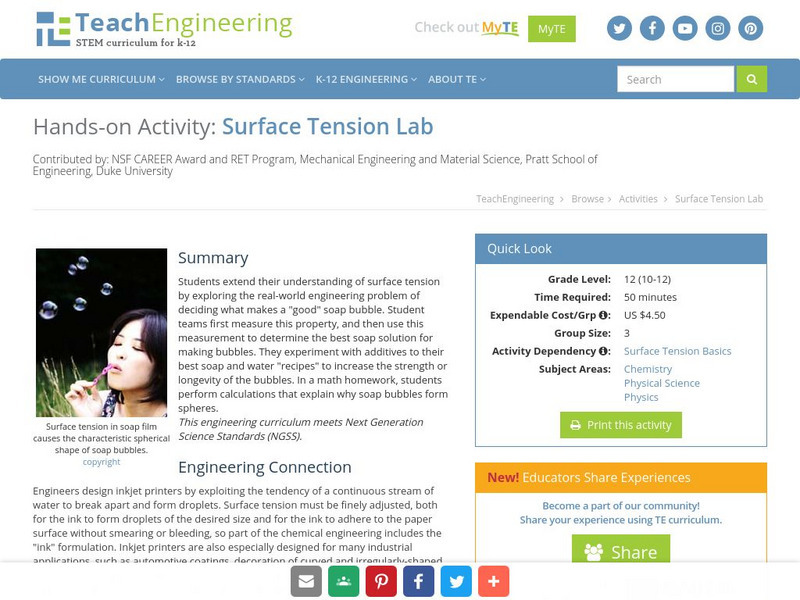
Teach Engineering: Surface Tension Lab
Students extend their understanding of surface tension by exploring the real-world engineering problem of deciding what makes a "good" soap bubble. Student teams first measure this property, and then use this measurement to determine the...

Museum of Science
The Atom's Family: Radiometer
Help Dracula find out about light waves by using a virtual radiometer.