Hi, what do you want to do?






Core Knowledge Foundation
Animals and Habitats Tell It Again!™ Read-Aloud Anthology
A read-aloud anthology explores various habitats and the animals that inhabit them, from the Artic to the desert, the forest, and bodies of water. First graders listen to and discuss texts and complete word work. Each lesson offers...

Lerner Publishing
Teaching Habitats
What makes up a habitat? Use this resource to engage first graders in the exploration of desert, wetland, forest, and ocean habitats. Youngsters classify plants and animals into the four distinct habitats through drawings and cutting and...

National Geographic
Animal Habitats
Explore animal habitats and reinforce speaking, listening, reading comprehension, and writing skills with a unit that focuses on the Arctic, desert, ocean, prairie, and rainforest. Enthusiastic scientists read informational text to...

Curated OER
Sustainability and Extinction
Galapagos Penguins are the only penguins on earth that live north of the equator (in the wild). In this last lesson plan a discussion on how the Galapagos islands developed their populations and diversity sparks the introduction. Two...

Purdue University
Mammals and Ecosystems
Mammals have unique interactions with their ecosystems. Using a multi-part lesson, learners research local mammals using recommended websites and use their findings to create their own paper ecosystems including appropriate mammals. They...

Houghton Mifflin Harcourt
Animal Adventures: Challenge Activities (Theme 6)
Challenge learners who have mastered the basic concepts in the Houghton Mifflin Harcourt thematic units on animal adventures with the activities and exercises suggested in this packet packed with ideas.

Core Knowledge Foundation
Ecology Tell It Again!™ Read-Aloud Anthology
A read-aloud anthology provides informational texts about ecology to boost reading comprehension. Third-graders listen and discuss readings where they answer questions and focus on vocabulary. Pupils complete extension activities,...

Purdue University
Reptiles, Amphibians, and the Scientific Method
What do a reptile and an amphibian have in common? A three-part lesson allows scholars to investigate the similarities and differences between the two types of animals by identifying specific body parts. The lesson highlights the...

Columbus City Schools
Get Your Organisms Organized
From large to small, show your class how to organize them all! Included within the guide is everything you need to take their knowledge of classification from the cellular to the species level. The worksheets focus on...

BioEd Online
Butterflies in Space
How does gravity affect the life cycle of a butterfly? Learn first-hand what types of investigations astronauts perform in space by following along with one of NASA's experiments. Create butterfly habitats in the classroom with specific...

National Wildlife Federation
Night Friends - American Bats
Bats are a misunderstood species. Pupils learn about the characteristics of bats in a three-part lesson. They begin by examining the adaptations of different types of bats, then explore the misconceptions humans have about the species....

Purdue University
The Great Clearcut Controversy
Urban development and habitat retention are often at odds. A three-part lesson examines the pros and cons of forest clearcutting. Learners review data and characteristics of a specific mammal to make conclusions about the effect...

Association of Fish and Wildlife Agencies
Schoolyard Biodiversity Investigation Educator Guide
In 1980, in the tropical rainforests of Panama, scientists discovered 1,200 species of beetles living in and around just 19 trees, with most of the species new to science—that's biodiversity! In the activity, learners work in teams to...

Curated OER
Habitats of the World
Students complete a unit of eighteen lessons that cover climate, geography, location, plants, and animals of each of the five habitats. They are also introduced to habitat destruction and discuss ways to protect the environment. They do...

Curated OER
Exploring Habitats
Students analyze the difference between the human habitat and the different habitats of animals in the six lessons of this unit. The students' imaginations and literature are used to explore important aspects of the living environments...

Curated OER
Fiction Stories
Students complete writing activities for fiction. In this fiction writing lesson, students complete four sets of activities in a writer's workshop format to practice reading and writing in a fiction style. Students develop plot outlines,...
E-learning for Kids
E Learning for Kids: Science: Easter Island: What Can We Find in a Pond?
Explore Easter Island in this module to learn about the animals and their habitats.
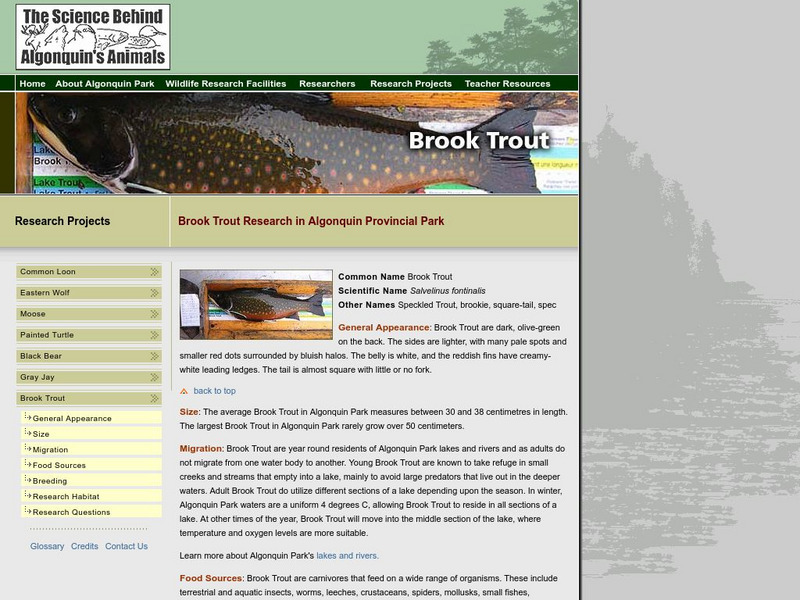
Friends of Algonquin Park
The Science Behind Algonquin's Animals: Brook Trout
Learn about the Brook Trout's appearance, size, migration, food sources and breeding as well as the answers to other interesting research questions. Included is a video showing the capturing and marking of a Brook Trout and an...
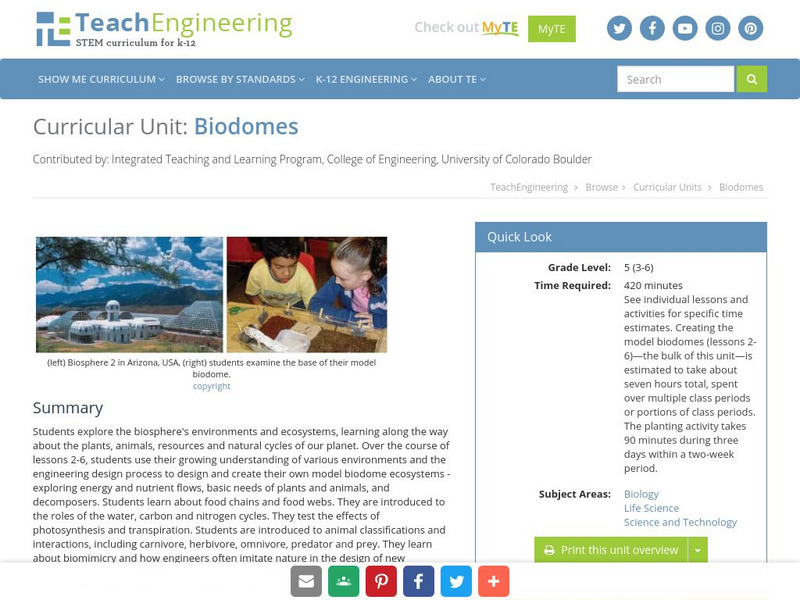
TeachEngineering
Teach Engineering: Biodomes
Students explore the biosphere's environments and ecosystems, learning along the way about the plants, animals, resources and natural cycles of our planet. Over the course of lessons 2-6, students use their growing understanding of...
E-learning for Kids
E Learning for Kids: Science: Nova Zembla Expedition: How Are Different Organisms Suited to Their Habitats?
Alex and Foxy White are walking around looking at animals and learning about their habitats. Join them on their expedition.
![De Paul University: Center for Urban Education: Prairie Changes [Pdf] Unit Plan](https://static.lp.lexp.cloud/images/attachment_defaults/resource/large/FPO-knovation.png "De Paul University: Center for Urban Education: Prairie Changes [Pdf] Unit Plan")
Polk Brothers Foundation Center for Urban Education at DePaul University
De Paul University: Center for Urban Education: Prairie Changes [Pdf]
"Prairie Changes" is a one page, nonfiction passage about the changes in the prairie over time and the effect it has on plants, animals, and habitats. It is followed by an open-ended question which requires students to provide evidence...
E-learning for Kids
E Learning for Kids: Science: Hawaii: What Can We Find in a Garden?
Daisy is learning all about the animals and plants that live in her beautiful garden. Join her and learn about habitats, too.
Wonderville Media
Wonderville: Ocean Habitats
Habitats are places where plants and animals live. There are many different habitats in the oceans of the world. Every plant and animal in the ocean prefers a particular habitat. Learn about Ocean Habitats in this well-constructed...
E-learning for Kids
E Learning for Kids: Science: Pacific Ocean: What Can We Find on a Beach?
Josephine lives on the Marshall Islands. Follow her to the beach and find out what kinds of plants and animals live there.