Hi, what do you want to do?






Teach Engineering
Building-Testing-Improving Paper Airplanes: Head's Up!
Take foldables to all new heights. Pupils build and fly different types of paper airplanes in the 14th portion of a 22-part unit on aviation. Groups collect data on distance and flight time for each plane and compare the data from the...

Teach Engineering
Equal and Opposite Thrust in Aircraft: You're a Pushover!
It's the law—every action requires a reaction, no matter how small. Pupils experience two demonstrations of Newton's third law of motion as it relates to thrust in the 10th segment of a 22-part unit on flight. Using their mathematical...

Teach Engineering
Better By Design
Which modification is the best? Using the scientific method, pairs determine the effects of each control surface on the distance of a glider's flight. The activity, section 16 in a 22-part unit on aviation, allows pupils to gain a better...

Teach Engineering
Egg-cellent Landing
The classic egg-drop experiment gets a new bounce with an activity that asks pairs to design a lander similar to one used to land a rover on Mars within a fixed budget. The activity provides a great introduction to the idea of...

Teach Engineering
What a Drag!
Stop and drop what is in your hand! Pupils investigate how form effects drag in the 12th part of a 22-part unit on aviation. Groups create equally weighted objects and determine which one falls the fastest by collecting data.

PBS
Reading Adventure Pack: Flight
A Reading Adventure pack focuses on the invention of flight. After reading a fiction and nonfiction book, scholars take their newfound knowledge to design a one-passenger flying device, experiment with different types of paper airplanes...


Noyce Foundation
Movin 'n Groovin
Examine the consequences of varying speed. An engaging set of five problem sets challenges young mathematicians by targeting a different grade level from K-12. In the initial lesson, scholars make conclusions about the time it...

Exploratorium
Balancing Ball
Demonstrate lift to the class that is studying aerodynamics. In the stream of air produced by a blow dryer, little physicists place a wad of tissue paper and a spherical figure to compare. Or, if you have a vacuum cleaner and beach ball,...

Perkins School for the Blind
Design and Problem Solving
What if you had a design problem you wanted to solve, but were unable to draw because you were unable to see? Teach your learners with visual impairments that they can use Wikki Stix®, a braille ruler, Legos®, and Constructo Straws to...

Teach Engineering
An Inflated Impression of Mars
Help your class understand the magnitude of the distance between Earth and Mars with an activity that asks small groups to use balloons to create scale models of the Earth, Moon, and Mars. Class members figure out the distances...

Chandler Unified School District
Art Masterpiece—Leonardo da Vinci Inventions
After getting to know the inventor, Leonardo da Vinci and his many inventions, scholars think up their own invention. Following a written description and a hand-drawn picture, learners use a method of mirror writing and antiquing to give...
![Federal Aviation Administration: Air Takes Up Room [Pdf] Activity](https://statictemp.lp.lexp.cloud/images/attachment_defaults/resource/large/FPO-knovation.png "Federal Aviation Administration: Air Takes Up Room [Pdf] Activity")
Other
Federal Aviation Administration: Air Takes Up Room [Pdf]
See how air takes up space by conducting this classroom experiment. With the aid of several common objects, observe the effects of air pressure.
Other
Federal Aviation Administration: Anti Gravity Marble [Pdf]
This experiment examines Newton's Second Law of Motion. Learn how centrifugal and centripetal force help to keep a marble in a can when turned upside down.
Texas Instruments
Texas Instruments: Numb3 Rs: Experimenting With Paper Airplanes
Based off of the hit television show NUMB3RS, this "fun" lesson has students creating paper airplanes and testing different variables (weight, wings, etc.) to see what type of plane flies the best. Data Analysis and imagination are both...
Science Buddies
Science Buddies: Project Ideas: How to Make an Aircraft Invisible to Radar
In this engineering science fair project, students will determine which 3-D geometric shapes scatter light the most. The Science Buddies project ideas are set up consistently beginning with an abstract, objective, and introduction,...

Library of Congress
Loc: Helicopters, the Multi Mission Aircraft
Delve into these videos and audio interviews conducted of several U.S. veterans regarding their experiences served as part of helicopter crews during various combat operations.
Science Buddies
Science Buddies: Why Winglets?
Make a paper airplane and experiment with adding winglets to it to test its performance. The Science Buddies project ideas are set up consistently beginning with an abstract, objective, and introduction, followed by a section on terms,...

PBS
Pbs: American Experience: Fly Girls: Bessie Coleman
A biography of the first African American female pilot, Bessie Coleman (1892-1926).
Science Buddies
Science Buddies: Winglets in Wind Tunnels
Have you noticed the little wing projections on the wings of jets? This Science Buddies project helps you understand whether these fins help stabilize airplanes. The Science Buddies project ideas are set up consistently beginning with an...
Exploratorium
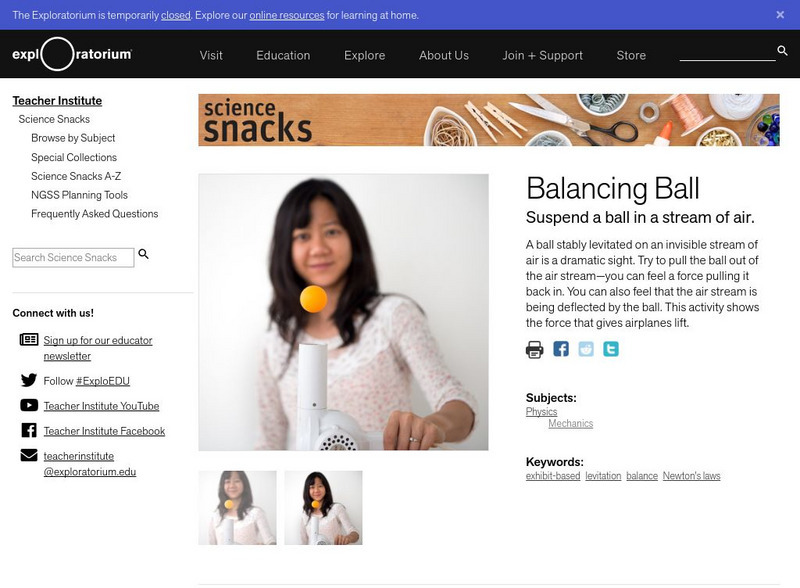
Exploratorium: Science Snacks: Balancing Ball
Experience the same lift that flies airplanes with this activity where you suspend a ball in a stream of air. This activity illustrates Bernoulli's principle.
Exploratorium
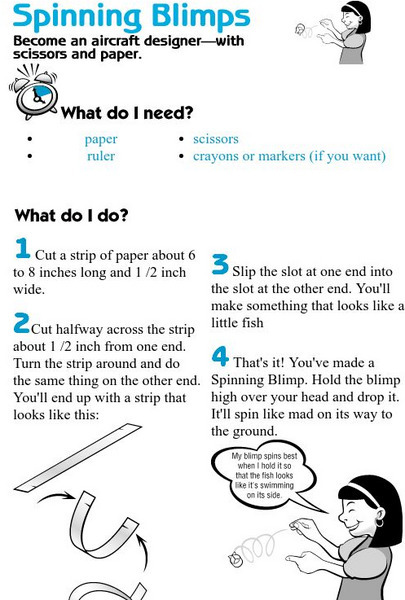
Exploratorium: Spinning Blimps
Students create a blimp and then experiment with the design to improve its aerodynamics.

Exploratorium
Exploratorium: Roto Copter
Students can experiment with a home-made helicopter that lets them change the blades to see how real aerodynamics work.
PBS
Pbs Learning Media: Engineer a Jetliner
In this interactive lesson, students will experience the engineering design process as an aerospace engineer assigned to design and test an airplane.