Hi, what do you want to do?






Concord Consortium
Squares and Cubes
The task is simple, but the solution is a little more complex. Learners must find the smallest number that results in a perfect square when multiplied by two and a perfect cube when multiplied by three. The task requires an analysis...

EngageNY
Existence and Uniqueness of Square Roots and Cube Roots
Teach cube roots by building on an understanding of square roots. The third installment of a 25-part series asks learners to solve simple quadratic and cubic equations using roots. Scholars compare square roots and cube roots throughout...

Mathed Up!
Factors, Multiples, and Primes
Reinforce the concept of factors, multiples, and prime numbers with a 16-problem practice worksheet. Eight pages offer a variety of problem solving opportunities with clear objectives and tips for successful completion.

EngageNY
Comparing Irrational Numbers
Build on your classes' understanding of irrational numbers by comparing their values. The 13th lesson in the 25-part module has individuals estimate values of both perfect and non-perfect roots. They finish by graphing these numbers on a...

McGraw Hill
Adding and Subtracting Radicals
Help remove some of the confusion surrounding the addition and subtraction of radical numbers with this set skills practice problems. Taken straight from the pages of a math text book, this resource provides learners with...

Odell Education
Translate and Evaluate
Translate, evaluate, educate. Discover how to translate and evaluate expressions. Young mathematicians first review words and phrases that indicate operations and learn to write algebraic expressions from verbal descriptions....

CK-12 Foundation
Whole Number Exponents: Teddy Bear Box
Five questions—multiple-choice, fill in the blank, and discussion—make up an interactive that challenges scholars to mail a teddy bear using the smallest box possible without squishing it. A box with movable sides allows mathematicians...

Del Mar College
Exponential and Radical Rules
So many rules and so little time. Make it easy and provide all the exponent and radical rules in one place as an easy reference guide. All of the properties come with several examples to show how the rules apply to different problems.

Charleston School District
Evaluation of Roots
You mean the square root of five and five don't have the same value? Learners estimate the value of irrational roots. As they practice estimating the value, they increase their understanding of roots. The lesson is the fourth in a series...

Curriculum Corner
Spring Fling Math and Literacy Centers
Fling your class into spring with a set of math and literacy center worksheets. Learners will enjoy the variety with sheets that practice multiplication, missing addends, before/after and more/less than number comparisons, as well...

EngageNY
Mastering Factoring
Math class is full of drama—there are so many problems to work out! Pupils work out factoring problems. They use quadratic methods of factoring higher degree polynomials, in addition to factoring the sum and difference of two...

Noyce Foundation
Pizza Crusts
Enough stuffed crust to go around. Pupils calculate the area and perimeter of a variety of pizza shapes, including rectangular and circular. Individuals design rectangular pizzas with a given area to maximize the amount of crust and do...

EngageNY
Roots of Unity
Visualize the nth roots of unity. Pupils calculate the nth roots of unity and find all n roots. Learners plot the solutions in the complex plane and observe that they are the vertices of a regular n-gon inscribed in the unit circle....

World Wildlife Fund
Shapes
Investigate the properties of three-dimensional figures with this Arctic-themed math lesson. Beginning with a class discussion about different types of solid figures present in the classroom, young mathematicians are then given a...

EngageNY
Analyzing a Graph
Collaborative groups utilize their knowledge of parent functions and transformations to determine the equations associated with graphs. The graph is then related to the scenario it represents.

Oregon Department of Education
Building Number Sense
It's never too early to begin a child's math education. This collection of fun hands-on activities engage youngsters in building their number sense as they learn how to count objects, identify numerals, compare amounts, and much more.

Primary Resources
Venn Diagrams
Combine your lessons on Venn diagrams, probability, and multiples with several activities. After picking seven cubes, learners note the number of cubes that are blue and mark them in a Venn diagram. The next assignments prompt them...

Math Wire
Gingerbread Man Combinations
Gingerbread men are just like us—they're unique! Discover how many combinations are possible when constructing a gingerbread man with several choices for shapes and colors of eyes, noses, and buttons.

Odell Education
Factoring
Uncover the relationship between factoring quadratics and higher degree polynomials. Learners develop their factoring skills through repetition. A comprehensive lesson begins with quadratics and shows how to use the same patterns to...

EngageNY
Exponents
Powered up! Here's a great resource on exponents. Scholars build on their previous understanding of exponents to include all positive real number bases. Distinguishing between an and a^n is a major goal in the fifth lesson of a 36-part...

Odell Education
Order Up!
Order in the math class! Scholars learn to evaluate expressions using the order of operations. A game has them rolling number cubes to determine numbers to use when evaluating.

Khan Academy
Khan Academy: Square and Cube Challenge
Practice solving problems using your knowledge of square and cube roots. Students receive immediate feedback and have the opportunity to try questions repeatedly, watch a video, or receive hints.
Khan Academy
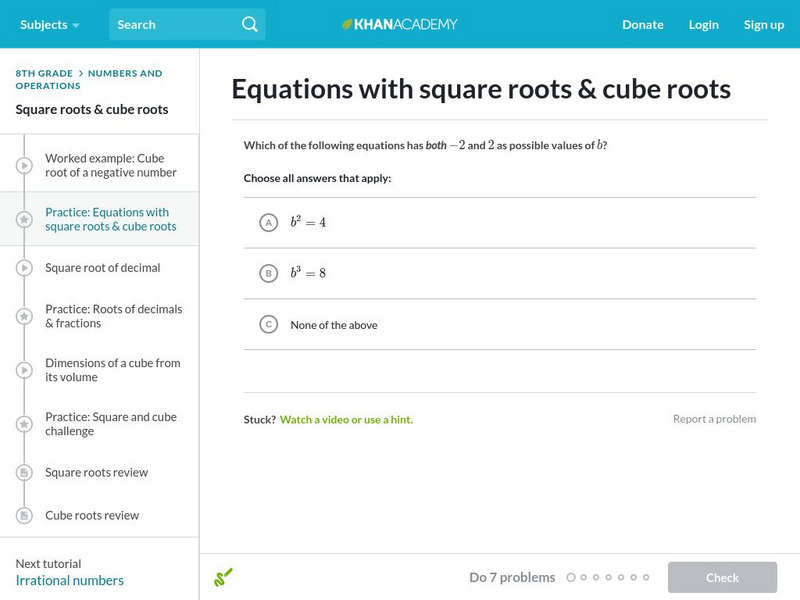
Khan Academy: Equations With Square Roots and Cube Roots
Practice solving equations by squaring or cubing both sides. Students receive immediate feedback and have the opportunity to try questions repeatedly, watch a video, or receive hints.

Fun Brain
Fun Brain: Tic Tac Toe Squares (Math Facts Games)
Players practice adding, subtracting, multiplying, and dividing skills while playing virtual Tic Tac Toe. They can also try their hand at squares, cubes, and square roots.