Hi, what do you want to do?






iCivics
Win the White House
What does it take to win the White House? A video game allows young political operatives to try their hand at winning 1600 Pennsylvania Avenue by deciding on key issues, where and how to spend campaign dollars, and the role of polling...

Constitutional Rights Foundation
U.S. Immigration Policy and Hitler’s Holocaust
Though the Statue of Liberty welcomes political refugees to her shores, the welcoming sentiment has not always been reflected in the American citizenry. High schoolers read about the regrettable period in United States history...

ProCon
Electoral College
The Electoral College's role in elections is sometimes confusing and controversial. Pupils use a debate topics website to research the pros and cons of the practice to debate whether the United States should still use the Electoral...

iCivics
Win the White House
Here is a unique and engaging approach to learning about the steps a presidential candidate must take during a campaign. Learners role play the part of a candidate in this online interactive, taking part in a presidential...

ProCon
Obamacare
Former President Barack Obama reformed the United States' health care system with Obamacare, but is the new legislation good for America? Scholars read a historical timeline about the passage of health care reform laws and compare United...

iCivics
Candidate Evaluation
How can we decide between candidates on election day? After contemplating various issues and qualities, your learners will go through a step-by-step process of researching and evaluating sample candidates and determining their...
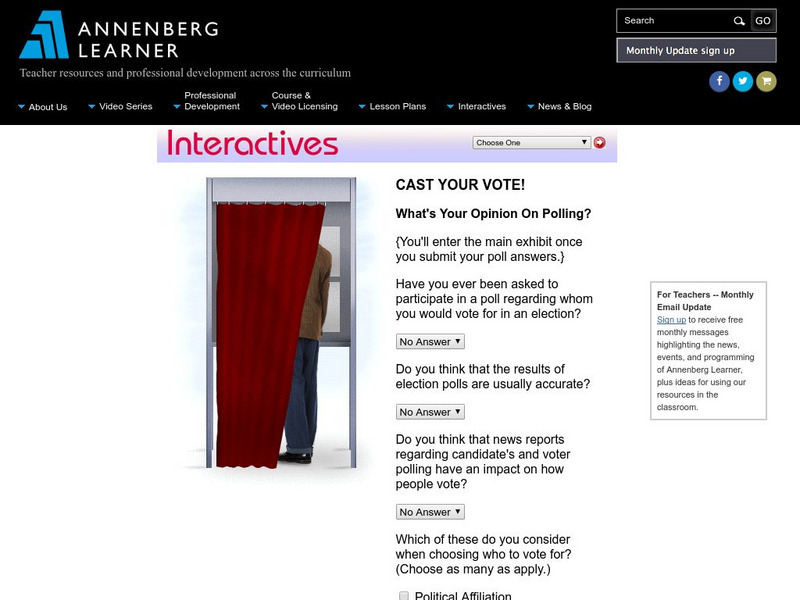
Annenberg Foundation
Annenberg Learner: Interactives: Cast Your Vote!
Upper elementary, middle, and high school students can use this exhibit to get an understanding of how polls and elections are conducted. The discussion includes random samples, margins of error, and other concepts related to statistics.