Hi, what do you want to do?






EngageNY
Margin of Error When Estimating a Population Proportion (part 1)
Use the power of mathematics to find the number of red chips in a bag — it's a little like magic! The activity asks learners to collect data to determine the percentage of red chips in a bag. They calculate the margin of error and...

EngageNY
Margin of Error When Estimating a Population Mean (part 1)
We know that sample data varies — it's time to quantify that variability! After calculating a sample mean, pupils calculate the margin of error. They repeat the process with a greater number of sample means and compare the results.

EngageNY
Margin of Error When Estimating a Population Mean (part 2)
Don't leave your classes vulnerable in their calculations! Help them understand the importance of calculating a margin of error to represent the variability in their sample mean.

EngageNY
Margin of Error When Estimating a Population Proportion (part 2)
Error does not mean something went wrong! Learners complete a problem from beginning to end using concepts developed throughout the last five lessons. They begin with a set of data, determine a population proportion, analyze their result...

Curated OER
Algebra Cheat Sheet
Full of info, this handout provides the rules, properties, and common mistakes found in an algebra course. This cheat sheet is a great resource for those hard-to-remember exponent rules and hyperbola equations, along with everything else...

EngageNY
Building Background Knowledge: Vietnam as a “Battleground in a Larger Struggle”
Read. Stop. Think. Scholars use a reading strategy to process the challenging text, "The Vietnam Wars." They read a paragraph and then stop to think about the text and its meaning. Readers then go on to work with partners and make notes...

Illustrative Mathematics
Paper Clip
With minimal setup and maximum freedom, young geometers are encouraged to think outside the box on a seemingly simple application problem. Though the task seems simple, measuring a given paper clip and finding how many 10 meters can...

EngageNY
Researching about the Red Cross, Continued: Who Is the Red Cross and What Does This Multinational Organization Do?
Code red! Learners read an informational article about the Red Cross, discussing the gist of the text in small groups. On a three-column note catcher, pupils take notes to show how the Red Cross functions as a multinational aid...

EngageNY
Building Background Knowledge: The Internment of Japanese-Americans during WWII, Part 2
Scholars learn about primary sources with a Primary Sources: Japanese-American Internment during World War II packet. Pupils work with a partner to read challenging sources in the packet while making notes in the margins. They then...

Curated OER
Rational Number Project
Infuse your unit on fractions, decimals, and operations with a thorough module about rational numbers. With a teaching guide, learner examples, templates for instruction, and lesson rationale, the module is a solid way to...

Illustrative Mathematics
Computations with Complex Numbers
This quick set of problems provides a brief refresher on the arithmetic of complex numbers. Learners need to multiply, add and subtract, and remember features of i when raised to a power. Included solutions are clear enough that...

EngageNY
Evaluating Reports Based on Data from a Sample
Statistics can be manipulated to say what you want them to say. Teach your classes to be wise consumers and sort through the bias in those reports. Young statisticians study different statistical reports and analyze them for...

K12 Reader
Using Prior Knowledge
Sometimes it's hard to relate to a new text. Teach kids to use their prior knowledge when reading something new with a comprehension exercise. A short passage tells them how to think of their brains like filing systems, and provides five...

Curated OER
The Lion, the Witch and the Wardrobe: Me Test
Get to know your scholars with this in-depth survey that asks learners to rate, answer true or false, write short answers, and draw abstract visuals about their academic and personal preferences.
Texas Education Agency
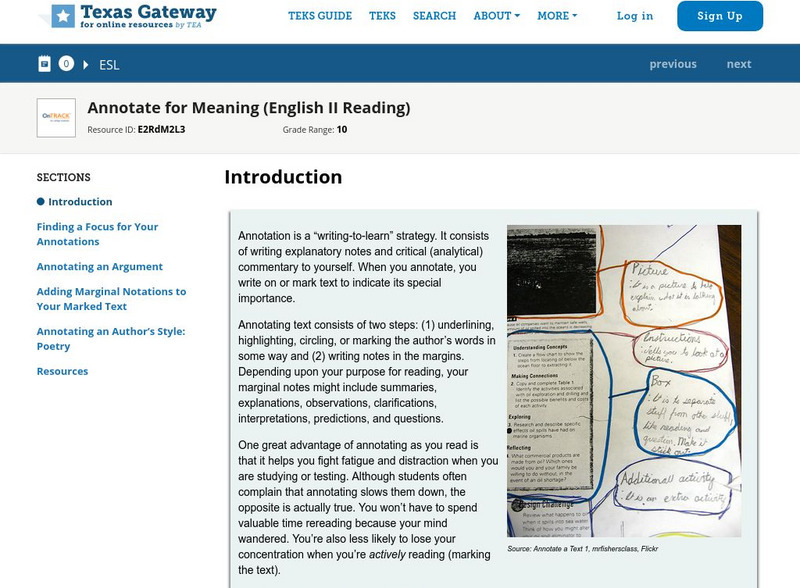
Texas Gateway: Reading Comprehension Across Genres: Annotate for Meaning
This lesson focuses on Annotation, a "writing-to-learn" strategy. It consists of writing explanatory notes and critical (analytical) commentary to yourself. Annotating text consists of two steps: (1) underlining, highlighting, circling,...
Texas Education Agency
Texas Gateway: Annotate for Meaning
This lesson focuses on annotating or marking text to enhance understanding. It offers tools and techniques for marking text including adding marginal notes to annotated pages.
Texas Education Agency
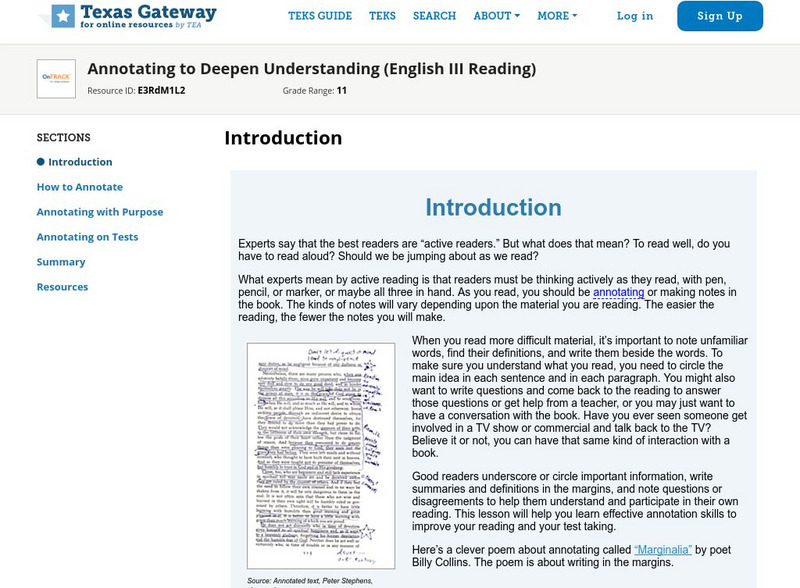
Texas Gateway: Annotating to Deepen Understanding (English Iii Reading)
Good readers underscore or circle important information, write summaries and definitions in the margins, and note questions or disagreements to help them understand and participate in their own reading. This lesson will help you learn...
Texas Education Agency
Texas Gateway: Annotate for Meaning (English I Reading)
This lesson focuses on annotation including the tools and techniques for marking texts, annotating for meaning in a story, and adding marginal notations to your marked text.
Texas Education Agency
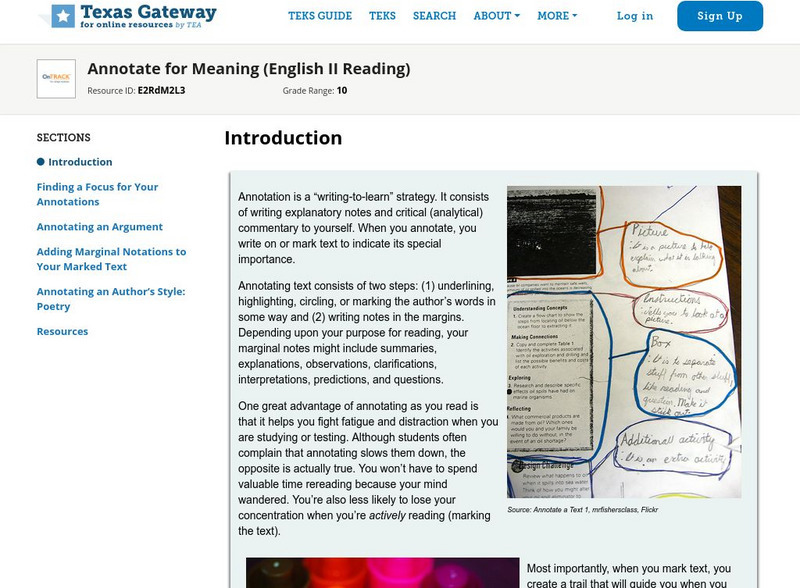
Texas Gateway: Annotate for Meaning (English Ii Reading)
This lesson focuses on annotating text to aid in understanding of the text including annotating an argument and poetry. It also provides tools and techniques for marking text.