Hi, what do you want to do?






Classroom Law Project
What does the Constitution say about voting? Constitutional Amendments and the Electoral College
As part of a study of voting rights in the US, class members examine Constitutional amendments connected with voting and the role of the Electoral College in the election process.

Classroom Law Project
What are some of today’s voting issues? Voting in Oregon, youth vote, and technology
The youth vote. Rock the Vote. Vote-By-Mail. Electronic voting. Class members investigate issues facing today's voters, and the ways they have adapted over the years to optimize voter turnout.

Deliberating in a Democracy
Voting
Young scholars read about voting rights and compulsory voting in democracies. For this voting rights lesson plan, young scholars analyze the reasons for supporting and opposing compulsory voting and discuss whether compulsory voting is...

Classroom Law Project
What do cartoonists see in this election?
Cartoons from the 2008 Presidential election provide the text for a lesson designed to help learners understand how political cartoonists use persuasive techniques to present a point of view.

Classroom Law Project
What is a class hearing and youth summit and what do they have to do with the presidential election?
After researching the presidential election process, class members develop questions and interview voters about their choice of candidate and the issues that concern them.

ProCon
Voting Machines
Does technology always mean advancement? Scholars take a close look at the use of voting machines. Does using a machine make voting more effective? Readers consider the advantages and disadvantages of the current voting process. They...

Middle Tennessee State University
Fights, Freedom, and Fraud: Voting Rights in the Reconstruction Era
As part of a study of post Civil War era, young historians investigate the changes in voting rights during the Reconstruction Era (1863-1876), the fraud involved in the Hayes-Tilden presidential election of 1876, and efforts by Pap...

C-SPAN
2016 Electoral College Map
The electoral college can be confusing for citizens of any age. Clear up misconceptions with a handy printable map that details how many electoral votes are allotted to each state, as well as a history of modern elections, complete with...

ProCon
Voting Age
Should age matter when it comes to voting? Scholars read an article discussing the pros and cons of lowering the voting age to 16. They then consider both the advantages and disadvantages of having younger voters. After thinking about...

ProCon
Electoral College
The Electoral College's role in elections is sometimes confusing and controversial. Pupils use a debate topics website to research the pros and cons of the practice to debate whether the United States should still use the Electoral...

Classroom Law Project
How do we hire a President?
What are the job requirements for the office of president of the United States? What attributes should a candidate possess? Are the qualities needed to govern the same as those needed to win? What can an analysis of the...

ProCon
President Ronald Reagan
At 69 years old, Ronald Reagan was the oldest man ever to be elected president in the United States. After reviewing a thorough history of Reagan's presidency, pupils read the main pro and con arguments to determine if he was a good...

Duke University
Duke University Libraries: Election of 1968
Comprehensive information on the election of 1968 which was a three party race with no incumbent. Content includes the candidates, the issues, the vote, and what happened as a result of the election.

Library of Congress
Loc: Today in History: November 4: Election Day
Learn about the history of November 4, which is an election day in the United States. Includes a discussion of presidential elections in the nineteenth century, and women's struggle to obtain the right to vote.
The White House
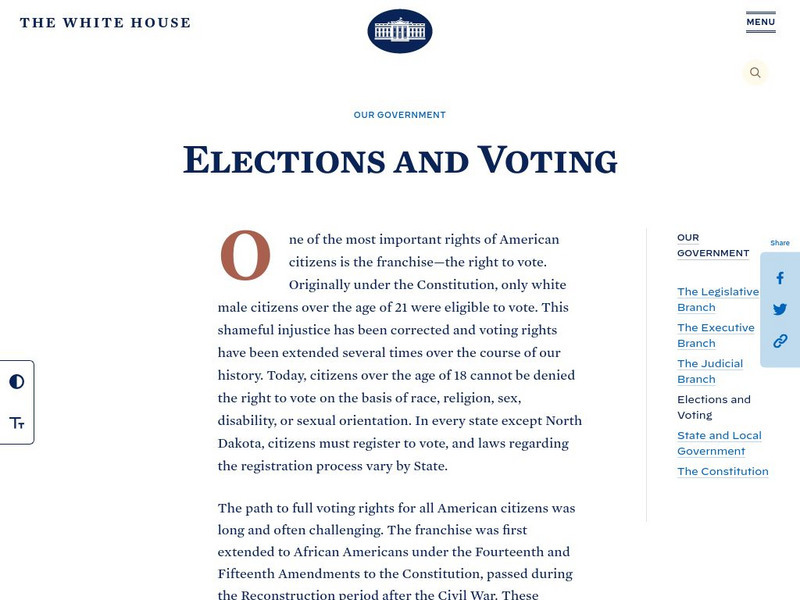
The White House: Elections & Voting
A brief discussion of Americans' right to vote and how federal elections happen.

Secretary of State-Texas
State of Texas: Election Results
Historical and current general election results from the Secretary of State of Texas.
PBS
Pbs Online News Hour: Vote 2004: Candidates
Outstanding web page that has biographical information on the candidates for President and Vice-President of the United States in the 2004 election.
PBS
Pbs Online News Hour: Presidential Election Coverage: Vote 2008: Candidates
PBS Online NewsHour provides current election news on the 2008 presidential race with biographical information on Democratic candidate Barack Obama, Republican candidate John McCain, and Third Party candidates Bob Barr and Ralph Nadar....
Indiana University
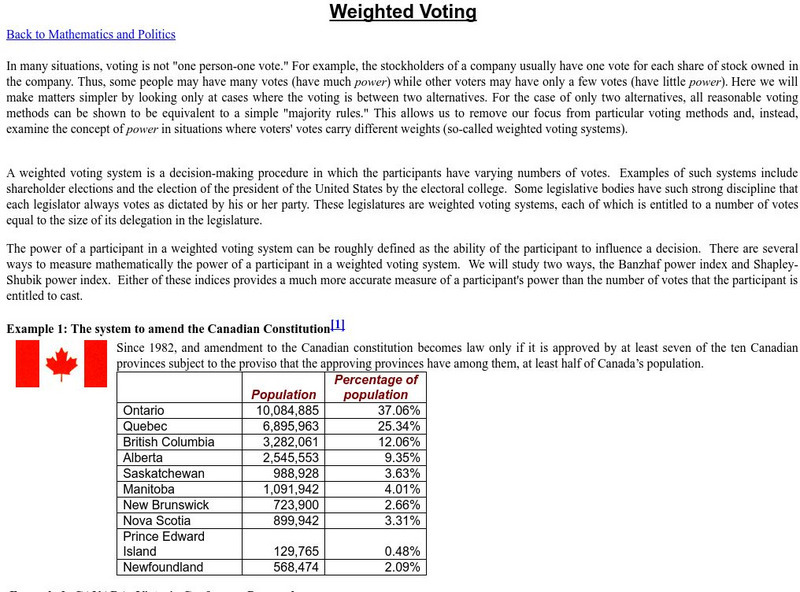
Indiana University Northwest: Weighted Voting
Explains how a weighted voting system works and provides examples for Canada, the European Economic Community, Nassau County in New York, the United Nations Security Council, and more. The Banzhaf index of power and the Shapley-Shubik...
Digital History
Digital History: Did the Vote Make a Difference?
Digital History provides a short article written about whether women gaining the right to vote made a difference in the election of 1920 and the issues of that decade.
University of Groningen
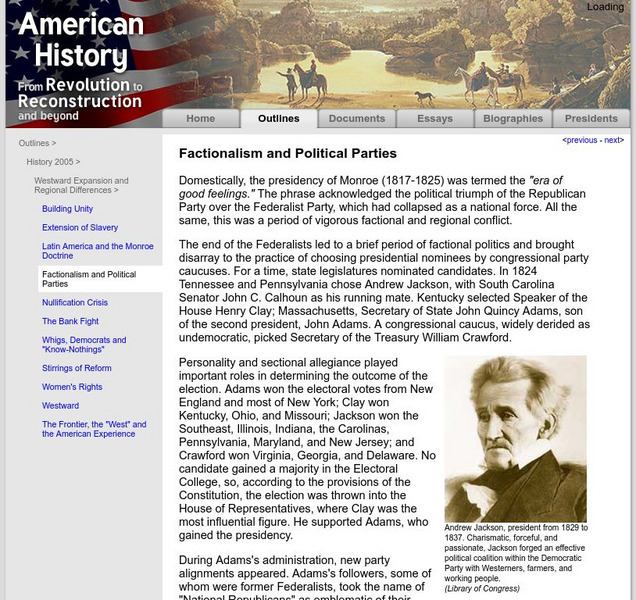
American History: Outlines: Factionalism and Political Parties
Find out about the rise of regionalism and factionalism in the development of political parties involved in the elections of 1824 and 1828.
Other
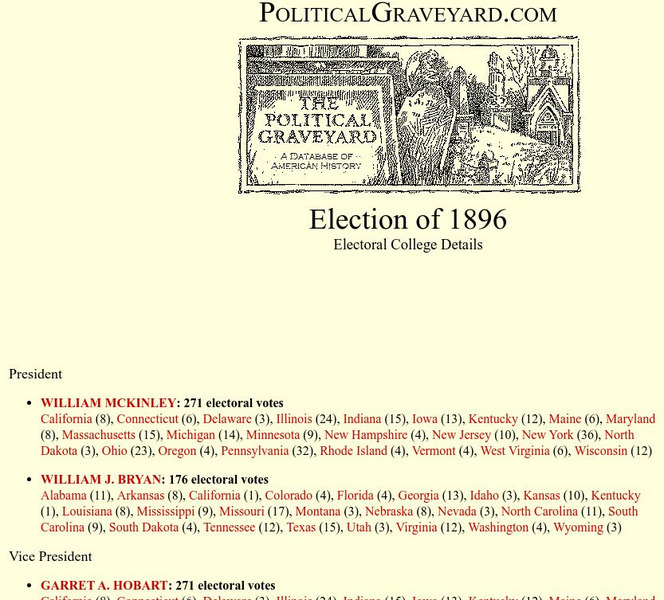
The Political Graveyard: Election of 1896
This page from The Political Graveyard just lists the electoral votes each candidate received in the 1896 election. Links to brief biographical listings about each candidate and elector.
Wikimedia
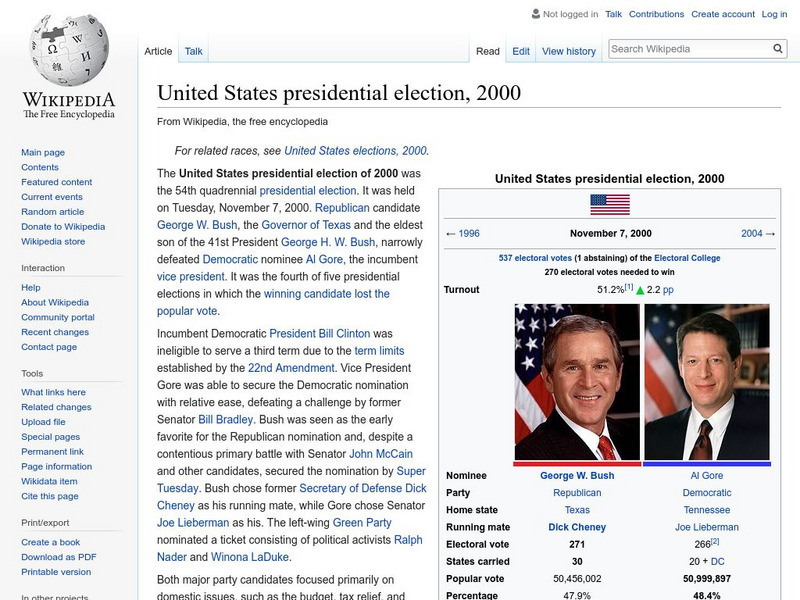
Wikipedia: United States Presidential Election, 2000
This encyclopedia article offers a thorough summary and analysis of the presidential election of 2000. Electoral maps, charts, photos and links are included. A good starting point for research, but because information may be edited, a...
Country Studies US
Country Studies: Lyndon Johnson and the Great Society
Lyndon B. Johnson ascended to the presidency after the assassination of President Kennedy in 1963. With a year to go until the election of 1964, LBJ appropriated Kennedy's "New Frontier" and transformed this agenda into his "Great Society."