Hi, what do you want to do?






Concord Consortium
Energy of a Pendulum
Just a swingin'! Introduce physical science scholars to the energy forms associated with a pendulum using a simple interactive. Learners adjust the height from which the pendulum starts, then observe changes in potential, kinetic, and...

Concord Consortium
Pendulum and Spring
Up, down, back, and forth. When you make a pendulum out of a spring, there's a lot to observe. Aspiring masters of motion examine the combined kinetic energies of spring and pendulum motion using a detailed interactive. Learners observe...

Concord Consortium
Pendulum
Add some zing to your swing! Explore pendulum motion through an engaging interactive. Physical science scholars specify the pendulum's mass, rod length, and starting angle before they observe the resulting angle graph.

Concord Consortium
Double Pendulum
What's better than a pendulum for studying motion and periods? A double pendulum! Young physical scientists use an interactive to explore pendulum motion—times two. The resource boasts a host of parameters to change and a running graph...

PHET
Pendulum Lab
How would a pendulum work on the moon or Jupiter? To answer that question scholars control up to two pendulums including their location, length, mass, and amplitude. Added controls include changing the friction and strength of gravity....

CK-12 Foundation
Oscillations Simulation
What makes a swing go back and forth like a pendulum rather than going all the way around? Scholars use the simulation to explore pendulums and how they work. They vary the weight, length of the rope, and even gravity in various trials.

Concord Consortium
Concord Consortium: Stem Resources: Pendulum
An interactive tool where students can explore how a pendulum works, and how length, mass, angle, and friction affect its motion or period. As the pendulum moves, its motion is shown in an angle-time graph.

Concord Consortium
Concord Consortium: Stem Resources: Pendulum and Spring
An interactive tool where students can explore how a pendulum behaves when attached to a spring, which means the length of the attachment is always changing. As the pendulum moves, its motion is shown on two graphs.

Concord Consortium
Concord Consortium: Energy of a Pendulum
In this interactive, drag a pendulum to set its initial height and observe how height is related to potential energy. Then release the pendulum and observe the change from potential energy to kinetic energy, and ultimately to thermal...
Physics Aviary
Physics Aviary: Pendulum Lab
This lab is designed to have students investigate the factors that affect the rate at which a pendulum oscillates. Students can change the length of the pendulum, the angle of release, and the heavenly body on which the pendulum is...
American Association of Physics Teachers
Com Padre Digital Library: Open Source Physics: Pendulum Energy Model
A simulation exploring the energy produced by a simple pendulum, written for middle school. Includes a lesson plan with accompanying worksheets.

American Association of Physics Teachers
Com Padre Digital Library: Open Source Physics: Double Pendulum Poincare Map
A double pendulum model where the angles and angular velocities can be manipulated and the effects observed.

American Association of Physics Teachers
Com Padre Digital Library: Open Source Physics: Double Pendulum Phase Space Model
Adjust to conditions of a double pendulum model and observe the results in an accompanying graph.

Concord Consortium
The Concord Consortium: Molecular Workbench: A Pendulum
Change the mass of a suspended object to see how its movement and forces are affected by gravity.

American Association of Physics Teachers
Com Padre Digital Library: Open Source Physics: Driven Pendulum With Phase Space
Illustrate the physics of a pendulum with this simulated exercise which examines the variation of a moving pendulum, its phase space, and its Poincare section.

American Association of Physics Teachers
Com Padre Digital Library: Open Source Physics: Two Springs and a Pendulum Model
Swing virtual pendulums and compare the motion of one oscillating weight on a horizontal spring to a second weight on another spring. Then, compare how these motions differ from the motion of a simple pendulum.
Concord Consortium
Concord Consortium: Molecular Workbench: Double Inverted Pendulum Oscillating
Adjust frequency, amplitude, and perturbation in this simulation to graph the trajectory of a mass at the end of each pendulum.
American Association of Physics Teachers
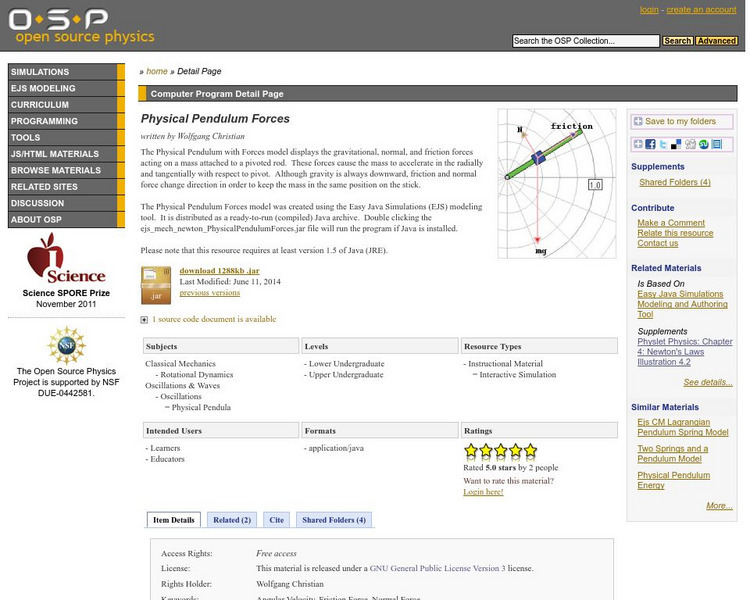
Com Padre Digital Library: Open Source Physics: Physical Pendulum Forces
This simulation of a pendulum will demonstrate how friction and force have to change to keep the mass in the same position on the pivoted rod.
Concord Consortium
Concord Consortium: Molecular Workbench: Inverted Pendulum on Oscillatory Base
Adjust variables in this simulation and observe as the results of your changes are graphed.
Other
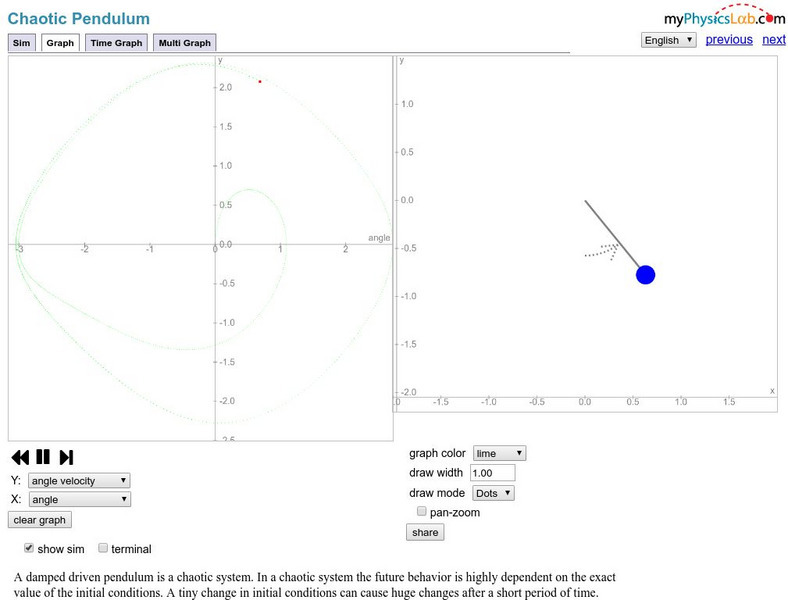
My Physics Lab: Chaotic Pendulum
Experiment with a damped driven pendulum to see what happens to the oscillation when you change the mass, gravity, or damping. Students can also change the starting position. Site includes equations to help students understand what is...

Other
My Physics Lab: Simple Pendulum
Experiment with a pendulum to see what happens to the oscillation when you change the mass, gravity, or damping. Students can also change the starting position. Site includes equations to help students understand what is happening in the...

Concord Consortium
The Concord Consortium: Molecular Workbench: Newton's Cradle
Adjust the mass of one of the balls to see how the other objects are affected in the animated Newton's Cradle.
Other
My Physics Lab: Double Pendulum
Experiment with a double pendulum to see what happens to the oscillation when you change the mass, gravity, or damping. Students can also change the starting position. The site includes equations to help students understand what is...
Concord Consortium
The Concord Consortium: Molecular Workbench: Pendulum, Slider, and Spring
Observe the motion of this animated system to represent an analogy for molecular mechanics of atoms and molecules.