Hi, what do you want to do?






Judicial Learning Center
Why Study Landmark Cases?
Why study landmark Supreme court cases? A helpful lesson offers a brief but valuable argument for the importance of these cases in the field of criminology. It introduces scholars to some key terms necessary for studying court cases and...

Judicial Learning Center
The U.S. Supreme Court
How do Supreme Court justices determine which cases to consider? What happens when the Supreme Court decides not to take a case? The lesson explores important questions and others in the field of criminology. It focuses on the...

Judicial Learning Center
Civil Rights and Equal Protection
Almost every American is familiar with the Supreme Court case of Brown vs. Board of Education. Far fewer understand the constitutional reasoning or the wide-ranging consequences of the ruling in the field of criminology. The interesting...

Judicial Learning Center
Your 4th Amendment Rights
Americans love to learn about their rights, especially those that protect them from the government's power to invade their privacy. Young people are especially engaged by this topic. An informative lesson explores four Supreme Court...

Judicial Learning Center
Types of Court Cases
How can one court acquit someone of a crime, while another convicts the person of the same one? It's all because of the differences between civil and criminal trials. An informative resource provides scholars in the field of criminology...

Judicial Learning Center
Levels of the Federal Courts
The Supreme Court gets all the glory, but very few federal cases make it to the highest court. An interesting lesson explores the structure of the lower levels of the federal court system. In addition to outlining the organization of...

Judicial Learning Center
Your 1st Amendment Rights
Why should classes care about the First Amendment? An engaging lesson serves as a powerful tool for answering just that. As all four cases in the lesson relate directly to freedom of expression in schools, young scholars explore the...

Judicial Learning Center
The Appeal Process
Why doesn't the Supreme Court hear testimony from witnesses? How do they complete an entire proceeding in less than two hours? A helpful lesson guides scholars of criminology through these and other questions by explaining how appeals...

Judicial Learning Center
The Power of Judicial Review
Marbury v. Madison is arguably the most important landmark case in the history of the Supreme Court. A fact-filled lesson provides background information about the case and two others related to the concept of judicial review. Scholars...

Judicial Learning Center
Judicial Independence
Most people support the idea of an independent judiciary in theory until they hear about a court case that violates their principles. An informative resource explains why the concept is important. It also provides scholars of criminology...

Judicial Learning Center
Article III and the Courts
What's the best way to make sense of the Constitution? A helpful lesson contains both the text of Article III and annotation of each of its sections, breaking it down into easy-to-understand parts. It also includes links to a...

Judicial Learning Center
About Federal Judges
Not just anybody can do the job of a federal judge, but according to the United States Constitution just about anybody can be appointed. The lesson outlines the process and requirements for becoming a federal judge, focusing on the...

ProCon
Gun Control
According to some estimates, there are more guns than people in the United States. Learners decide if America should enact more gun control laws. They analyze information about gun deaths in the United States by year, read about the...

Other
Landmark Supreme Court Cases
Excellent resources for teaching about landmark Supreme Court cases. Strategies include case study, moot court activity, role play, continuum, community resources, evaluating websites, and political cartoon analysis.
Social Studies for Kids
Social Studies for Kids: The Supreme Court
The Supreme Court is the highest in the land. It has nine members and decides whether laws are unconstitutional. It handles appeals from federal courts or state supreme courts. Learn more about how it works and some famous Justices.
University of Missouri
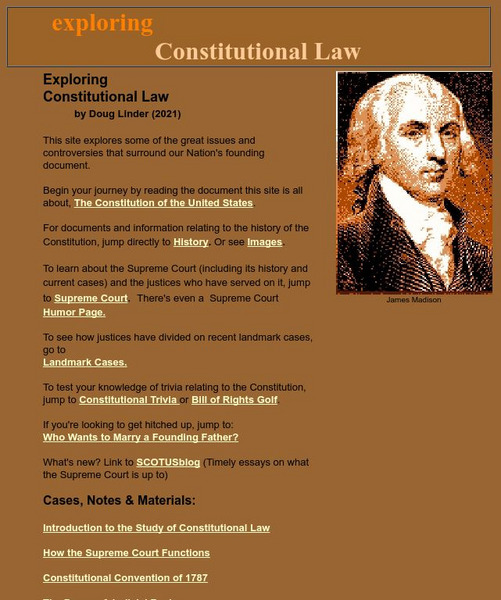
Exploring Constitutional Conflicts: Exploring Constitutional Law
Although the Constitution is the supreme law of the land, its interpretation is open to many opinions, causing great controversies. Students can read the Constitution as well as the many issues that surround the document. If that proves...