Hi, what do you want to do?






New York State Education Department
TASC Transition Curriculum: Workshop 4
Why is it important to use precise language? Participants explore this question in the fourth activity in a series of 15 on effective instruction. Perfect for all content areas, the activity promotes appropriate language choice through...

Transforming Education
Self-Management Strategies
What self-management techniques help scholars achieve their goals? Readers review a list of strategies for managing stress, increasing motivation, and setting goals. They discover how to monitor their emotions, create checklists to stay...

Transforming Education
Growth Mindset Strategies
Help your students develop a growth mindset with a list of sample strategies for prioritizing efforts instead of results.Pupils learn how to embrace mistakes, set high expectations, and focus on process over product.

New York State Education Department
TASC Transition Curriculum: Workshop 10
How have educational standards evolved? Educators of adults examine expectations in the 10th workshop out of 15 to better determine how standards have grown. Participants respond to a variety of sample questions to determine how they...
AdLit
Ad lit.org: Effects of Intensive Reading Intervention of Decoding Skills
This article summarizes a study that evaluated the effectiveness of intensive instruction in the Word Identification Strategy, a learning strategy for decoding multi-syllabic words. Results indicate that intense strategy instruction...
AdLit
Ad lit.org: Teaching Content Knowledge and Reading Strategies in Tandem
Many areas of instruction can have a rippling effect for the expansion of readers' repertoire of skills, including pre-reading, predicting, testing hypotheses against the text, asking questions, summarizing, etc. Literacy-rich,...
AdLit
Ad lit.org: Classroom Strategies: Summarizing
Summarizing teaches students how to take a large selection of text and reduce it to the main points for a more concise understanding. Upon reading a passage, summarizing helps students learn to determine essential ideas and consolidate...
Auburn University
Auburn University: Invitations: Reading Lessons From Preservice Teachers
Links are provided for leveled reading lessons created by preservice teachers at Auburn University. Levels include emergent literacy, beginning reading, growing independence and fluency, and reading to learn.

AdLit
Ad lit.org: Recommendations for Improving Adolescent Literacy
In its practice guide Improving Adolescent Literacy: Effective Classroom and Intervention Practices, the Dept. of Education offers five recommendations for increasing the reading ability of adolescents. Those recommendations are...

AdLit
Ad lit.org: Teach the Seven Strategies of Highly Effective Readers
To improve students' reading comprehension, teachers should introduce the seven cognitive strategies of effective readers: activating, inferring, monitoring-clarifying, questioning, searching-selecting, summarizing, and...
AdLit
Ad lit.org: Classroom Strategies: Paragraph Shrinking
Paragraph Shrinking is an activity developed as part of the Peer-Assisted Learning Strategies (PALS). PALS is a classwide peer tutoring program in which teachers carefully partner a student with a classmate. The Paragraph Shrinking...
McGraw Hill
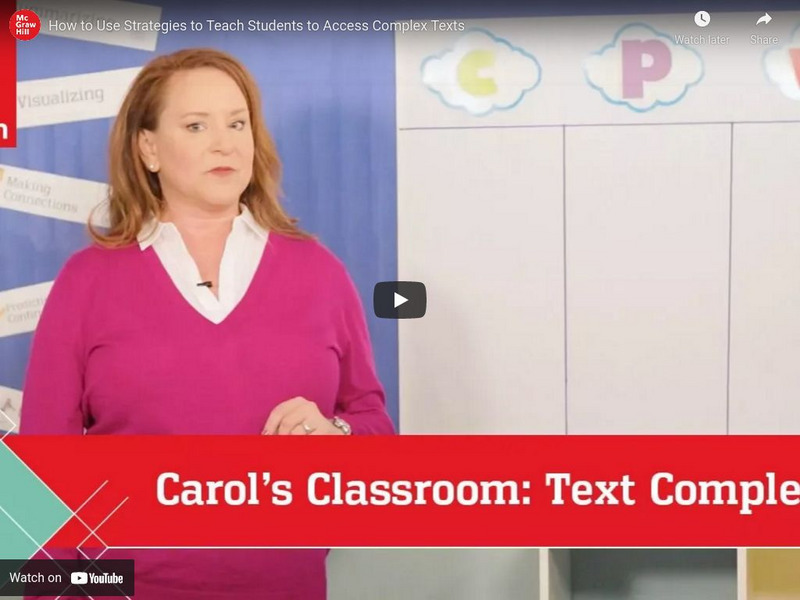
Mc Graw Hill: How to Use Strategies to Teach Students to Access Complex Texts
In this short video, the strategies of summarizing, clarifying, and asking-answering questions are used. These instructional tools will help teachers show students how to access complex texts. [5:54] CCSS.ELA-Literacy.CCRA.R.10
AdLit
Ad lit.org: Classroom Strategies: Story Maps
Story Maps are used for teaching students to work with story structure for better comprehension. This technique uses visual representations to help students organize important elements of a story. Students learn to summarize the main...
AdLit
Ad lit.org: Classroom Strategies: Selective Highlighting
Selective Highlighting/Underlining is used to help students organize what they have read by selecting what is important. This strategy teaches students to highlight/underline ONLY the key words, phrases, vocabulary, and ideas that are...

American Institutes for Research
Center on Response to Intervention: Progress Monitoring: Study Group Content
The purpose of the Progress Monitoring: Study Group Content module is to provide participants with an introduction to procedures for progress monitoring using Curriculum-Based Measurement (CBM). The module outlines the steps required to...
AdLit
Ad lit.org: Classroom Strategies: Reciprocal Teaching
Reciprocal Teaching is a strategy that asks students and teachers to share the role of teacher by allowing both to lead the discussion about a given reading. Reciprocal Teaching involves four strategies that guide the discussion:...