Hi, what do you want to do?






Noyce Foundation
Cutting a Cube
Teach the ins and outs of the cube! A series of five K–12 level activities explore the make-up of the cube. The beginning lessons focus on the vocabulary related to the cube. Later lessons explore the possible nets that describe a cube....

5280 Math
Multiplication Table Algebra
Patterns, patterns, everywhere! Young scholars examine the multiplication table to identify patterns. Their exploration leads to an understanding of the difference of squares and sum of cubes by the completion of the algebra project.

Noyce Foundation
Poly-Gone
Investigate polygons from rectangles to triangles to octagons. Each level of the five-problem series targets a different grade level. Beginning with the level A problem, learners examine the relationship between area and perimeter by...

Jim Noble, Richard Wade & Oliver Bowles
Pyramid Model
Seeking to derive the formula for the volume of a square pyramid, geometry learners construct six square based pyramids that, when pieced together properly, form a cube. Two short videos demonstrate the relationship...

Illustrative Mathematics
Overlapping Squares
The objective of this activity is to find the percent of the area of a two squares overlapping. Mathematicians find the ratio of area for the part that overlaps to the rectangle formed. The final answer is a percent as a rate per 100....

Florida Center for Reading Research
Phonological Awareness: Phoneme Isolating, Move and Tell
Build phonological awareness with this fun game focused on isolating and identifying medial phonemes. This game board contains an image on each square; when the child lands on a square, they must say the medial sound of the word they...

Illustrative Mathematics
Christo’s Building
Hook your charges on how to solve a real-world art problem with mathematics by showing works of Christo. You can find eye-catching images on the Christo and Jeanne Claude webpage. Here, math learners help Jean Claude and Christo prepare...

Illustrative Mathematics
Box of Clay
What happens to a volume when you scale the dimensions of a rectangular prism? In this problem, a box of clay is increased in each dimension, with the intent to see if learners can generalize the result. The addition of...

Curated OER
Solidly Platonic
When they do, they learn. Using this resource, young mathematicians learn about platonic solids by actually building, touching, and examining the shapes. They connect their observations about the shapes to Euler's formula.

Early Childhood Education
Shape It Up!
The best way to understand shapes is to make them. Young geometers explore basic shapes through a variety of gross motor and fine motor activities. Shape sorting, singing songs about shapes, and eating shape snacks are just a few of the...

Terry Kawas
Catch the Gingerbread Men Game
Catching men made of gingerbread motivates your young graphers to begin exploring the concept of finding a point in two-dimensional space. Learners practice locating each cookie by rolling two cubes (one with...

New Mexico State University
Lab 6: Kepler's Laws
A 15-page package thoroughly teaches your physics or astronomy learners about Kepler's three laws of planetary motion. Each one is stated and explained. Class members answer questions, solve problems, and participate in the classic...

Oregon Department of Education
Building Number Sense
It's never too early to begin a child's math education. This collection of fun hands-on activities engage youngsters in building their number sense as they learn how to count objects, identify numerals, compare amounts, and much more.

Curated OER
Radical Equations
This task gives geometry learners practice in solving radical equations in one variable and zeros in extraneous solutions.

North Carolina State University
Shapes
Expose youngsters to 3-D objects in a hands-on learning activity involving marshmallows and toothpicks. Engage your young mathematicians by introducing them to 3-D shapes by means of a story book. Explore 3-D shapes by manipulating...

American Museum of Natural History
Thinking in the Three Dimensions
Discover different dimensions with paper folding. Pupils first read about zero, one, two, and three dimensions, and then learn about the fourth dimension, time. They then use origami to create models of shapes in three dimensions and use...

101 Questions
Dandy Candies
Package design is an economic necessity. Young scholars assume the role in an interesting inquiry-based lesson. Given 24 cubic shaped candies to package, they must determine the arrangement that uses the least amount of cardboard to...

Exploratorium
Far Out Corners
Construct a three-dimensional optical illusion when your class is exploring vision and how the eye and brain work together. Three concave corners are mounted inside of a black box, but as a light is shined upon them, they appear to be...

Indian Institute of Technology
Could King Kong Exist?
The title says it all: Could King Kong exist? Investigate how increasing the dimensions of an object affects its surface area and volume to mathematically conclude whether a creature with the weight and height of King Kong could actually...

Curated OER
Jelly Beans for Sale
Students connect literature (story Jelly Beans for Sale by Bruce McMillan) to math concepts. In these estimating and money lessons, students work with jelly beans, unifix cubes, pennies, nickels, dimes, and quarters, to estimate and make...

Florida Center for Instructional Technology
Two for One Box Company
Given a box of certain dimensions, young mathematicians must determine if a box that is twice as big, actually holds twice as much. This is a brain-teaser of a problem. The worksheet provides a handy table that has learners calculate the...
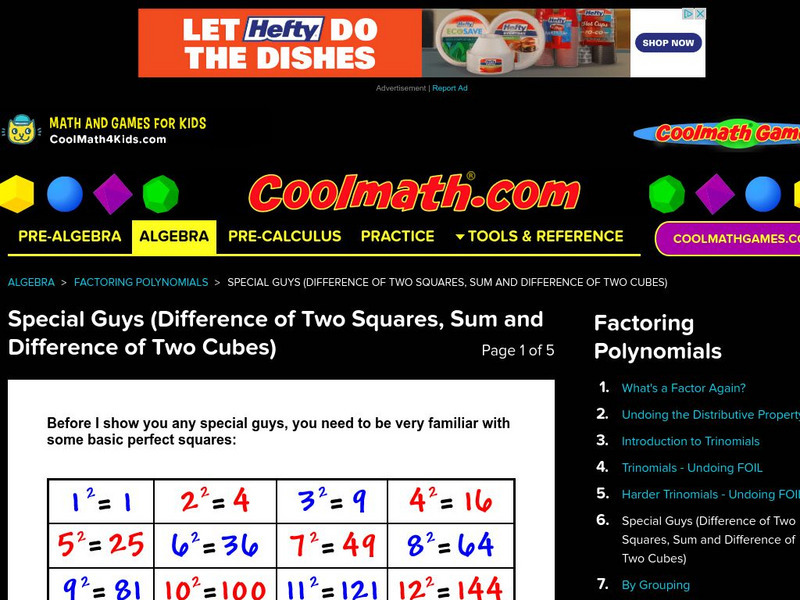
Cool Math
Coolmath: Difference of Two Squares, Sum and Difference of Two Cubes
This algebra lesson explains how to factor the difference of two squares and the sum and difference of two cubes.
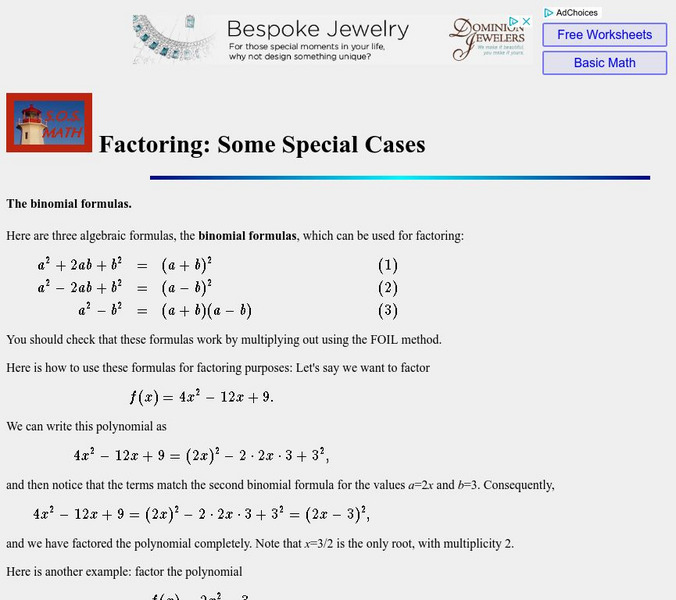
Math Medics
S.o.s. Math: Factoring: Some Special Cases
In this lesson, special cases of factoring are described, including perfect squares, difference of squares, and difference and sum of cubes. Exercises with answers included.
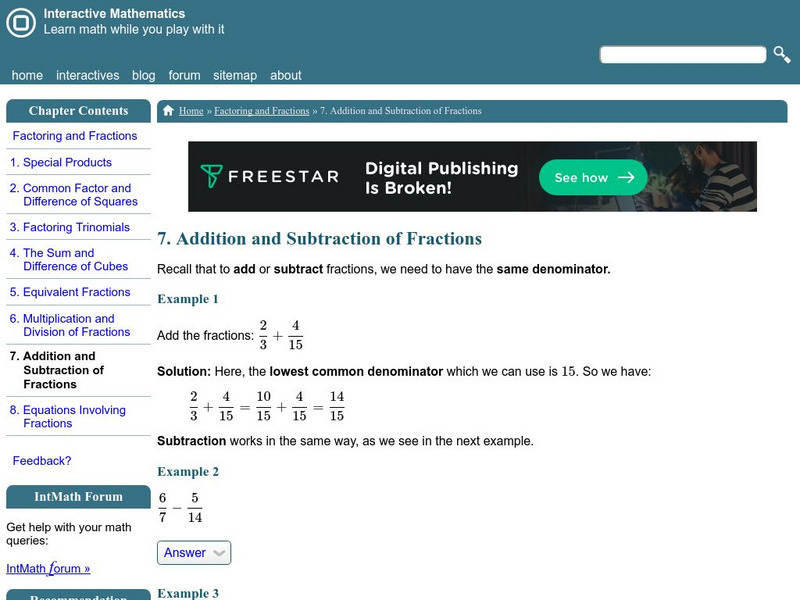
Interactive Mathematics
Interactive Mathematics: Factoring and Fractions
Polynomials are the focus of these lessons, concentrating on factoring and special products to work with rational expressions. Interactive tools of Live Math and Scientific Notebook are used to provide animated solutions to the examples....