Hi, what do you want to do?






US Department of Agriculture
Sink or Float?
Will it sink or will it float? Learners predict the outcome as they drop random objects into a container of water. Then, they keep track of the results and record the data in a t-chart to draw a final conclusion.

DiscoverE
Action Figure Diver
Will your next buoyancy lab rise to the occasion? Make a splash with action figure divers! Teams of young physicists explore the relationship between mass and buoyancy by adding weights or balloons to achieve a diver that neither sinks...

Teach Engineering
Determining Densities
Don't be dense—use a robust resource. The second installment of a five-part Floaters and Sinkers unit has learners determine the densities of several objects. As part of the activity, they learn the displacement method for finding...

PBS
Watercraft
Whatever floats your boat—with some additional weight. The first activity in a five-part series challenges pupils to design a boat to hold pennies. Using the design process, learners design, build, and test their boats, making sure they...

PBS
Reading Adventure Pack: Oceans
Flotsam by David Wiesner and The Magic School Bus on the Ocean Floor by Joanna Cole, illustrated by Bruce Degen, begin a reading adventure pack focusing on oceans. With story listening and thoughtful discussion, scholars complete several...

Exploratorium
Descartes' Diver
Pique interest in water pressure, demonstrate buoyancy, and explore water displacement concepts with a homemade Cartesian diver. You may want to change the name of the toy, however, as is is not documented the Rene Descartes...

Teach Engineering
Clay Boats
Clay itself sinks, but clay boats float. Why? Young engineers build clay boats to learn about buoyancy. They test the weight the boats can hold using washers and then tweak their designs to make improvements, following the engineering...

Teach Engineering
Buoyant Boats
Eureka! Using the clay boats made in the previous lesson, learners investigate the idea of buoyancy and water displacement to finish the last installment of five in a Floaters and Sinkers unit. Their observations during the activity...

Teach Engineering
Rock and Boat
Present the class with a question on whether the water level of a pond will rise they take a large rock out of a boat and drop it into the pond. Groups come down on all sides of the question and try to justify their answers. The activity...

Discovery Education
Motion in the Ocean
How do temperature changes affect ocean currents? Scholars explore convection currents by demonstrating the flow of water in a baking dish. They use ice, heat, and food coloring to see currents. Then, they draw conclusions about their...

DiscoverE
Design a Flotation Device
Save the soup! Scholars devise a flotation device using straws, balloons, foam, corks, and other objects. A can of soup must stay afloat for at least a minute with this device—your dinner might depend on it!

Exploratorium
Bubble Suspension
Create a cushion of carbon dioxide gas to float some soap bubbles on. Many concepts can be demonstrated through this activity:
Carbon dioxide gas is more dense than air
Bubbles are semipermeable, allowing only carbon dioxide to diffuse...

Center for Learning in Action
Properties of Balls
Enhance your states of matter lessons with a hands-on science investigation that compares six different balls' color, texture, size, weight, ability to bounce, and buoyancy.

DiscoverE
Water Sampling
What is the best way to test water quality? Using plastic bottles, scholars create monitoring sensors to test water quality. Creating three different sensors allows individuals to measure water quality at different water levels.

Other
National Engineers Week Foundation: Flinker
Students investigate with common objects to see if they can make something that neither floats nor sinks, but rather "flinks" in the middle.
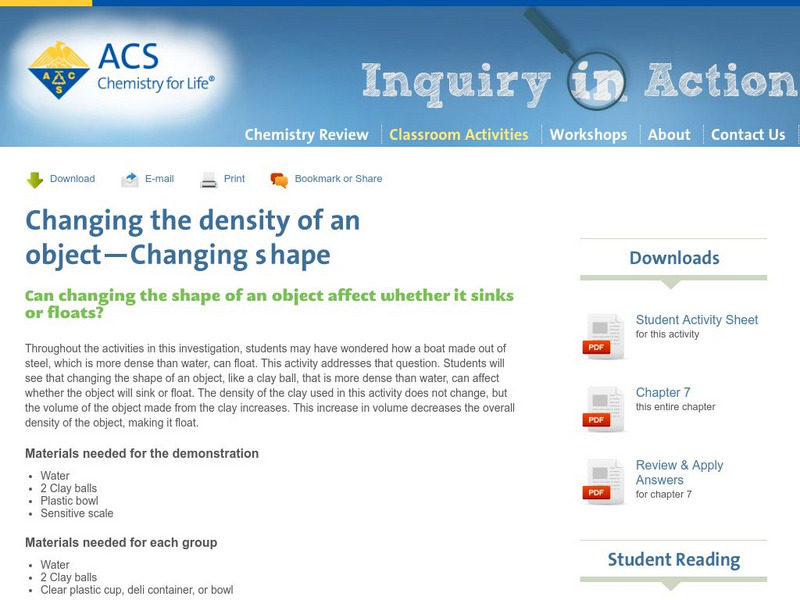
American Chemical Society
Inquiry in Action: Changing the Density of an Object: Changing Shape
Throughout the activities in this investigation, students may have wondered how a boat made out of steel, which is more dense than water, can float. This activity addresses that question. Students will see that changing the shape of an...