Hi, what do you want to do?






Center for Learning in Action
Introduction to the States of Matter
Liquids, gases, and solids are the states of matter in which scholars investigate in a lesson plan that offers in-depth information and engaging activities that look into the three states and the changes their properties make when mixed...

It's About Time
Properties of Matter
Never trust an atom; they make up everything! Young chemists make modeling dough and add another ingredient to change the properties. Scholars then compare the properties of emulsion to composite materials. A reading passage and analysis...

Center for Learning in Action
Challenge with Solids, Liquids, and Gases
There's a container for every matter—liquid, solid, and gas. Pupils design three different containers, each with the capability to hold one of the states of matter, and share their design with the class.

Center for Learning in Action
Density
Explore the concept of density within states of matter—gases, liquids, and solids—through a group experiment in which young scientists test objects' texture, color, weight, size, and ability to sink or float.

Center for Learning in Action
Investigating Physical and Chemical Changes
Super scientists visit ten stations to predict, observe, and draw conclusions about the physical and chemical changes that occur when different states of matter—liquid, solid, and gas—are placed under a variety of conditions. To...

Center for Learning in Action
Gases
Explore the properties of gases through one activity and two investigations in which super scientists observe the changes gas makes when encountering different conditions.

Center for Learning in Action
Water – Changing States (Part 2)
Here is part two of a two-part lesson in which scholars investigate the changing states of water—liquid, solid, and gas—and how energy from heat changes its molecules. With grand conversation, two demonstrations, and one hands-on...

Center for Learning in Action
Water—Changing States (Part 1)
Here is part one of a two-part lesson in which scholars investigate the changing states of water—liquid, solid, and gas. With grand conversation and up to three demonstrations, learners make predictions about what they think will happen...

National Institute of Open Schooling
The Gaseous State
Sixth in a series of 36, this lesson focuses on gases and their behavior in given situations. Learners review the states of matter and then focus on gases, specifically learning Boyle's, Charles's, Avogadro's Laws, Dalton's, and Graham's...

American Chemical Society
The Discovery of Fullerenes
Carbon is the most common element on earth, so the innovative discovery of a new type of carbon molecule won the 1996 Nobel Prize. In the ready-to-go lesson, scholars learn about C60 and how it has opened up the entire area of...

National Institute of Open Schooling
The Liquid State
Due to surface tension, dew — a liquid, is spherical in shape. Learners explore the properties of liquids in activity seven in this series of 36. Beginning with its basic properties such as boiling point and moving through to surface...

National Institute of Open Schooling
Solutions
Aqua regia, or royal water in Latin, is a solvent that can dissolve solid gold and platinum into a solution. Activity nine in a series of 36 allows classes to learn, through readings and answering questions, what a solution is and the...

It's About Time
Elements and Compounds
Young scientists use electrolysis to separate water into its elements before experimenting with fire to learn about their properties. A helpful resource provides a reading passage and analysis questions.

National Institute of Open Schooling
Colloids
Classes explore colloids through readings and questions in lesson 10 in a series of 36. They learn everything from methods of preparation and properties to how to classify colloids. They finish the lesson by seeing how to apply...

It's About Time
The Electricity and Magnetism Connection
Magnets don't grow in fields, but magnetic fields are important to understand. The lesson covers the effect electricity has on magnetic fields. Scholars use a compass, magnets, and electrical wire to test magnetic fields and energy...

National Institute of Open Schooling
Solid State
Crystal comes from a Greek word meaning ice. Activity eight in a series of 36 has class members analyzing amorphous and crystalline solids and further classifying them based on their forces. They then explore solids, learning about unit...

National Institute of Open Schooling
Atomic Structure
Learners explain historical findings such as Rutherford and Bohr's contributions, explain wave particle duality, and formulate Heinsenberg's uncertainty principle. They also draw s, p, and d orbitals, explain more historical findings,...
University of Waterloo (Canada)
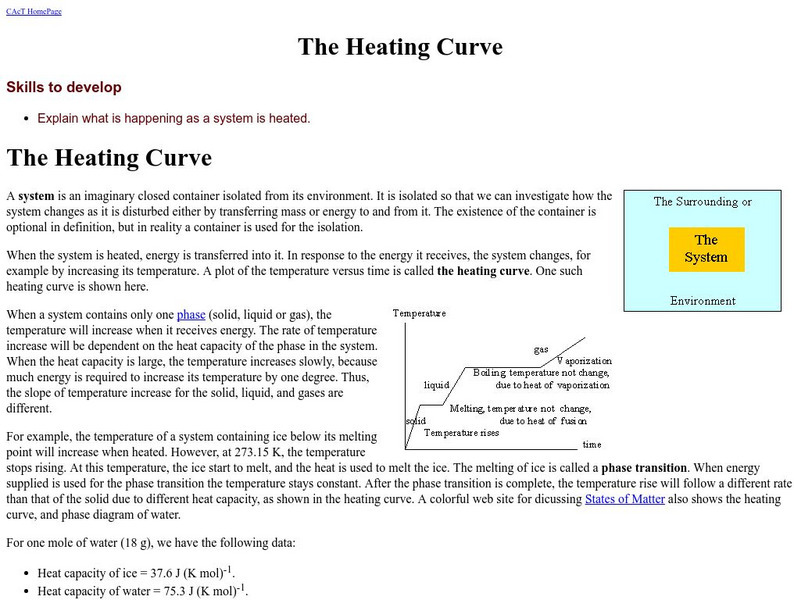
The University of Waterloo: The Heating Curve
The heat of vaporization along with several other thermal properties are explained. Sample problems are given. Illustrations.

CK-12 Foundation
Ck 12: Earth Science: States of Water Study Guide
[Free Registration/Login may be required to access all resource tools.] This study guide summarizes key points about the three states of water. Includes a few questions to check for understanding.
Science Struck
Science Struck: Translucent, Transparent, and Opaque Materials
The definitions of transparent, translucent, and opaque can be found here. The article explains how the density of a material and its ability to absorb light determine which of these three properties it has. A list of examples is given...
Fact Monster
Fact Monster: Adhesion and Cohesion
The forces of adhesion and cohesion are compared and contrasted. Various phenomena which can be explained by such forces are identified and discussed.