Hi, what do you want to do?






Scholastic
Lesson Five: The Earth, Rocks and Minerals
Apply the principles of geology to a series of collaborative, hands-on class activities. Young earth scientists learn more about igneous, metamorphic, and sedentary rocks before classifying and weathering rocks that they find....

Teach Engineering
Rocks, Rocks, Rocks: Test, Identify Properties and Classify
Time is growing short. Teams work together to identify physical properties of rocks in order to determine the properties that would best suit their cavern shelter design.

University of Miami
What is it? Weathering, Erosion, or Deposition?
Just as rocks move through the rock cycle, your giddy geologists will move descriptions around until they are all in the correct category. After cutting out several types of rock movement, learners determine whether the action is...

DiscoverE
Bridges, Buildings and Beyond Activity Packet: Grades 3-5
The road to a better understanding of engineering lies with bridges and tunnels. A set of four engaging activities teaches learners about engineering concepts related to construction projects. They perform an experiment to find the...

Teach Engineering
Exploring Capillary Action
Explore capillary action from different perspectives. In the fourth installment of a nine-part series, scholars perform several experiments to observe capillary action. They look at the meniscus of water in a glass, observe capillary...

Forest Foundation
Forests, Carbon & Our Climate
To conclude their examination of forest ecosystems, class members consider the role forests play in the carbon cycle and how forests can offset climate change.

NOAA
The Incredible Carbon Journey: Play the Carbon Journey Game
Class members explore the carbon cycle in the final installment of the 10-part Discover Your Changing World series. They play a simulation game where they walk through the steps carbon takes as it cycles through the different layers...

US Environmental Protection Agency
Building an Model Aquifer
With almost half of Americans relying on groundwater supplies, it is more important than ever to protect aquifers from possible contaminants. Working in small groups, young environmentalists explore this problem as they create an aquifer...

Scholastic
Lesson Four: The Earth, Layers of Earth
Get your hands dirty with a set of earth science activities! Class members delve into a hard-boiled egg to find the similarities to the earth's layers, create a papier-mâché model of the earth, craft a simulation of the earth's...

Teach Engineering
Are We Alone?
Find an answer to the age-old debate of whether life exists on Mars. Groups determine criteria to help look for signs of life on Mars. The activity has the class simulate testing Martian soil samples for signs of life before drawing...

US Environmental Protection Agency
Aquifer in a Cup
Young scientists create their very own aquifers in this science lesson on ground water. After learning about how some people get their drinking water from underground wells, young learners use sand, modeling clay, and aquarium rocks to...

American Farm Bureau Foundation for Agriculture
My Miniature Greenhouse!
Here is an activity that will peak your super scientists' interest and knowledge of greenhouse gardening. Green thumbs flourish when they build, prepare, take care of, and observe their seedlings inside a miniature greenhouse. With...

Museum of Science
Terrarium
Make a premium terrarium. Learners create a miniature terrarium to study ecosystems. They use a clear container, along with rocks, soil, moss, leaves, woodland plants, earthworms, and bugs to construct their terrariums.

Utah LessonPlans
Water, Water Everywhere
Murals are used to represent the various ways we rely on water.
TeachEngineering
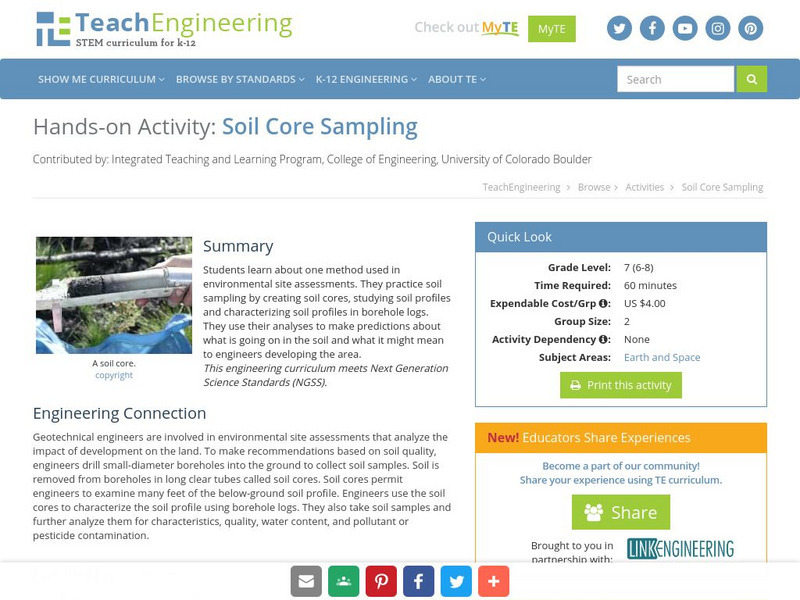
Teach Engineering: Soil Core Sampling
Students learn about one method used in environmental site assessments. They practice soil sampling by creating soil cores, studying soil profiles and characterizing soil profiles in borehole logs. They use their analysis to make...
Discovery Education
Discovery Education: The Dirt on Soil
This interactive website explores the various soil layers and introduces you to the lifeforms that live in those soil layers.
Science Education Resource Center at Carleton College
Serc: Soil vs. Rocks
Students will compare soil and rocks by observing and sifting a soil mixture and a rock mixture. To complete the activity students will make a Venn diagram.
TeachEngineering
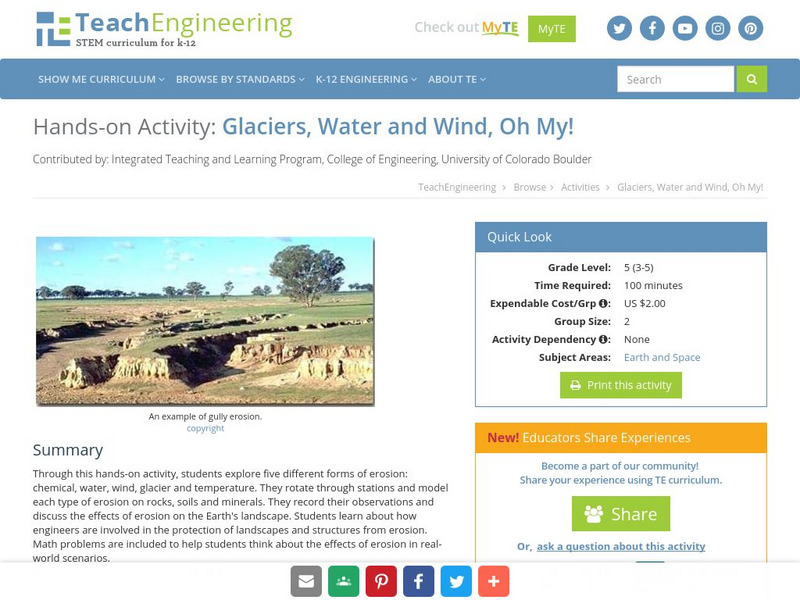
Teach Engineering: Glaciers, Water and Wind, Oh My!
This hands-on activity explores five different forms of erosion (chemical, water, wind, glacier and temperature). Students rotate through stations and model each type of erosion on rocks, soils and minerals. The students record their...

Environmental Education for Kids
Eek!: Art and Crafts: Edible Aquifer
Groundwater is stored in and moves slowly through layers of soil, sand and rocks called aquifers. To help you visualize groundwater, you will make an aquifer, in this case, an edible one. This will show you how groundwater is stored and...
TeachEngineering
Teach Engineering: Engineering for the 3 Little Pigs
The purpose of this activity is to demonstrate the importance of rocks, soils and minerals in engineering and how using the right material for the right job is important. The students build three different sand castles and test them for...
American Geosciences Institute
American Geosciences Institute: Earth Science Week: What's Down There?
Students build a model to learn about the cycle of erosion and deposition by water and wind which deposits layer upon layer of rock, soil, and organic material to the surface.