Hi, what do you want to do?






Curated OER
The Class Trip
Mrs. Moore's class is trying to earn money for a trip to the science museum, but how much more do they need? Solve this problem with your own class as they develop their ability to model real-life situations algebraically. As an added...

College Board
2007 AP® English Language and Composition Free-Response Questions Form B
Do museums offer eyes into the past? Scholars synthesize sources to make a claim in an essay about the importance each museum artifact deserves. Pupils also write to analyze journalist level of ethics as well as a speech by Wendell...

California Education Partners
Animals of Rhomaar
Investigate the growth rates of alien animals. Pupils study fictional animals from another planet to determine how much they grow per year. The investigators plot the growth of their animals over a period of time and then compare...

College Board
2004 AP® Calculus AB Free-Response Questions Form B
The test is not all about skills. The six free-response questions contain two real-world application problems. Those items deal with populations and velocities. The other four questions ask pupils to show their knowledge of calculus...

College Board
2008 AP® Calculus AB Free-Response Questions Form B
How would those items score? The resource provides pupils an opportunity to answer actual free-response questions and determine their scores. Items from the AP® Calculus AB exam from the 2008 administration demonstrate how topics appear...

Mathematics Assessment Project
A Day Out
An applicable task presents a problem for pupils to solve: where to go for a class field trip. The pupils must take into consideration the first and second choices of members of the class when determining where to go. Individuals also...

Bowland
Day Out
Use mathematics to help plan a field trip. Scholars use the results of a survey to determine where a class should go on a field trip. They use provided data about entrance fees and mileage to calculate the cost per person of such a...

George W. Bush Presidential Library and Museum
Teaching Primary and Secondary Sources
What makes a source primary or secondary? Middle schoolers read a definition of each term before exploring different examples and applying their knowledge to a research project.

Balanced Assessment
Egyptian Statue
Investigate the proportional relationships of length, area, and volume. Learners use the dimensions of rectangular prisms to create ratios and proportions. They compare the different ratios to solve more advanced problems.

EngageNY
Comparing Distributions
Data distributions can be compared in terms of center, variability, and shape. Two exploratory challenges present data in two different displays to compare. The displays of histograms and box plots require different comparisons based...

Mathematics Assessment Project
Historic Bicycle
"Ordinary" bicycles are not so ordinary. Learners use given information to determine the circumference of wheels for a historic Ordinary or Penny Farthing bicycle. Pupils then determine the number of times each wheel turns when the...

Illustrative Mathematics
Use Cavalieri’s Principle to Compare Aquarium Volumes
Learners are designing a stunning new water feature for an aquarium, but they soon discover that more than just a pretty home for their fishy friends is required. From calculating the volume of a composite shape through the...

Curated OER
Place Names
In this interactive vocabulary learning exercise, 3rd graders read various descriptions of places and select the appropriate name of the place. For example, for the description of a place where you can see different kinds of fish the...

Curated OER
Verb Tenses
In this verb tense worksheet, students complete a total of 18 multiple choice questions, selecting the correct verb to complete sentences. Students may click an "answer" button for immediate feedback, worksheet is labeled ESL, but is not...

Curated OER
Look At / Look For / Look After
In this word choice learning exercise, students complete a ten question multiple choice on-line interactive quiz about the correct use of "look at", "look for" and "look after".

Curated OER
Make Or Do?
In this word choice worksheet, students complete a ten question multiple choice on-line interactive quiz about the correct use of "make" or "do".

Curated OER
Britain and the British
For this Great Britain worksheet, students complete a 10 question multiple choice on-line interactive quiz about British history and culture.
American Museum of Natural History
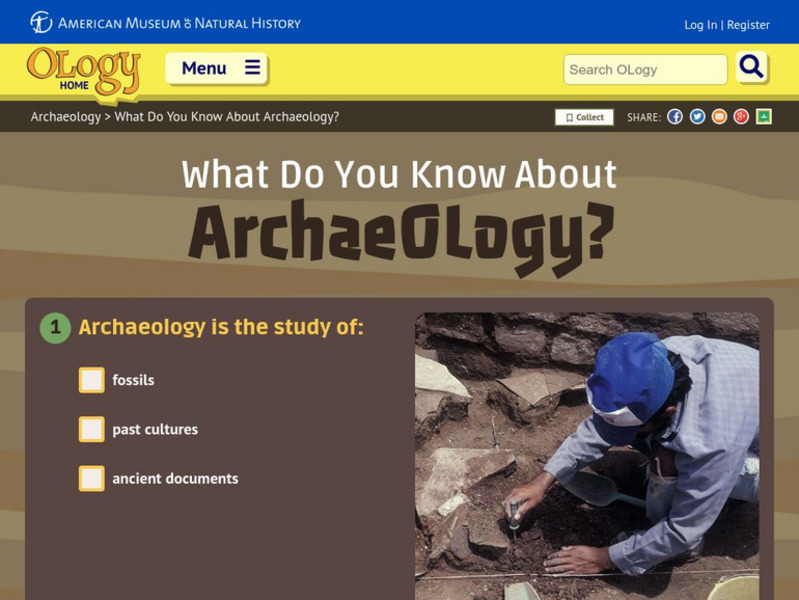
American Museum of Natural History: O Logy: What Do You Know? Archaeology
A ten question quiz on the study of archaeology.
American Museum of Natural History
American Museum of Natural History: O Logy: What Do You Know? Dinosaurs
Test knowledge about dinosaurs with this ten question quiz.
American Museum of Natural History
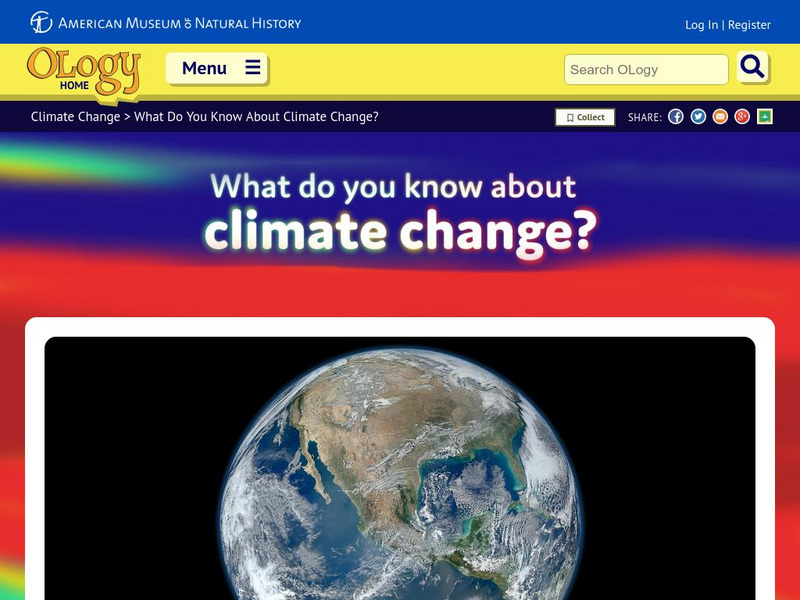
American Museum of Natural History: O Logy: What Do You Know? Climate Change
Test your knowledge on climate change with this short quiz.
American Museum of Natural History
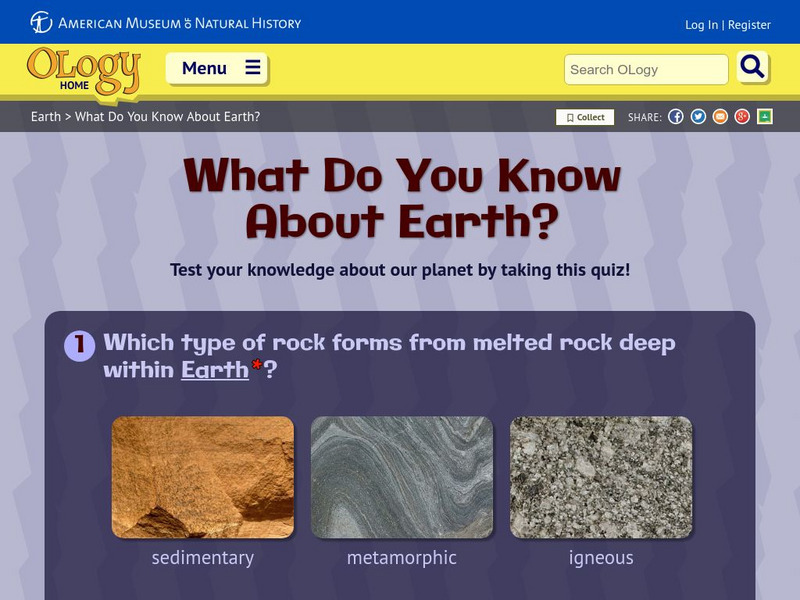
American Museum of Natural History: O Logy: What Do You Know? Earth Science
Take a ten question quiz on the Earth's surface.

Science Museum, London
Science Museum: Energy Today Quiz
This ten-question interactive quiz from Science Museum focuses on the role of energy used in society today. The questions are answered and explained.
Science Museum, London
Science Museum: Energy Action Quiz
This ten question interactive quiz from Science Museum focuses on energy action. The questions are answered and explained.
American Museum of Natural History
American Museum of Natural History: Ology Quiz: What Do You Know? Paleontology
Test your knowledge of paleontology by taking a quick quiz.
Other popular searches
- Museums and Exhibits
- History of Science Museums
- Online Museums
- History Museums
- Children's Museums
- Science Museums
- Childrens Museums
- Art Museums
- Museum Directories
- +Childrens +Museum
- On Line Museums
- Museums of History