Hi, what do you want to do?






Teach Engineering
Straw Bridges
Pairs work as engineering teams to design and build model bridges from drinking straws and tape. In this third segment in a series of 10, teams compete in an attempt to build the strongest bridge. To help with the design, the groups...

Illustrative Mathematics
3-D Shape Sort
From the apple on your desk and the coffee cup in your hand, to the cabinets along the classroom wall, basic three-dimensional shapes are found everywhere in the world around us. Introduce young mathematicians to the these common figures...

Illustrative Mathematics
Toilet Roll
Potty humor is always a big hit with the school-age crowd, and potty algebra takes this topic to a whole new level. Here the class develops a model that connects the dimensions (radii, paper thickness, and length of paper) of a...

Noyce Foundation
Part and Whole
Now you'll never have trouble cutting a cake evenly again. Here is a set of five problems all about partitioning shapes into a given number of pieces and identifying the fractional amount of each piece. As learners progress through the...

Illustrative Mathematics
Ice Cream Cone
Every pupil with a sweet tooth will be clamoring for this lab and analysis, particularly when they're allowed to eat the results! Volume and surface area formulas for cones are developed from models, and then extended to the printing of...

Illustrative Mathematics
How Thick Is a Soda Can I?
The humble soda can gets the geometric treatment in an activity that links math and science calculations. After a few basic assumptions are made and discussed, surface area calculations combine with density information to develop an...

Illustrative Mathematics
Representing Half of a Circle
Geometric shapes make great visual models for introducing young mathematicians to the concept of fractions. Looking at a series of four circles, learners are asked to determine whether or not one half of each circle is shaded. To support...

Illustrative Mathematics
Paper Clip
With minimal setup and maximum freedom, young geometers are encouraged to think outside the box on a seemingly simple application problem. Though the task seems simple, measuring a given paper clip and finding how many 10 meters can...

Illustrative Mathematics
Use Cavalieri’s Principle to Compare Aquarium Volumes
Learners are designing a stunning new water feature for an aquarium, but they soon discover that more than just a pretty home for their fishy friends is required. From calculating the volume of a composite shape through the...

Teach Engineering
Build the Biggest Box
Boxing takes on a whole new meaning! The second installment of the three-part series has groups create lidless boxes from construction paper that can hold the most rice. After testing out their constructions, they build a new box....

Illustrative Mathematics
The Lighthouse Problem
Long considered the symbol of safe harbor and steadfast waiting, the lighthouse gets a mathematical treatment. The straightforward question of distance to the horizon is carefully presented, followed by a look into the...

Illustrative Mathematics
Stained Glass
A complex question looking for the total cost of a stained glass window by calculating area and circumference of a circle. With detailed components, this activity will challenge your designers to figure out if they have enough money to...

5280 Math
Polygon Polynomials
Patterns in polygons lead to patterns in polynomials. Presented with a series of polygons, individuals create polynomial expressions to represent their patterns. The algebra project consists of nine problems that incorporate polynomial...
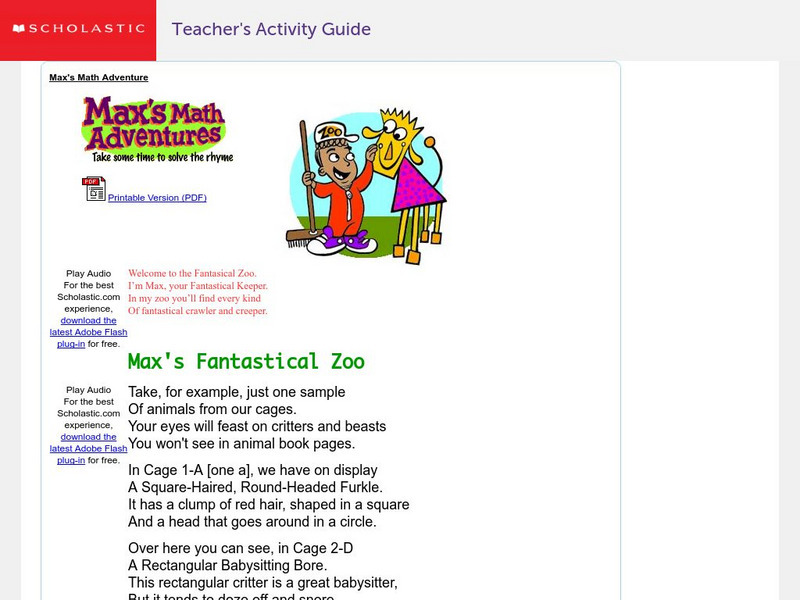
Scholastic
Scholastic: Max's Math Adventures: Max's Fantastical Zoo
Use this rhyming description of Max's Fantastical Zoo to make some amazing animals from geometric shapes. There is a teacher's guide for easy lesson planning.
National Council of Teachers of Mathematics
The Math Forum: The Cylinder Problem: Elementary Lesson
Use this lesson plan to help students learn about cylinders. Students will be creating cylinders, and comparing them and their capacity. This engaging, hands-on lesson will hold student interest and be very beneficial to student learning.
National Council of Teachers of Mathematics
The Math Forum: The Cylinder Problem: Middle School Lesson
This lesson offers an interesting, hands-on experience for middle school students studying cylinders. Students will create cylinders, and measure and compare their volumes.
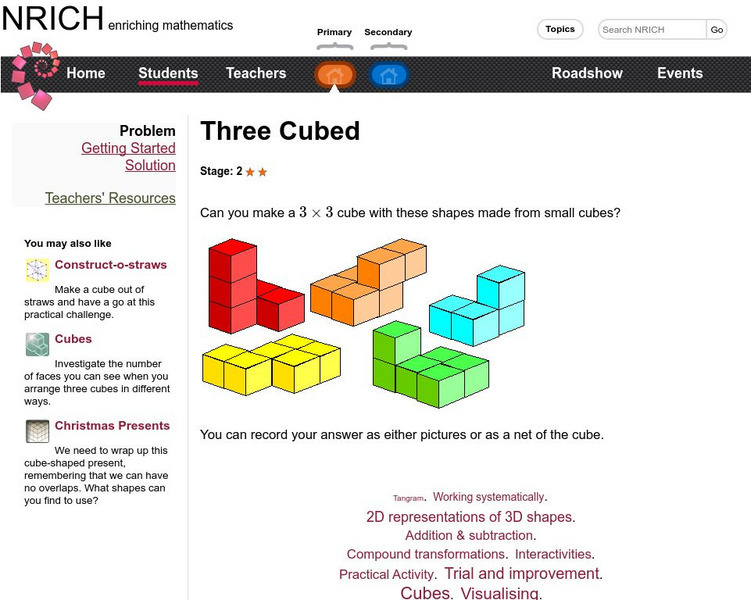
University of Cambridge
University of Cambridge: Nrich: Three Cubed
Use the shapes provided and figure out how they fit together to make a 3 X 3 cube at this one page website. The solution is readily available right at the website.
University of Cambridge
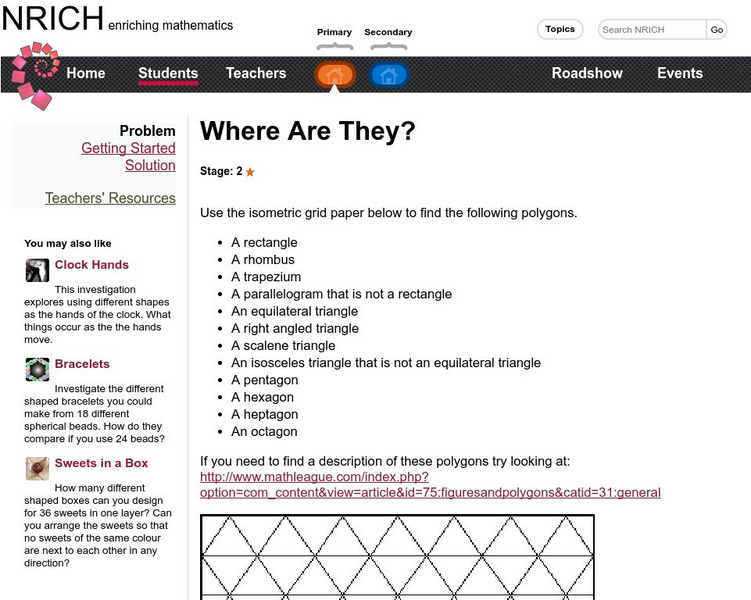
University of Cambridge: Nrich: Where Are They?
Test your logic, polygon properties, and pattern recognition skills working on this challenge. Solution included.
University of Cambridge
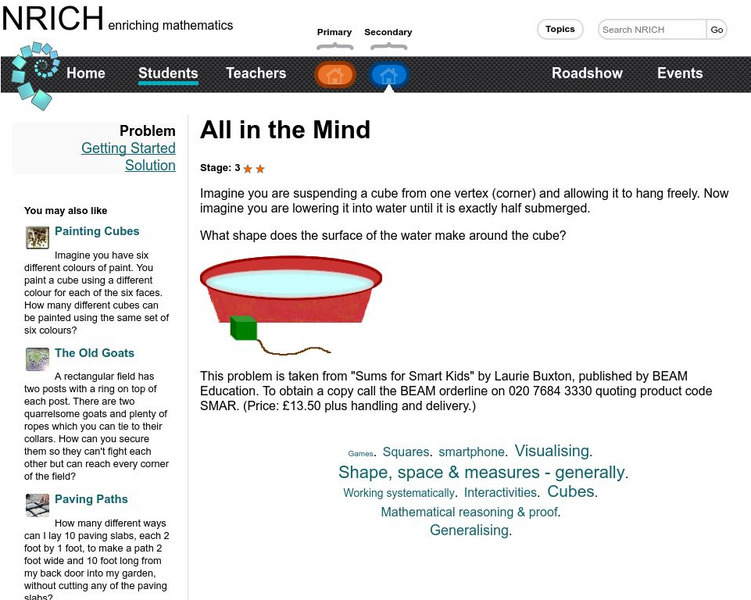
University of Cambridge: Nrich: All in the Mind
You will have to use visualization to help you solve this challenge. At this one page website, you will be able to check your solution.
University of Cambridge
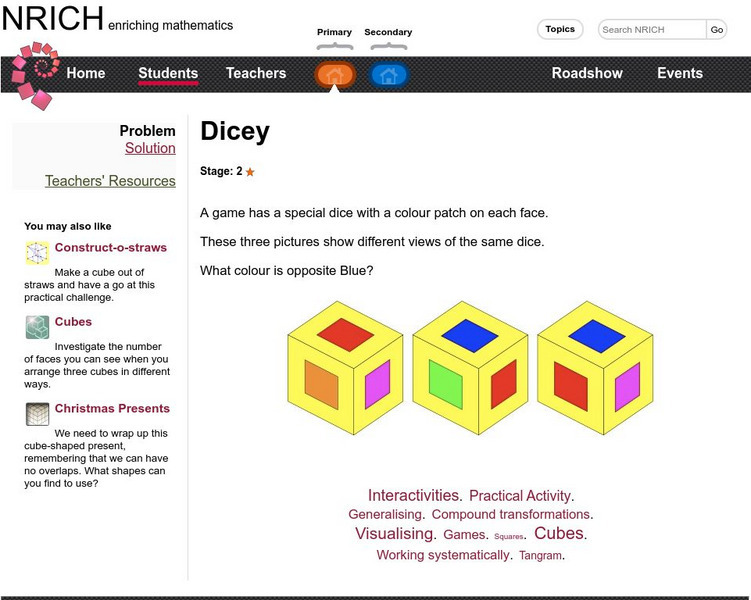
University of Cambridge: Nrich: Dicey
If you can visualize a cube and turn it around in your mind, then this is the challenge for you. This one page website has the solution available to check your thinking.
University of Cambridge
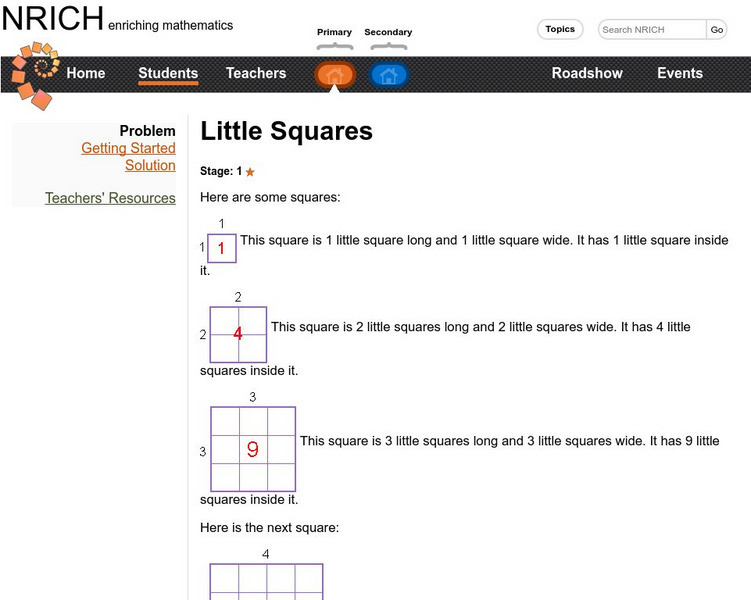
University of Cambridge: Nrich: Little Squares
What are square numbers? Use tiles at this one page website to discover the pattern of square numbers. See if you can solve the challenge. Once you have your solution you can check the solution given right at the website.

University of Cambridge
University of Cambridge: Nrich: A Puzzling Cube
See if you can figure out which symbols are on which cube face at this one page website. The solution is just a click away once you have your solution in mind.

Oswego City School District
Regents Exam Prep Center: Arcs in Circles
Provided are definitions of arcs in circles, an example and theorems to assist with test preparation.
University of Cambridge
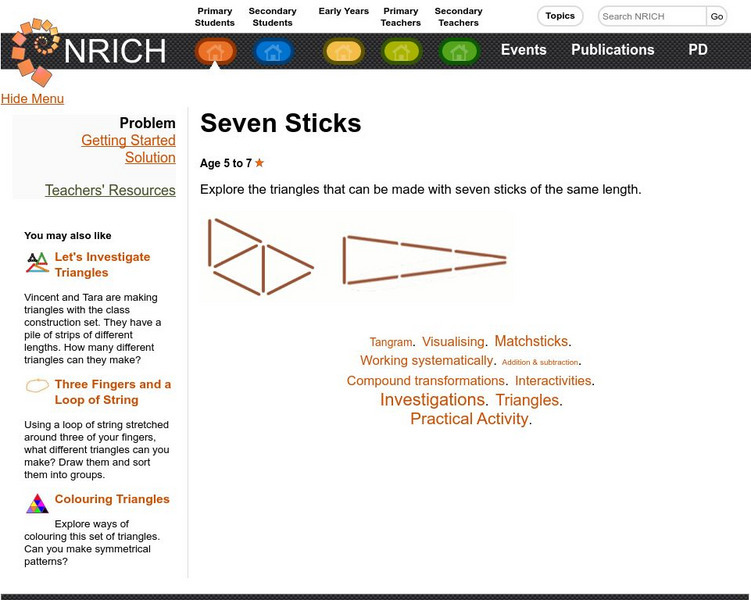
University of Cambridge: Nrich: Seven Sticks
On this one page website sharpen your logic, triangle properties, and pattern recognition skills while working on this challenge. The solution is available to double check your solution.