Hi, what do you want to do?






NorthEast Ohio Geoscience Education Outreach
Introduction to Density
Seventh grade scientists weigh in on the concept of density. In a nutshell, they participate in the following activities:
Measurement of the mass and volume of fruit in order to compare densities
Measurement of the mass of oil and water...

University of Waikato
Temperature, Salinity and Water Density
The difference between sinking and floating may be a little salt. Young experimenters analyze the effect of salt and temperature on the density of water. They use their results to predict the effect of climate change on ocean ecosystems.

Teach Engineering
Density Column Lab - Part 2
Groups suspend objects within layers of liquids to determine the densities of different liquids and compare them to the densities of objects calculated in Part 1. The groups then carefully test their calculations by layering the...

Discovery Education
Motion in the Ocean
How do temperature changes affect ocean currents? Scholars explore convection currents by demonstrating the flow of water in a baking dish. They use ice, heat, and food coloring to see currents. Then, they draw conclusions about their...

It's About Time
Mass and Volume
Don't be so dense that light bends around you; study the relationship between mass and volume instead. Young chemists measure the density of a variety of liquids and solids. A reading passage and analysis questions introduce pupils to...

American Chemical Society
All Wet
Sometimes liquids just don't get along together. A fun experiment has scholars determine whether various liquids dissolve in water. They pour isopropyl alcohol, vegetable oil, and corn syrup into cups of water to see which ones mix well...

Teach Engineering
Aerogels in Action
Model an oil spill cleanup. An engaging engineering lesson has groups using aerogels to simulate an oil spill cleanup (vegetable oil in water). Along the way, they learn about nanotechnology and hydrophilia/hydrophobia.

Exploratorium
The Dipping Bird
If you have or want to order the dipping bird demonstration, it is useful for showing how evaporation and changes in the pressure of a closed system cause cyclical motion. After teaching about pressure, consider setting this little guy...

Exploratorium
Bubble Suspension
Create a cushion of carbon dioxide gas to float some soap bubbles on. Many concepts can be demonstrated through this activity:
Carbon dioxide gas is more dense than air
Bubbles are semipermeable, allowing only carbon dioxide to diffuse...
American Chemical Society
Inquiry in Action: Comparing the Density of Different Liquids
How do the densities of vegetable oil, water, and corn syrup help them to form layers in a cup? Students will carefully pour vegetable oil, water, and corn syrup in any order into a cup and discover that regardless of the order they are...
American Chemical Society
Inquiry in Action: Changing the Density of a Liquid: Heating and Cooling
In this activity, students will investigate whether the temperature of water affects its density. Students will place colored hot and cold water in a cup of room-temperature water to see that cold water sinks while hot water floats. Then...
American Chemical Society
Inquiry in Action: Changing the Density of a Liquid: Adding Salt
In this activity, students will see that a carrot slice sinks in fresh water and floats in saltwater. Considering the placement of the carrot slice in water and salt water, students will infer that the density of salt water must be...
TeachEngineering
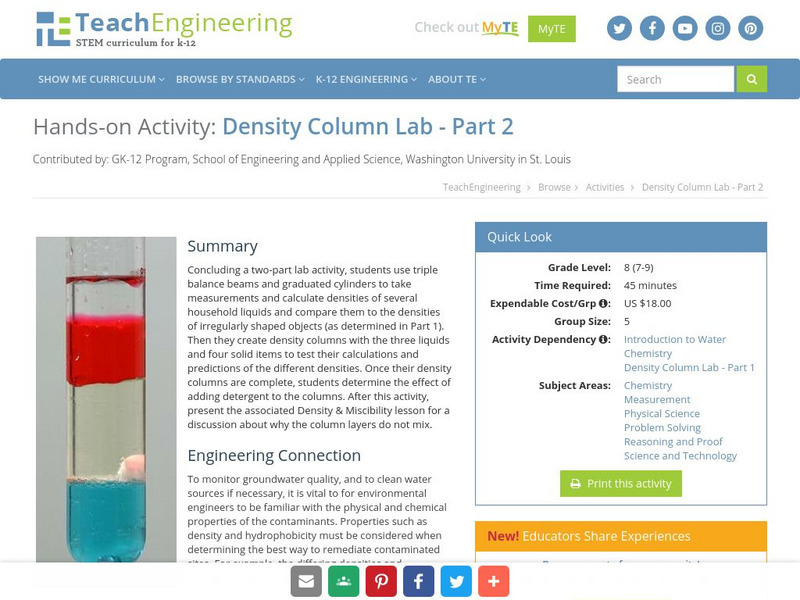
Teach Engineering: Density Column Lab Part 2
Concluding a two-part lab activity, students use triple balance beams and graduated cylinders to take measurements and calculate densities of several household liquids and compare them to the densities of irregularly shaped objects (as...
Science Education Resource Center at Carleton College
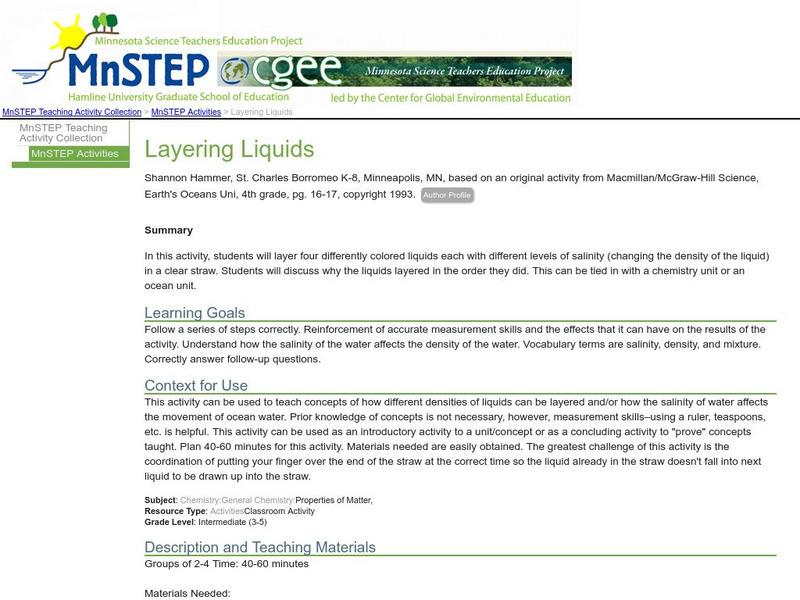
Serc: Layering Liquids
A lab activity to show students how different densities of liquid layer on top of each other by using four different colored liquids that contain different levels of salinity. This activity can also be used in an ocean unit where...
Science Buddies
Science Buddies: Can Water Float on Water?
Of course it can, you say: ice is water and ice floats. And you're right. But we're talking about water in the liquid phase Can liquid water float on water? The goal of this project is to investigate what happens to layers of water with...
Other
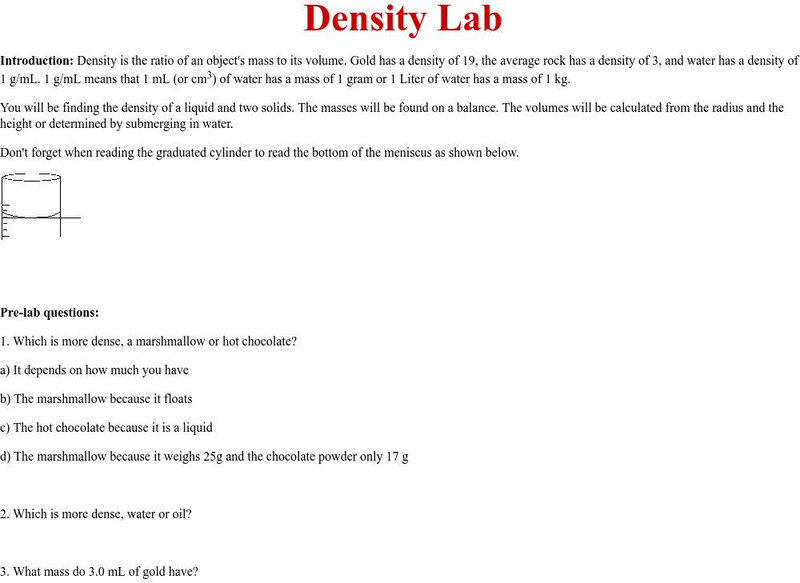
Lapeer County Schools Science Resources: Density Lab
A simple lab experiment for students to find the density of two solids and a liquid (does not use water displacement). Note that number 1d should not state "weighs" since mass is being found.
Science Museum of Minnesota
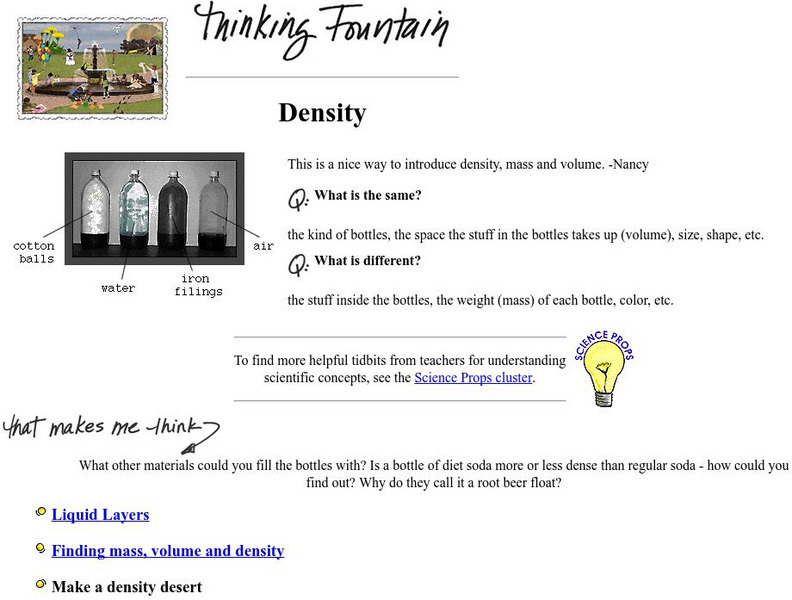
Science Museum of Minnesota: Thinking Fountain: Density
An introduction to density, mass, and volume with links to related books and activities.
![Thinking Fountain: Liquid Layers [Pdf] Activity](https://static.lp.lexp.cloud/images/attachment_defaults/resource/large/FPO-knovation.png "Thinking Fountain: Liquid Layers [Pdf] Activity")
My Science Site
Thinking Fountain: Liquid Layers [Pdf]
Students contrast the densities of oil and water in this lab activity. Can be done in groups or individually. This resource is in PDF form; requires Adobe Reader.

PBS
Pbs Teachers: Water Density
Demonstrate the effect that dissolving different amounts of salt in water has on the density of the liquid.
Read Works
Read Works: Talk About Dense
[Free Registration/Login Required] An informational text explaining the density of solids and liquids. A question sheet is available to help students build skills in reading comprehension.
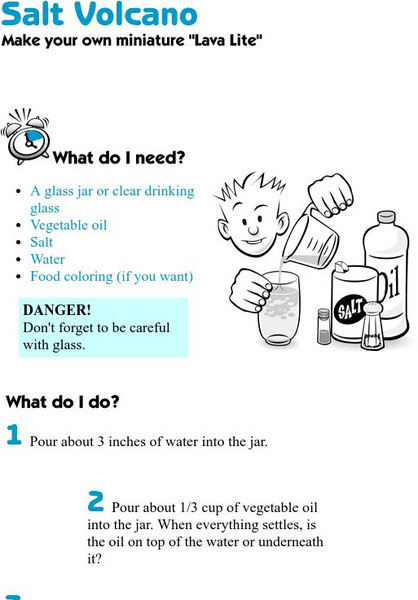
Exploratorium
Exploratorium: Salt Volcano
By making oil float on water--with the help of other ingredients--students can create a lava-lite effect.
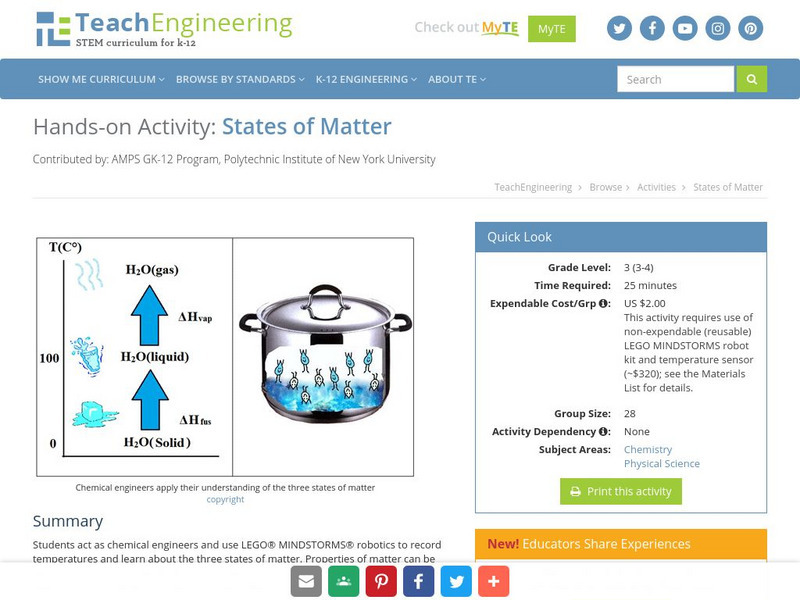
TeachEngineering
Teach Engineering: States of Matter
Students act as chemical engineers and use LEGO MINDSTORMS NXT robotics to record temperatures and learn about the three states of matter. Properties of matter can be measured in various ways, including volume, mass, density and...

PBS
Pbs Teachers: What's More Dense
Compare the density of water, corn oil and corn syrup by trying to float different items in each material and then putting all three liquids into one container.