Hi, what do you want to do?






Massachusetts Institute of Technology
Lego Atoms and Molecules: Chemical Reactions
Show young chemists what a chemical reaction looks like with two parts of a hands-on experiment. First, learners conduct a wet lab where they observe the reactants (baking soda and calcium chloride, with phenolsulfonphthalein)...

Curated OER
Introduction to Lego Robotics
Students utilize computer programs to operate a simple robot. In this technology instructional activity, students create robots using Lego pieces and simple motors to move them. Students measure the speed of the robots by...

DiscoverE
Levitating Train
Levitation isn't just for magicians. Pupils design and build a small portion of track for a maglev train using magnets and Lego bricks. The goal is to get the trains to levitate—without using magic!

Curated OER
The Assembly Line
Learners create an assembly line and build a simple car from LEGO bricks. They explore about the effects of Ford's use of the assembly line, auto financing, and increased wages to make his fortune early in the 20th century.

Curated OER
LEGO Construction Basics-Axles and Wheels
Students examine axles and wheels using LEGO materials. They investigate the uses of axles, gears, and wheels.

Core Knowledge Foundation
Chaos within the Living World? NOT!
What are the five kingdoms? Fifth graders engage in a series of investigations and research activities focused on the methods of classification used by scientists, as well as the language they use to describe the similarities and...

NOAA
Oceans of Energy
Are the earth's oceans really just giant batteries, waiting for their energy to be harnessed? Middle school mechanical engineers will be shocked by the amazing amount of energy that forms around them after diving into part four of a...

LABScI
The Rutherford Atomic Model: Hidden Obstacles
Historically, scientists had to be creative to study subatomic structure. Scholars step into their minds to recreate the procedure Rutherford used to create his atomic model. Learners identify the creative efforts of early scientists...

National Nanotechnology Infrastructure Network
Synthesis and Characterization of CdSe Quantum Dots
Does the size of a sample change the physical properties of that substance? It turns out it can! Young scientists combine physics and chemistry to synthesize CdSe quantum dots and record their color properties. Learners should...

Curated OER
Photosynthesis
Learners conduct a variety of experiments on photosynthesis. In this biology lesson, students identify the factors required for the process to occur. They perform computerized experiments to test the amount of oxygen produced when plants...

Curated OER
A Human-Powered Vehicle for Trans-Glacial Transport
Learners practice problem solving skills and experimental design. They build a vehicle that can traverse "glacial" ice capable of carrying a specific load and glide smoothly, creating as little effort as possible for the skier pulling...

Curated OER
Structures
Students choose which building material to use to create their structure and which animal to house. After being read a story, they examine and identify the differnet types of homes mentioned. They take pictures of their structures...

PBS
Pbs Learning Media: Environmental Public Health: Understanding Air: Air Pollution & Modeling Pollutants With Lego Bricks
In this lesson, students learn about the chemical reactions that release various pollutants into the atmosphere and what happens when pollutants in the air are exposed to sunlight. They model incomplete combustion using LEGO bricks, and...
TeachEngineering
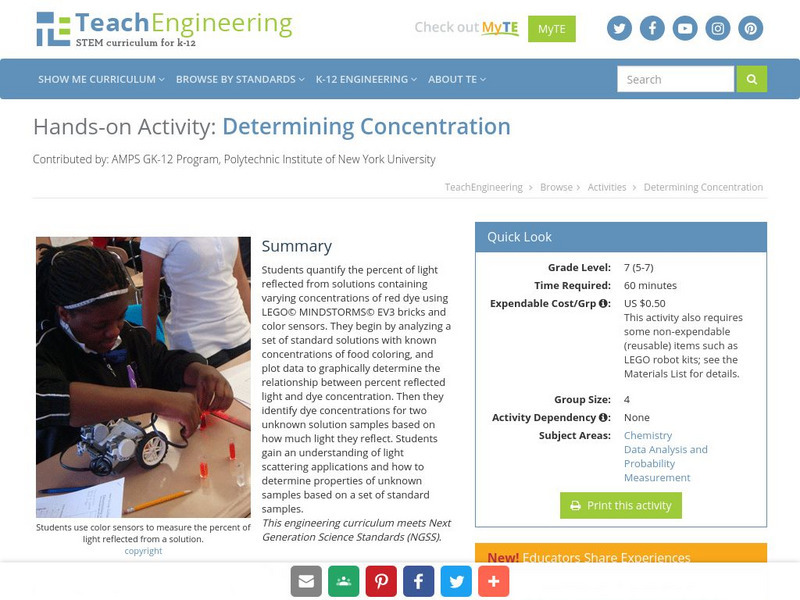
Teach Engineering: Determining Concentration
Students quantify the percent of light reflected from solutions containing varying concentrations of red dye using LEGO MINDSTORMS NXT bricks and light sensors. They begin by analyzing a set of standard solutions with known...
TeachEngineering
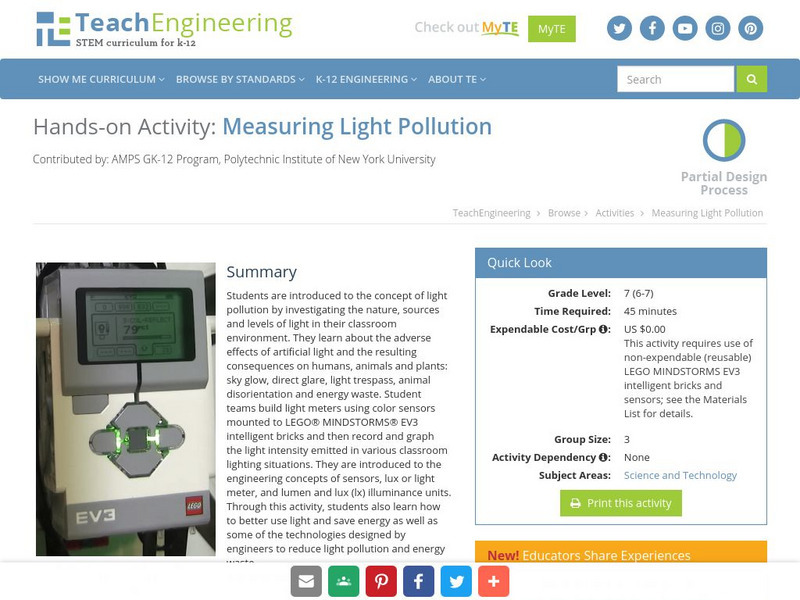
Teach Engineering: Measuring Light Pollution
Students are introduced to the concept of light pollution by investigating the nature, sources and levels of light in their classroom environment. They learn about the adverse effects of artificial light and the resulting consequences on...
TeachEngineering
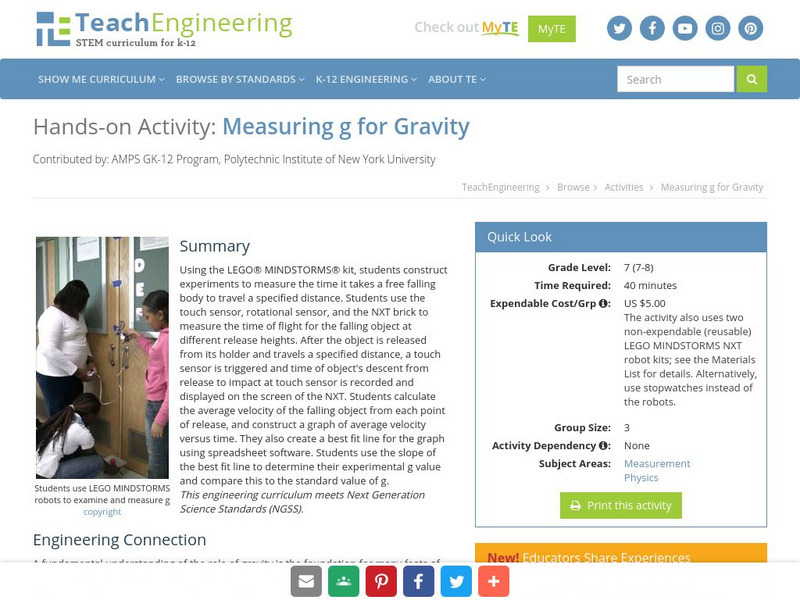
Teach Engineering: Measuring G
Using the LEGO MINDSTORMS NXT kit, students construct experiments to measure the time it takes a free falling body to travel a specified distance. Students use the touch sensor, rotational sensor, and the NXT brick to measure the time of...
TeachEngineering
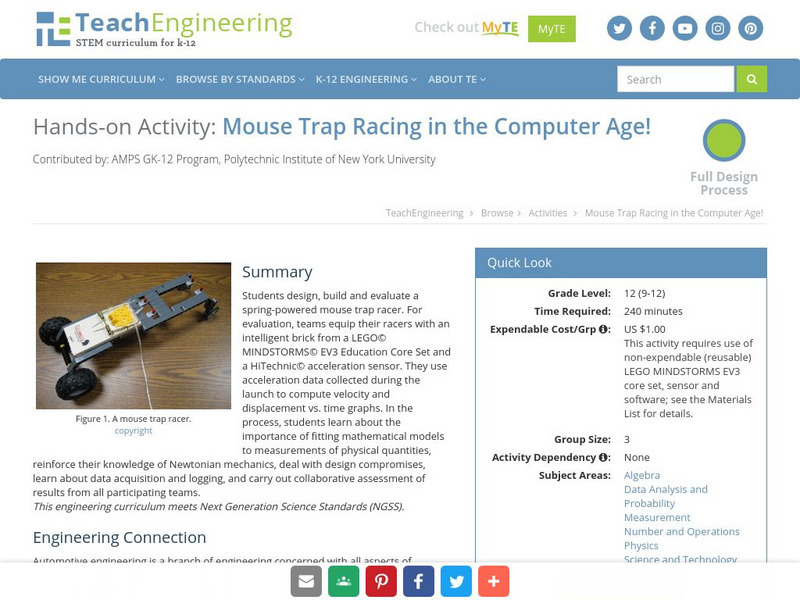
Teach Engineering: Mouse Trap Racing in the Computer Age!
Students design, build and evaluate a spring-powered mouse trap racer. For evaluation, teams equip their racers with an intelligent brick from a LEGO MINDSTORMS NXT Education Base Set and a HiTechnic acceleration sensor. They use...
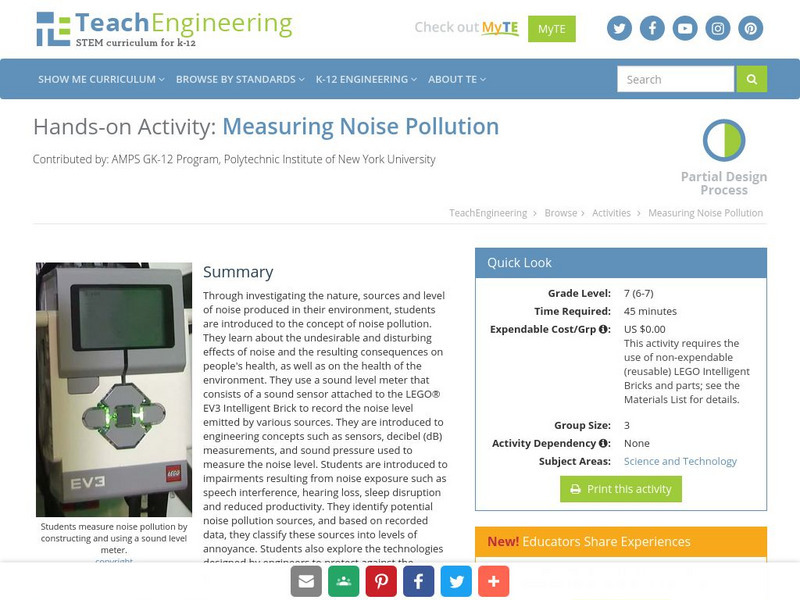
TeachEngineering
Teach Engineering: Measuring Noise Pollution
Through investigating the nature, sources and level of noise produced in their environment, students are introduced to the concept of noise pollution. They learn about the undesirable and disturbing effects of noise and the resulting...
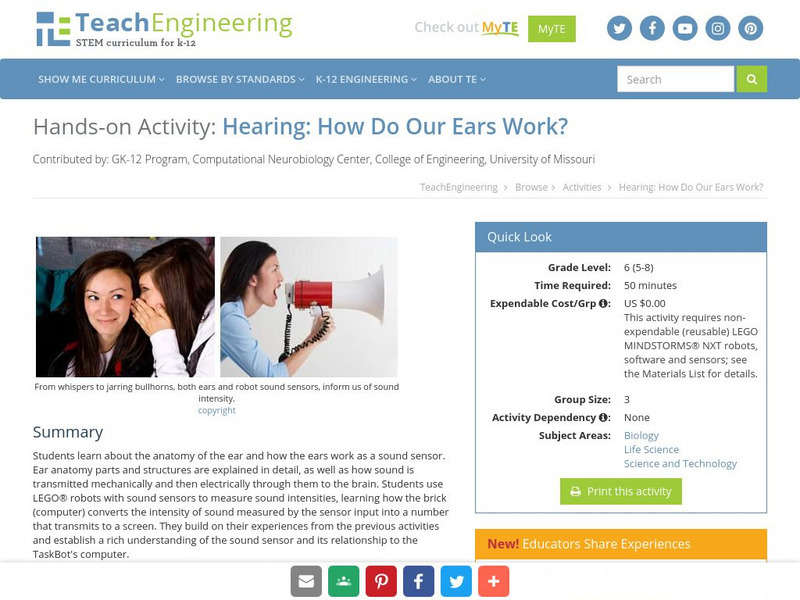
TeachEngineering
Teach Engineering: Hearing: How Do Our Ears Work?
Students learn about the anatomy of the ear and how the ears work as a sound sensor. Ear anatomy parts and structures are explained in detail, as well as how sound is transmitted mechanically and then electrically through them to the...
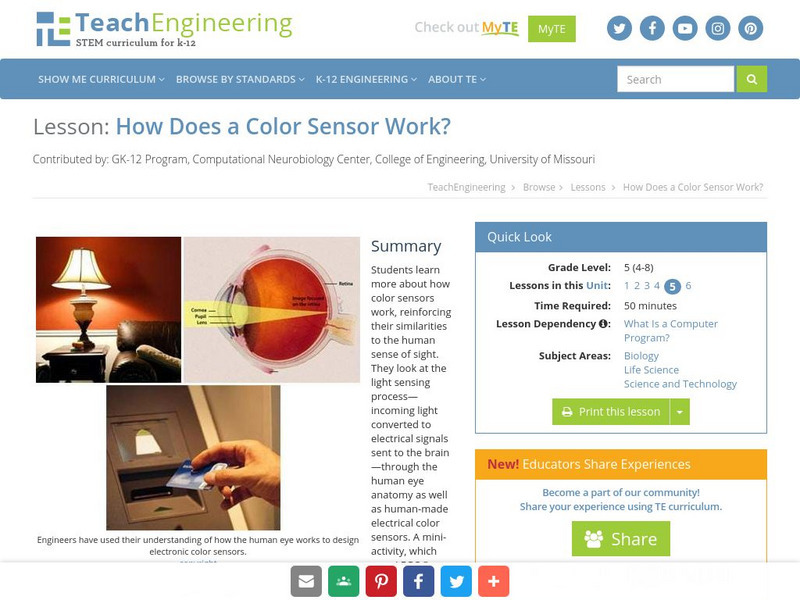
TeachEngineering
Teach Engineering: How Does a Light Sensor Work?
A mini-activity, which uses LEGO MINDSTORMS NXT intelligent bricks and light sensors gives students a chance to investigate how light sensors function in preparation for the associated activity involving the light sensors and taskbots.
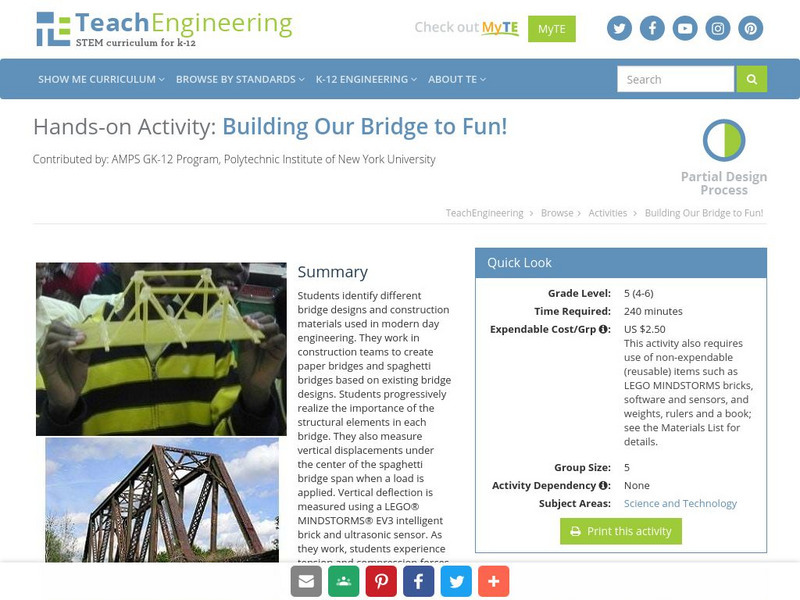
TeachEngineering
Teach Engineering: Building Our Bridge to Fun!
Students identify different bridge designs and construction materials used in modern day engineering. They work in construction teams to create paper bridges and spaghetti bridges based on existing bridge designs. Students progressively...