
Curated OER
Magic Rope Curl-ups
Learners imagine that they are pulling themselves up from the floor using a magic rope.

Curated OER
Hip Replacement
Students take a close examine animals' skeletons to see how their pelvis and femur work together for movement. By investigating their skeletons students discover the placement and functions of our own bodies. They use owl pellets in this...

Curated OER
Tennis
Tenth graders participate in a warm-up activity. They practice the proper way to grip a tennis racquet. They investigate the forehand ground stroke including the hand, arm and follow through motions. They complete the session by playing...

OpenStax
Open Stax: Axial Muscles of the Head, Neck, and Back
The skeletal muscles are divided into two categories: the axial, muscles of the trunk and head, and the appendicular, muscles of the arms and legs. Learn here all about the axial muscles.

Gateway Community College
James Crimando:major Superficial Muscles: Anterior Thigh and Leg
Learn the anatomy of the anterior thigh and leg.
Other
Get Body Smart: Functional Anatomy of Skeletal Muscles
Brought to you by Get Body Smart, students can learn about the human musculoskeletal system through this easy-to-access tutorial. Sections include muscles that act on the arm, shoulder, forearm, wrist, palm, digits, anterior thigh,...
Curated OER
Kids Health: Going to a Physical Therapist
There are different reasons for going to a physical therapist. Kids go there, as do older people. Sometimes kids go to help them get well after a minor injury, like a broken arm or leg. Some kids go because they have a physical...
Curated OER
Kids Health: Strength Training
Strength training isn't just for people wanting to develop larger muscles. This article discusses many of the benefits associated with weight training and how to determine your appropriate level of involvement. Links to related articles...
CK-12 Foundation
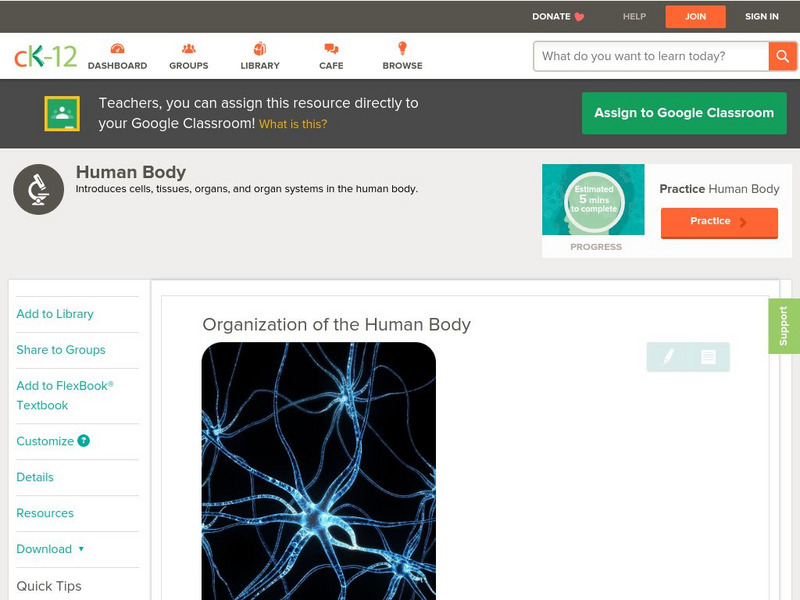
Ck 12: Life Science: Organization of the Human Body
[Free Registration/Login may be required to access all resource tools.] Cells, like these nerve cells, do not work in isolation. To send orders from your brain to your legs, for example, signals pass through many nerve cells. These cells...