Hi, what do you want to do?






Teach Engineering
Solar Power
Elementary schoolers discover how engineers use solar energy to heat buildings. They take a close look at some of the materials used: sand, salt, water, and shredded paper and evaluate the efficiency of each material. An incredible...

Curated OER
The Greenhouse Effect and Me: How Do We Affect Each Other?
Ninth graders create a model of greenhouse effect in the lab. In this integrated science lesson, 9th graders investigate the different variables affecting this condition. They research about global warming and prepare a PowerPoint...

Curated OER
Global Warming and Hurricanes: Is an Increase in the Number of Stronger Hurricanes an Indicator of Global Warming
Ninth graders investigate whether stronger hurricanes are signs of global warming. In this environmental science lesson plan, 9th graders research both sides of the issue about global warming. They debate for or against this issue in class.

Curated OER
Breaking Beams
Students work together designing and building their own beams. They discover the concepts of stress and strain. They participate in a competition to determine the best beam.
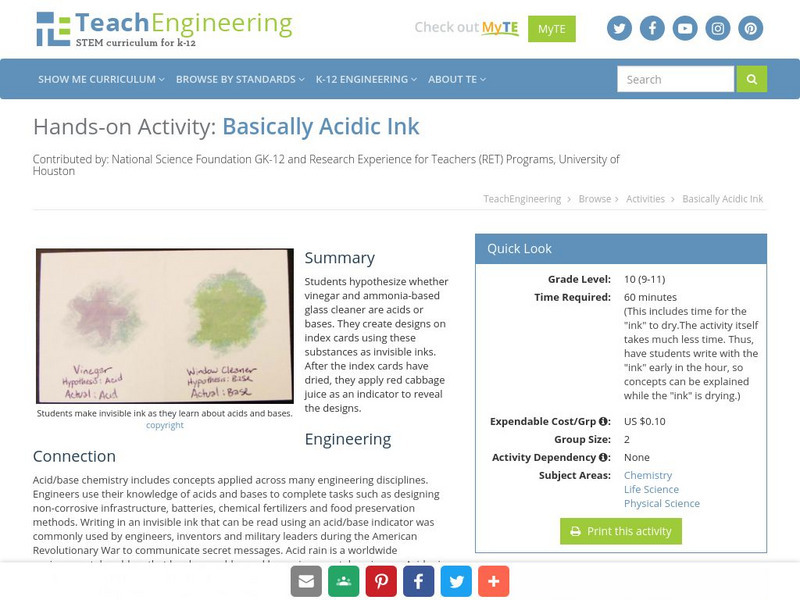
TeachEngineering
Teach Engineering: Basically Acidic Ink
Students hypothesize whether vinegar and ammonia-based glass cleaner are acids or bases. They create designs on index cards using these substances as invisible inks. After the index cards have dried, they apply red cabbage juice as an...
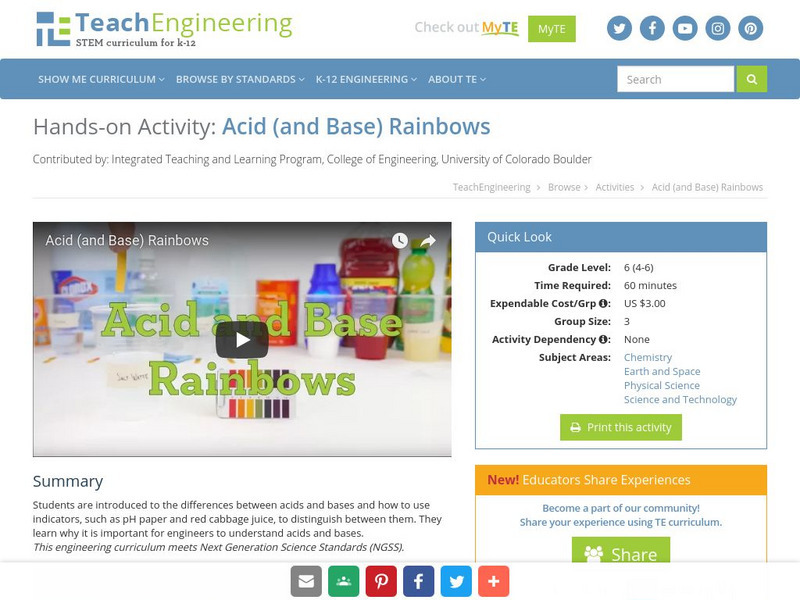
TeachEngineering
Teach Engineering: Acid (And Base) Rainbows
Students are introduced to the differences between acids and bases and how to use indicators, such as pH paper and red cabbage juice, to distinguish between them.

TeachEngineering
Teach Engineering: Cell Membrane Experimental Design
The final activity of this unit, which integrates the Keepers of the Gate unit through the Go Public challenge, involves students taking part in experimental design. They design a lab that answers the challenge question: "You are...
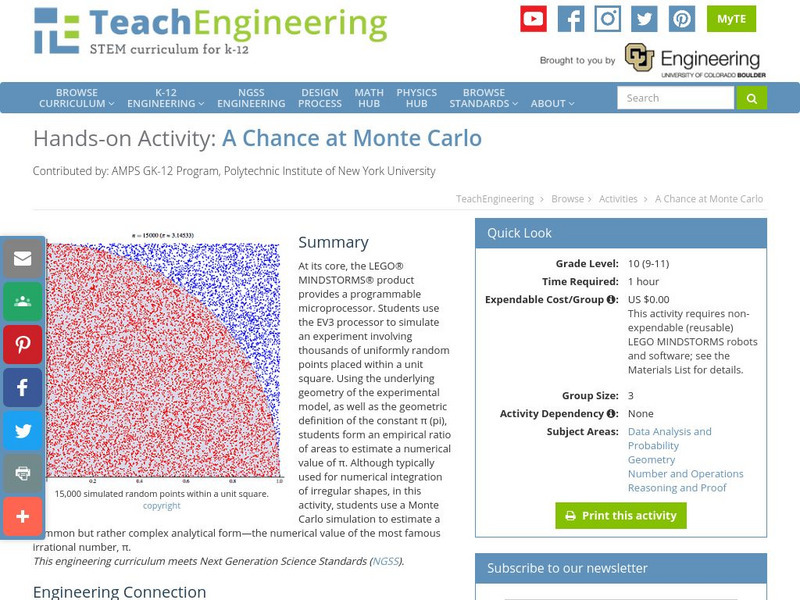
TeachEngineering
Teach Engineering: A Chance at Monte Carlo
At its core, the LEGO MINDSTORMS product provides a programmable microprocessor. Students use the EV3 processor to simulate an experiment involving thousands of uniformly random points placed within a unit square. Using the underlying...
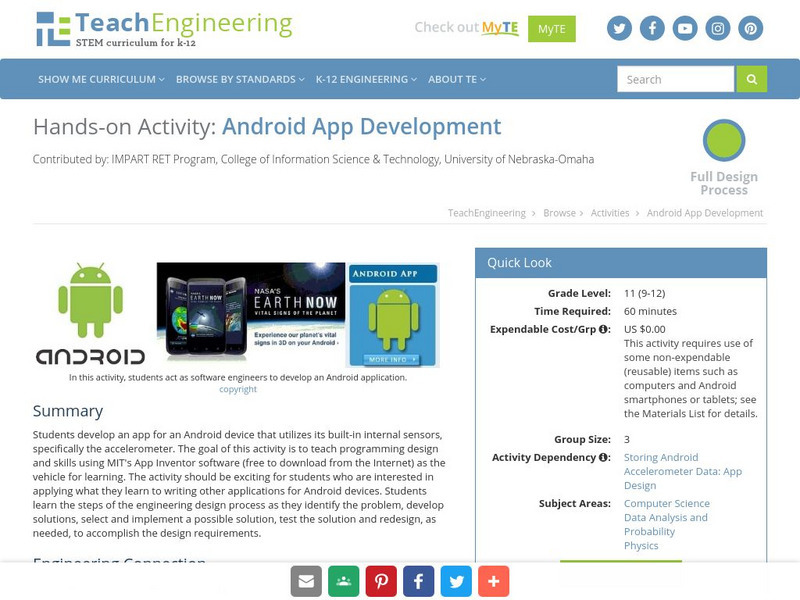
TeachEngineering
Teach Engineering: Android App Development
Students develop an app for an Android device that utilizes its built-in internal sensors, specifically the accelerometer. The goal of this activity is to teach programming design and skills using MIT's App Inventor software (free to...

TeachEngineering
Teach Engineering: Program Analysis Using App Inventor
In computer science, program analysis is used to determine the behavior of computer programs. Flow charts are an important tool for understanding how programs work by tracing control flow. Control flow is a graphical representation of...
TeachEngineering
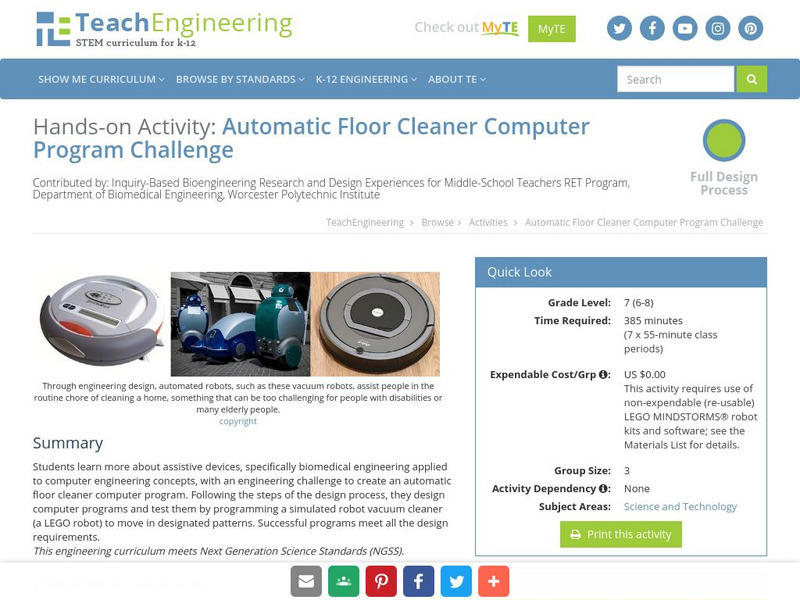
Teach Engineering: Automatic Floor Cleaner Computer Program Challenge
Students learn more about assistive devices, specifically biomedical engineering applied to computer engineering concepts, with an engineering challenge to create an automatic floor cleaner computer program. Following the steps of the...

TeachEngineering
Teach Engineering: Teaching the Engineering Design Process
Students follow the steps of the engineering design process (EDP) while learning about assistive devices and biomedical engineering. They first go through a design-build-test activity to learn the steps of the cyclical engineering design...
TeachEngineering
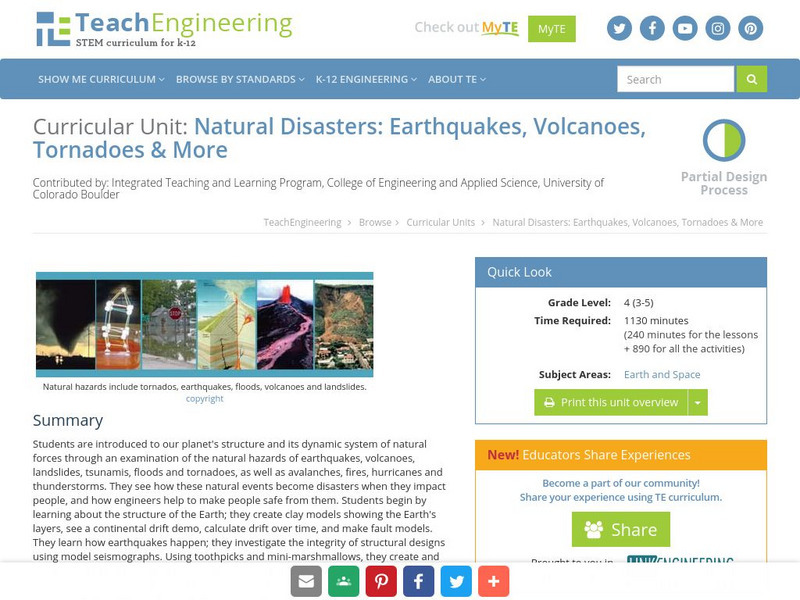
Teach Engineering: Natural Disasters
Students are introduced to our planet's structure and its dynamic system of natural forces through an examination of the natural hazards of earthquakes, volcanoes, landslides, tsunamis, floods and tornados, as well as avalanches, fires,...
TeachEngineering
Teach Engineering: Does It Work? Test and Test Again
Testing is critical to any design, whether it be in the creation of new software or building a bridge across a wide river. Despite risking the quality of the design, the testing stage is often hurried in order to get products to market....
TeachEngineering
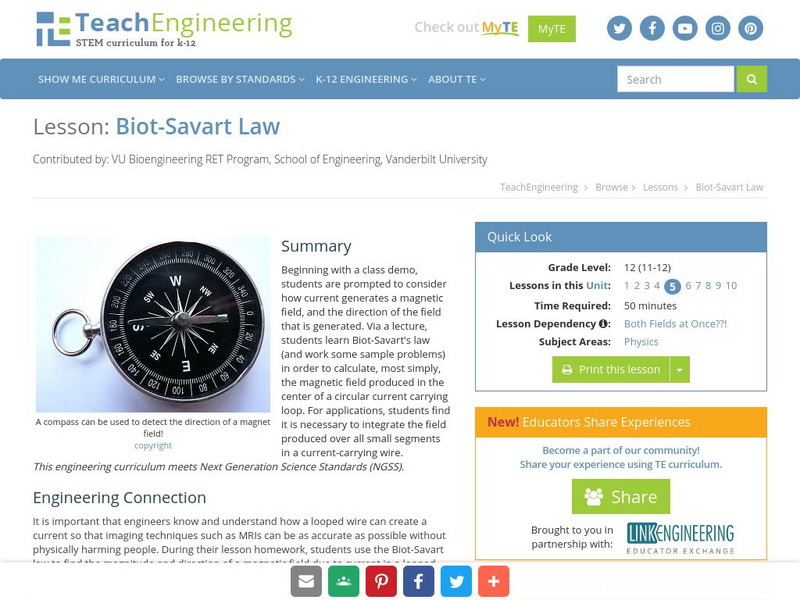
Teach Engineering: Biot Savart Law
This lesson plan begins with a demonstration prompting students to consider how current generates a magnetic field and the direction of the field that is generated. Through formal lecture, students learn Biot-Savart's law in order to...
TeachEngineering
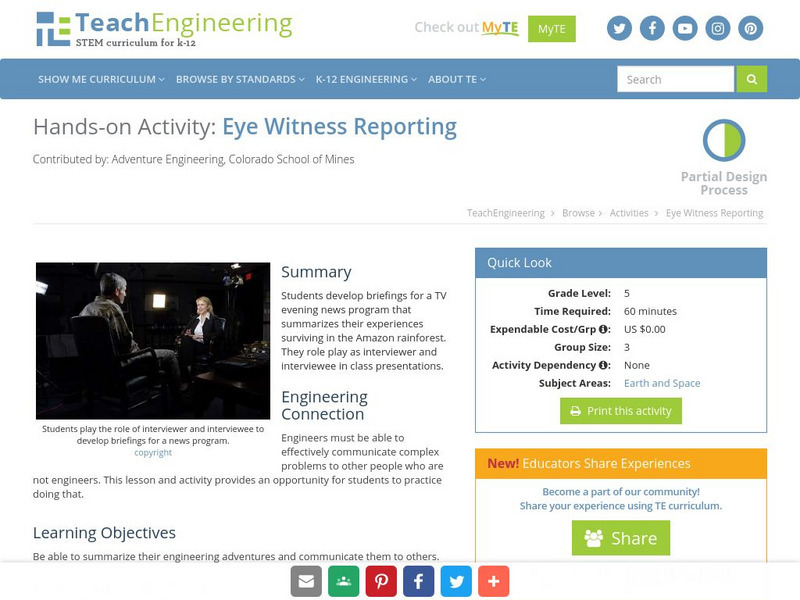
Teach Engineering: Eye Witness Reporting
In this activity, the students will develop a briefing for a T.V. evening news program that summarizes their experiences surviving in the Amazon rainforest. The students will have the opportunity to role play as interviewer and...
TeachEngineering
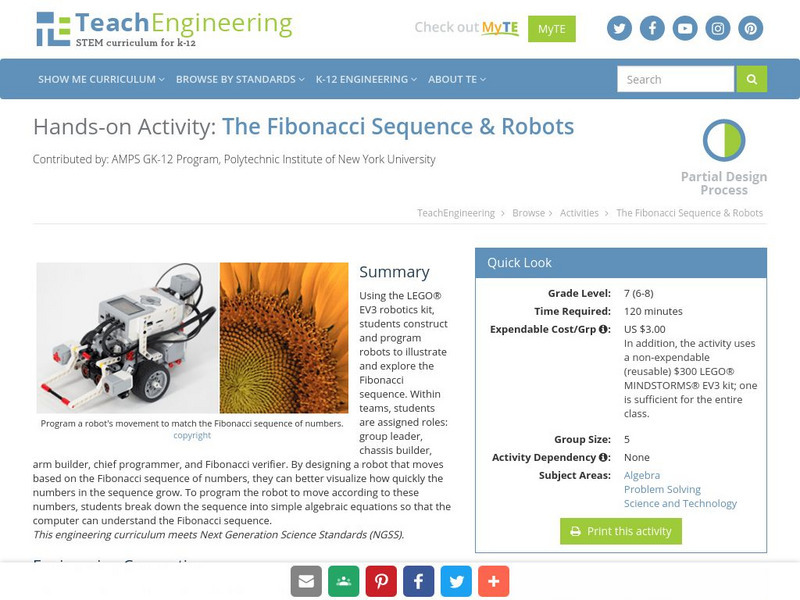
Teach Engineering: The Fibonacci Sequence & Robots
Using the LEGO NXT robotics kit, students construct and program robots to illustrate and explore the Fibonacci sequence. Within teams, students are assigned roles: group leader, chassis builder, arm builder, chief programmer, and...
TeachEngineering
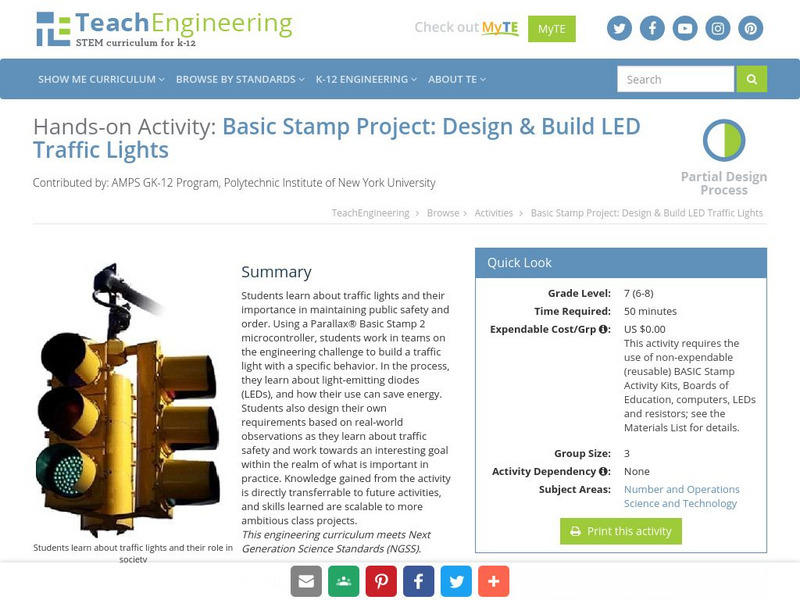
Teach Engineering: Traffic Lights
Students learn about traffic lights and their importance in maintaining public safety and order. Using a Parallax Basic Stamp 2 microcontroller, students work in teams on the engineering challenge to build a traffic light with a specific...
TeachEngineering
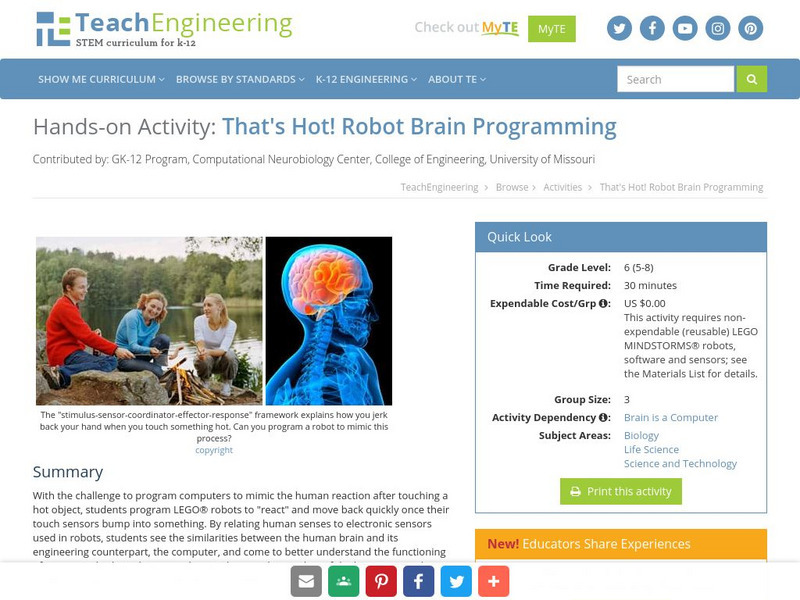
Teach Engineering: That's Hot! Robot Brain Programming
With the challenge to program computers to mimic the human reaction after touching a hot object, students program LEGO robots to "react" and move back quickly once their touch sensors bump into something. By relating human senses to...
TeachEngineering
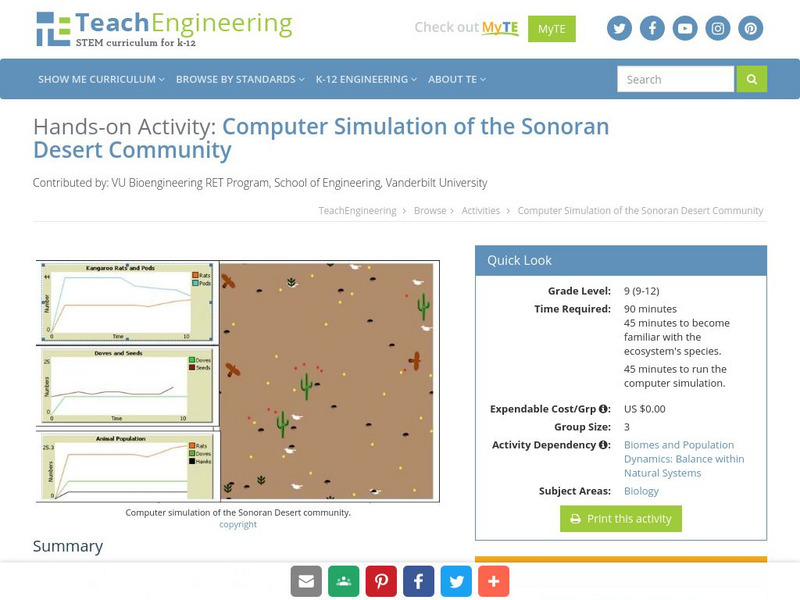
Teach Engineering: Computer Simulation of the Sonoran Desert Community
The computer program's simulation of a Sonoran desert community should ultimately strengthen the student's comprehension of what is required for a natural ecosystem to sustain itself (remain in balance). This computer simulation program...
TeachEngineering
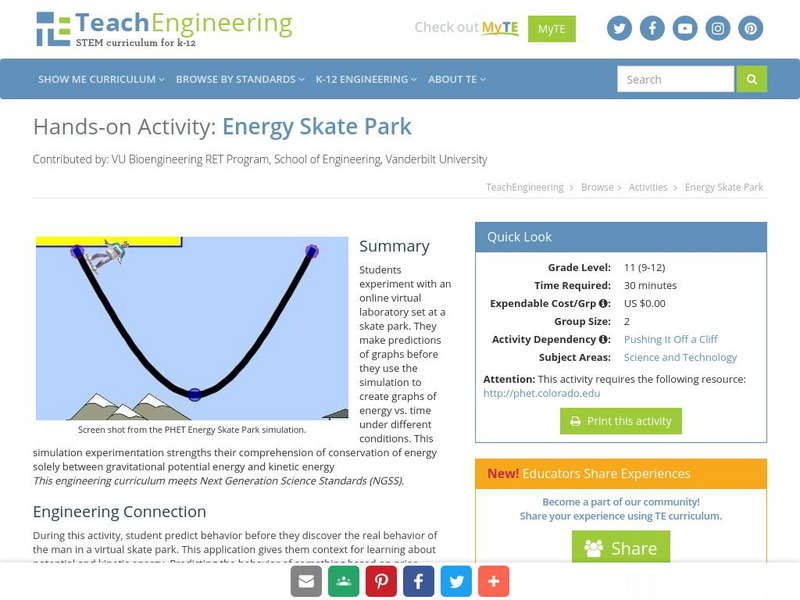
Teach Engineering: Energy Skate Park
This activity focuses on the conservation of energy solely between gravitational potential energy and kinetic energy. Students work with a virtual laboratory set at a skate park. They make predictions of graphs before they use the...
TeachEngineering
Teach Engineering: The Evening News
In this instructional activity, the students will summarize their experiences in the Amazon rainforest by developing and presenting a briefing for a T.V. evening news program.
TeachEngineering
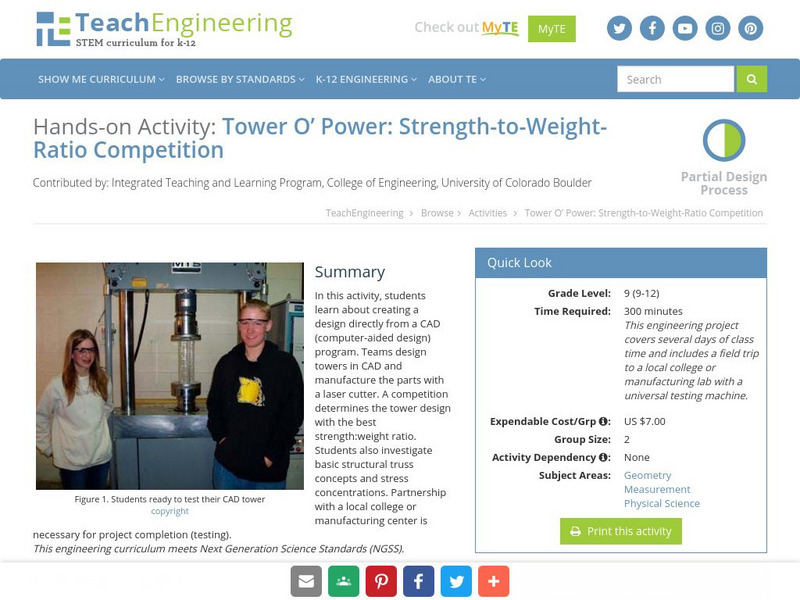
Teach Engineering: Tower O' Power
In this activity, students learn about creating a design directly from a CAD (computer-aided design) program. They will design a tower in CAD and manufacture the parts with a laser cutter. A competition determines the tower design with...
TeachEngineering
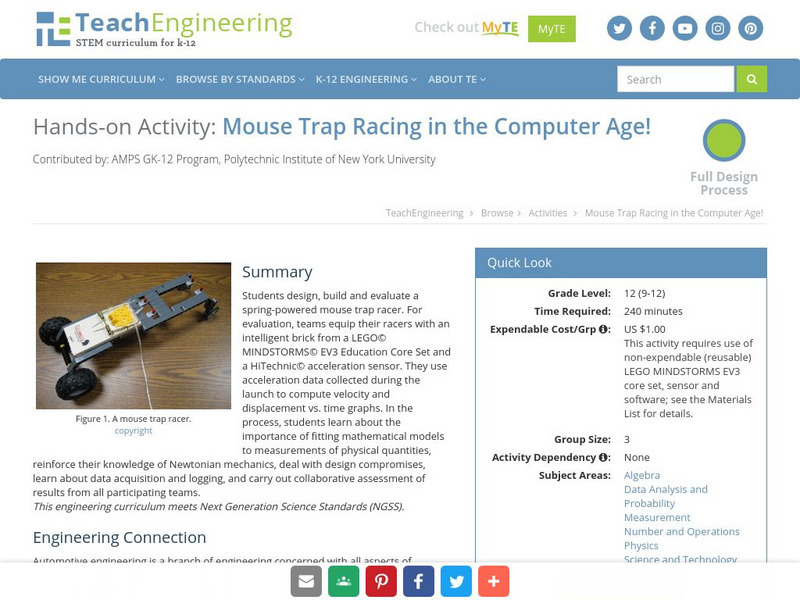
Teach Engineering: Mouse Trap Racing in the Computer Age!
Students design, build and evaluate a spring-powered mouse trap racer. For evaluation, teams equip their racers with an intelligent brick from a LEGO MINDSTORMS NXT Education Base Set and a HiTechnic acceleration sensor. They use...