Hi, what do you want to do?






Cal Recycle
Conserving Natural Resources
Trying to plan an engaging elementary science unit on natural resources? Conserve your energy! This five-part series of lessons and hands-on activities has exactly what you need to teach young scholars about the importance of conservation.

Core Knowledge Foundation
Taking Care of the Earth Tell It Again!™ Read-Aloud Anthology
A read-aloud anthology closely examines human impact on the Earth while boosting reading comprehension skills. Through stories, scholars examine the concepts of natural resources, pollution, garbage, and recycling and brainstorm...

Curated OER
Sustainability and Extinction
Galapagos Penguins are the only penguins on earth that live north of the equator (in the wild). In this last lesson plan a discussion on how the Galapagos islands developed their populations and diversity sparks the introduction. Two...

NASA
Transportation and Space: Reuse and Recycle
What can I use in space? The three-lesson unit has groups research what man-made or natural resources would be available during space exploration or habitation. Team members think of ways that resources can be reclaimed or reused in...

Odell Education
Reading Closely for Textual Details: Grade 12
Help your class examine humanity's unpredictable nature through "Life Steps Almost Straight." Learners read various works from philosophers such as Viktor Frankl, The Buddha, and Nietzsche to gather textual evidence and explain their...

Curated OER
Hazards: Fifth Grade Lesson Plans and Activities
After comparing earthquake and volcanic hazards to one another, fifth graders take a closer look at damage associated with a volcanic eruption. They then create a simulation of mudslides due to a volcanic eruption. Using different...

Mathematics Vision Project
Module 3: Arithmetic and Geometric Sequences
Natural human interest in patterns and algebraic study of function notation are linked in this introductory unit on the properties of sequences. Once presented with a pattern or situation, the class works through how to justify...

Henry Ford Museum
Human Impact on Ecosystems
An environmenta science unit includes three lessons plus a cumulative project covering the ecosystem. Scholars follow the history of the Ford Rouge Factory from its construction on wetlands and how it destroyed the...

Curated OER
Rock On! Featuring the Igneous, Sedimentary and Metamorphic Trio!
Get your classroom rocking with this four-lesson earth science unit. Through a series of shared reading activities and hands-on investigations, young geologists learn about the three types of rocks and the unique properties of each.

Allen & Unwin Book Publishers
In the Skin of a Monster
Kathryn Barker's In the Skin of A Monster explores how a school massacre impacts a community. Unfortunately, the events depicted are all too familiar to many. This teacher's guide for Barker's novel offers activities that enable readers...

Curated OER
Artificial Selection
The second lesson in the series begins with a starter activity discussing wild versus domesticated animals. Then, scholars play a card game, with optional variations, to emphasize artificial selection. Next, they attend a field trip to a...

Curated OER
Taking Charge of our Earth and its Resources
Students identify natural resources, discuss conservation and protection of them, and identify how pollution is harmful to the environment. Seven lessons on one page.

Louisiana Department of Education
Hatchet
Accompany a novel study of Hatchet by Gary Paulson with a unit consisting of 16 lessons focused on physical and emotional survival. Reading the story along with a variety of informational texts, scholars compare and contrast reading...

Council for Economic Education
Teaching Economics Using Children's Literature
Introduce young learners to the subject of economics using their favorite stories and books. Including 24 separate lessons, this guide covers economic principles such as trade, scarcity, consumer goods and services, renewable and...

Intel
Biomes in Action
A STEM project-based learning lesson, number four in a series of 10, focuses on human impacts to biomes around the world. Groups work together as environmentalists to research a specific biome, investigating human impacts on it. From...

Western Illinois University
Holocaust Unit Plan
Would it have been you? Scholars investigate the horrors of the Holocaust during World War II. They view, interpret, and analyze the video The Holocaust to gain insight into who exactly was impacted by the events Europe. They then...

Curated OER
Fables Unit Lesson Plan
Students study fables in a broad context. In this literary lesson on fables, students define terms unique to them. Students use a variety of technological resources to gather and classify information into three categories. Students also...

Curated OER
Mysteries of the Past-An Artistic Expedition
Students explore expression in artwork. In this interdisciplinary lesson, students travel to ancient Egypt to examine abstract art of the Nile River valley through several hands-on activities.
Virginia Tech
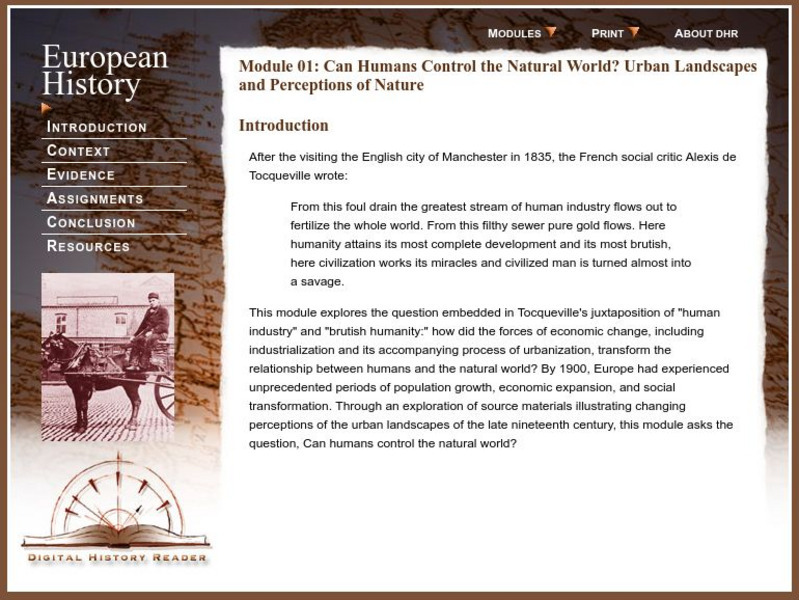
Digital History Reader: Can Humans Control the Natural World?
The course of industrialization and migration of society forced a shift within the natural world. Through context, writing assignments, reports, articles, visual materials, and bibliographical resources this unit dives into the question,...

Scholastic
Scholastic: Study Jams! Science: Energy, Light and Sound: Natural Resources
A slideshow and a short quiz on natural resources, the difference between renewable and nonrenewable resources, and the impact humans have on the Earth's natural resources.
CK-12 Foundation
Ck 12: Biology: Renewable and Nonrenewable Resources
[Free Registration/Login may be required to access all resource tools.] Identifies renewable and nonrenewable resources based on the rate at which humans use a resource. Natural resources, such as water, oxygen, and soil, are supplied by...
E-learning for Kids
E Learning for Kids: Science: Denmark: What Are Natural Resources and Why Are They Important?
Learn about natural resources, both renewable and nonrenewable, and the impact humans have on the natural world.
PBS
Pbs: Pov Borders: Environment
Point of View is television's longest running showcase for independent non-fiction films. This particular feature provides insight regarding alternative means of energy, transport, and the consumption of natural resources. Video, games,...

Annenberg Foundation
Annenberg Learner: The Habitable Planet: Water Resources
Learn about water as a precious resource in danger of being depleted. Understand the roles that overuse and agricultural use play in the sustainability efforts of this essential resource. Includes video. [28:25]