Hi, what do you want to do?






EngageNY
Grade 11 ELA Module 3: Researching Multiple Perspectives to Develop a Position
The only way that a heinous act of genocide can succeed is if citizens of surrounding groups and countries turn their backs on those suffering. A thorough language arts module addresses shared central ideas with three separate units,...

Voices of a People's History
Voices in The Classroom
Everyone's perspective of the past is different. A thought-provoking unit gives young academics the opportunity to explore their perspectives on history and their neighborhoods. Based on the work of Howard Zinn, each lesson explores...

Curated OER
Farewell to Manzanar
Examine human resilience across two texts with a detailed unit. Over the course of a week, learners will conduct a close reading of excerpts from Unbroken and Farewell to Manzanar. The resource includes clear procedures for reading and...

Student Achievement Partners
You've Been Lied To: The REAL Christopher Columbus
Looking for resources that explore alternative perspectives of the Christopher Columbus story? Check out the images, videos, cartoons, primary source documents, and other texts in a packet designed to spark...

Annenberg Foundation
America's History in the Making: Classroom Applications One
Someone finds a time capsule 100 years from now, and it includes your family photo album. What would the photos tell that person about you and your place in history? Scholars investigate how artifacts tell stories. Using photos, maps,...

National Endowment for the Humanities
Faulkner's As I Lay Dying: Form of a Funeral
Learners read and analyze William Faulkner's novel, 'As I Lay Dying.' They define Faulkner's place in American literary history, describe Faulkner's "South" in the context of the historical South and examine the Bundren family through...

Simon & Schuster
Curriculum Guide: The Scarlet Letter
The Scarlet Letter may be a classic, but keeping high schoolers engaged in the reading of Hawthorne's vocabulary, syntax, imagery, and historical references presents it own set of challenges. Here's a guide that offers readers...

Gilder Lehrman Institute of American History
Slave Narratives: Frederick Douglass, Harriet Jacobs, and the Columbian Orator
Young historians practice in-depth, quality analysis of primary source texts in this three-lesson unit, which examines excerpts from the slave narratives of Frederick Douglass, Harriet Jacobs, and Caleb...

Anthropological Association
Race: Teacher Guide: Race
How has the concept of race changed over time? Explore the genetic, cultural, and social aspects of race through a series of impactful activities. Scholars discover how race is influenced by inherited traits, examine census records to...

Film Foundation
Mr. Smith Goes to Washington: What Is a Movie?
Watching is not the same as seeing. Transform viewers from passive watchers to active students of film with this 34-page packet, filled with lessons and activities that use Mr. Smith Goes to Washington to examine the technology, the...

Curated OER
Unit 2: Post-Revolution: The Critical Period 1781-1878
The post-Revolutionary Period of 1781-1787, also known as the Critical Period, is the focus of a series of lessons that prompt class members to examine primary source documents that reveal the instability of the period of the...

California State University
The American Revolution
Invite your class on a ride through the American Revolution. Young historians travel through time as they explore the events that led to the foundation of the United States of America. Over the course of eight lessons, this unit...

Foreign Policy Research Institute
Exploring Korea
A thorough and fun lesson on Korea! In groups of four (Social Chair, Historian, Translator, Travel Agent) class members research North and South Korea to determine a good location for an overseas institute for studying abroad. Once this...

Columbus City Schools
History Helps When It Comes To Plate Tectonics
Get ready to move, shake, slip, and slide with a well-rounded plate tectonics unit! The engaging resource includes everything you need to inspire eighth grade science scholars, from worksheets to demonstrations. Assess their...

Pacific University Oregon
Civil Rights: US History
To gain an understanding of the Civil Rights Movement of the 1960s, class members investigate the Jim Crow Laws, the Emancipation Proclamation, the 13th, 14th, and 15th Amendments of the US Constitution, and the 1898 Supreme Court case,...

College Board
Choices and Consequences
Paul Fisher, the main character in Tangerine, comes to see that it's the choices in life that lead to the consequences that make all the difference. A unit study of Bloor's young adult novel leads readers down this same path.

Annenberg Foundation
By the People, For the People
A picture speaks a thousand words—no matter how old. The 18th installment of a 22-part series on the making of American history has scholars research the causes of the Great Depression and the factors of the New Deal. Using photographic...

Curated OER
Visions for Students: A Study of British Ghost Stories
Ghost stories are the hook suggested in this proposed unit to engage reluctant readers.

Core Knowledge Foundation
Christopher Columbus
Take some time to focus on Christopher Columbus, his three ships, the purpose of his voyage, and the new land he discovered. Pay special attention to the included additional materials, they are the real value in this resource.

University of Wisconsin
Teaching Things Fall Apart in Wisconsin: A Resource Guide for Educators
“There is no story that is not true, . . .” And uncovering the truths in Things Fall Apart is the focus of a 68-page resource packet designed to provide instructors with a wealth of materials that enhance understanding of Chinua Achebe’s...

Curated OER
Our Native Americans
Students complete a unit of lessons on Native Americans. They label maps, list resources the Native Americans used in their daily lives, create an original short story, define key vocabulary, and develop a model of something that...
Other
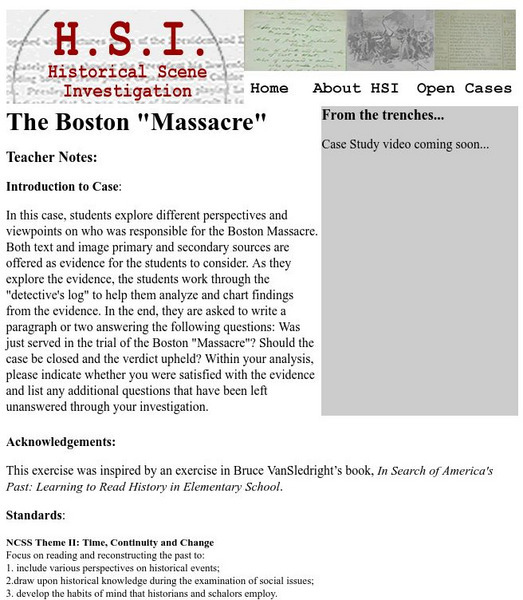
Historical Scene Investigation: The Boston "Massacre"
In this activity, students examine primary sources to learn about the perspectives of the different parties involved in the Boston Massacre of 1770, and to form opinions about who was responsible for what happened and whether the verdict...
Cengage Learning
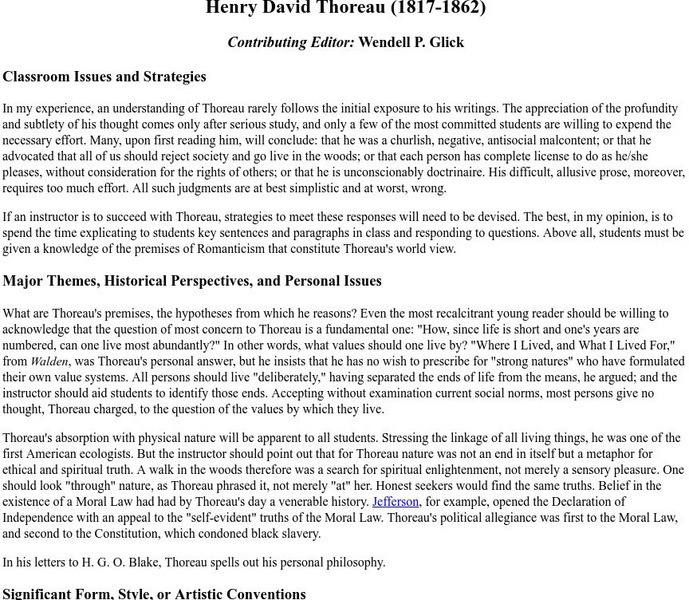
Henry David Thoreau (1817 1862)
This lesson plan discusses teaching students the themes found in Henry David Thoreau. Describes historical perspectives and influences, form, style, and artistic conventions, and the original audience for his work. Includes study...
Annenberg Foundation
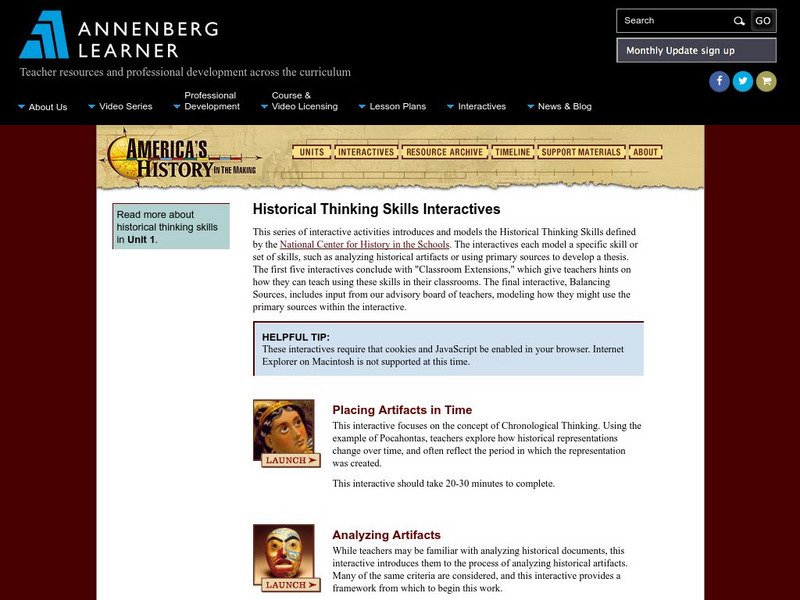
Annenberg Learner: America's History in the Making: Historical Thinking Interactives
Six interactive activities are presented that walk students through how to use their critical thinking skills in the analysis of historical artifacts and documents. The sixth one explains how to balance the various perspectives that...