Hi, what do you want to do?






Rochester Institute of Technology
Heat Transfer
Use an exciting role play activity to teach young chemists about the importance of heat transfer in maintaining homeostasis. They assume the role of a dog sled owner who has been abandoned and must fend for themselves with only a...

It's About Time
Renewable Energy Sources - Solar and Wind
There has been a huge solar energy spill! Let's go outside to play in it. This lesson includes multiple experiments showcasing solar and wind energies. Scholars build a solar heater and an anemometer before testing the results. The...

It's About Time
Energy Flow in Ecosystems
Emerging biochemists more fully understand the flow of energy in ecosystems as they explore the laws of thermodynamics and relate them to energy transfer in food chains. They also investigate heat loss from the human body and how...

Center for Learning in Action
Water – Changing States (Part 2)
Here is part two of a two-part lesson in which scholars investigate the changing states of water—liquid, solid, and gas—and how energy from heat changes its molecules. With grand conversation, two demonstrations, and one hands-on...

National Institute of Open Schooling
Spontaneity of Chemical Reactions
Do spontaneous reactions really occur? Activity 12 in a series of 36 focuses on spontaneity of chemical reactions. Learners read about, discuss, and answer questions pertaining to entropy, explain the third law of thermodynamics, explore...
Purdue University
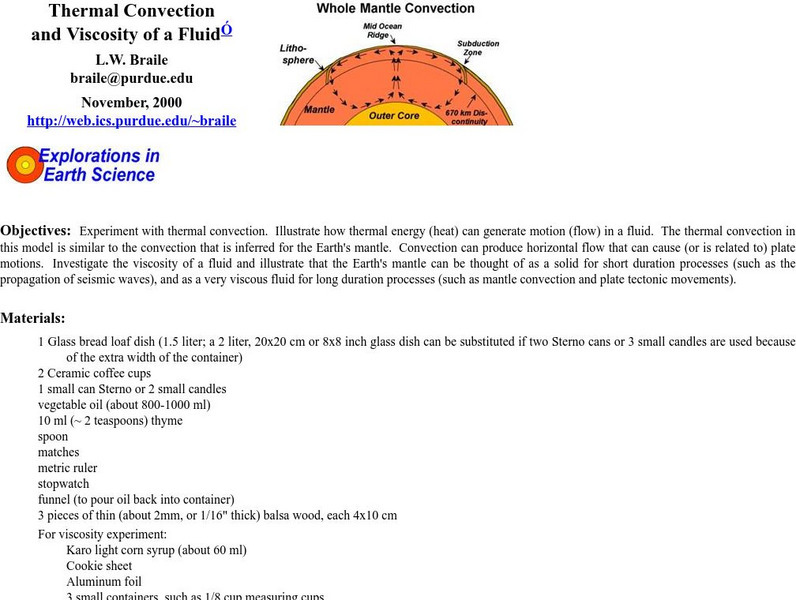
Purdue University: Thermal Convection
Students build a model representing the properties of Earth's mantle, illustrating how thermal energy creates movement in a fluid.
National High Magnetic Field Laboratory
Magnet Academy: James Joule
James Prescott Joule experimented with engines, electricity and heat throughout his life. Joule's findings resulted in his development of the mechanical theory of heat and Joule's law, which quantitatively describes the rate at which...