Hi, what do you want to do?






DiscoverE
Water Pollution Cleanup
How do scientists determine the best method for removing pollutants from our water sources? Environmental scholars experiment with pollution clean-up options to discover which are the most cost-effective, fastest, and most thorough....

US Environmental Protection Agency
Building an Model Aquifer
With almost half of Americans relying on groundwater supplies, it is more important than ever to protect aquifers from possible contaminants. Working in small groups, young environmentalists explore this problem as they create an aquifer...

US Environmental Protection Agency
Aquifer in a Cup
Young scientists create their very own aquifers in this science lesson on ground water. After learning about how some people get their drinking water from underground wells, young learners use sand, modeling clay, and aquarium rocks to...

US Environmental Protection Agency
Role of Plants in Water Filtration
Investigate the amazing ability of plants to filter contaminants from water with this series of in-class demonstrations. After placing six small, potted plants in plastic cups, different solutions and mixtures are poured into them that...

University of Waikato
Groundwater Contamination
Scientists study how pollution occurs in hopes of minimizing its effects. A quick activity shows how point and non-point source pollution enters groundwater and aquifers. Learners mimic the phenomenon with models that show how rain...

US Environmental Protection Agency
Protecting Your Drinking Water
Having a clean, reliable source of drinking water is essential for any community, but in many cases this is easier said than done. Engage young environmentalists in exploring the five factors affecting vulnerability of a groundwater...

US Environmental Protection Agency
A Mock Town Meeting on a Proposed Tank Farm
Intended as a follow up to the Protecting Your Drinking Water activity, young environmentalists use their assessment of the a hypothetical town's water supply to debate the installation of underground chemical storage tanks. With...

NOAA
It All Runs Downhill
Examine how pollution makes its way into an ocean with help from a model watershed. Scholars use household items to recreate a mini-watershed, equipped with pollutants, that when mixed with rain drain into a model's body of...

University of Florida
Protecting Our Water Resources
Teach young environmentalists to protect their planet's resources with a set of interactive experiments. Kindergartners and other youngsters learn about watersheds and the water cycle, while older elementary learners focus on fertilizer...

Teach Engineering
Chromatography Lab
Groups use alcohol and chromatography paper to separate the color components of black ink. The purpose of the activity is to allow the class to become aware that mixtures exist in hidden places.

University of Wisconsin
Conjunction Function
As part of a unit, this instructional activity familiarizes youngsters with components of a rain garden. They speculate about the role of an assigned component in contributing to a rain garden, and ultimately, in the health of the local...

University of Wisconsin
Follow the Drop
Young surveyors look for patterns in water flow around campus. Using a map of the school (that you will need to create), they mark the direction of the path of water. They also perform calculations for the volume that becomes runoff. The...
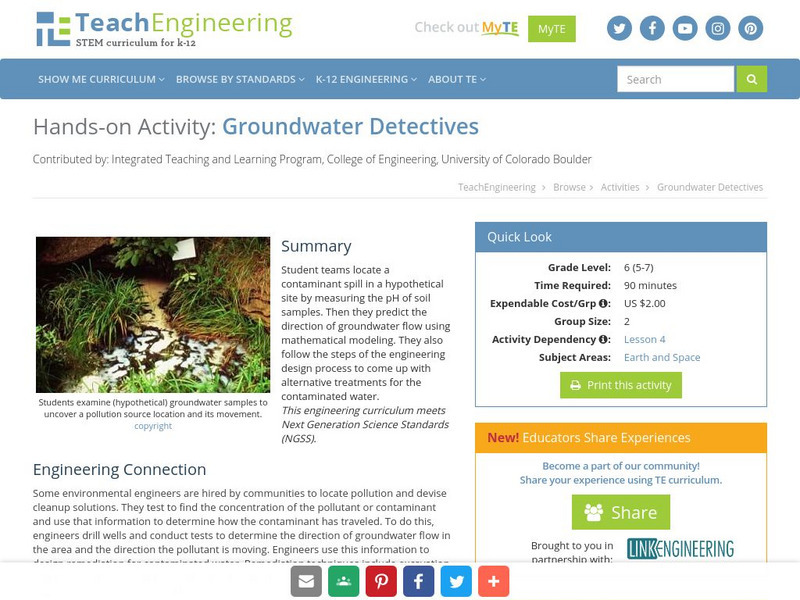
TeachEngineering
Teach Engineering: Groundwater Detectives
Student teams locate a contaminant spill in a hypothetical site by measuring the pH of soil samples. Then they predict the direction of groundwater flow using mathematical modeling. They also use the engineering design process to come up...
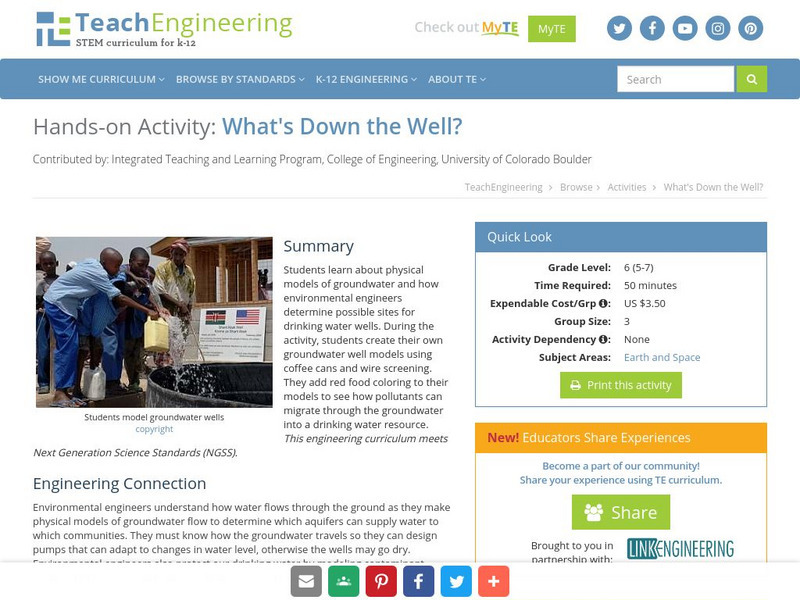
TeachEngineering
Teach Engineering: What's Down the Well?
This activity looks at physical models of groundwater and how environmental engineers determine possible sites for drinking water wells. During this activity, students will create their own groundwater well model using a coffee can and...
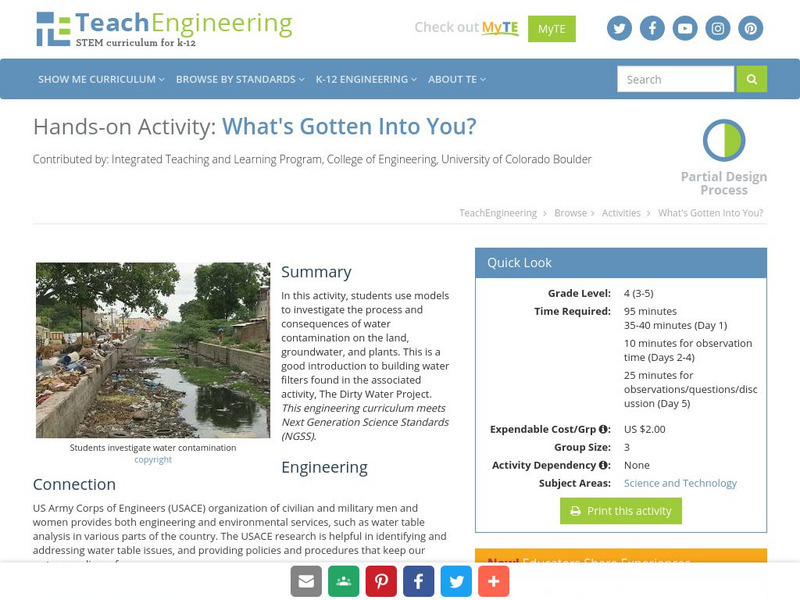
TeachEngineering
Teach Engineering: What's Gotten Into You?
In this activity, students use models to investigate the process and consequences of water contamination on the land, groundwater, and plants. This is a good introduction to building water filters found in the associated activity, The...
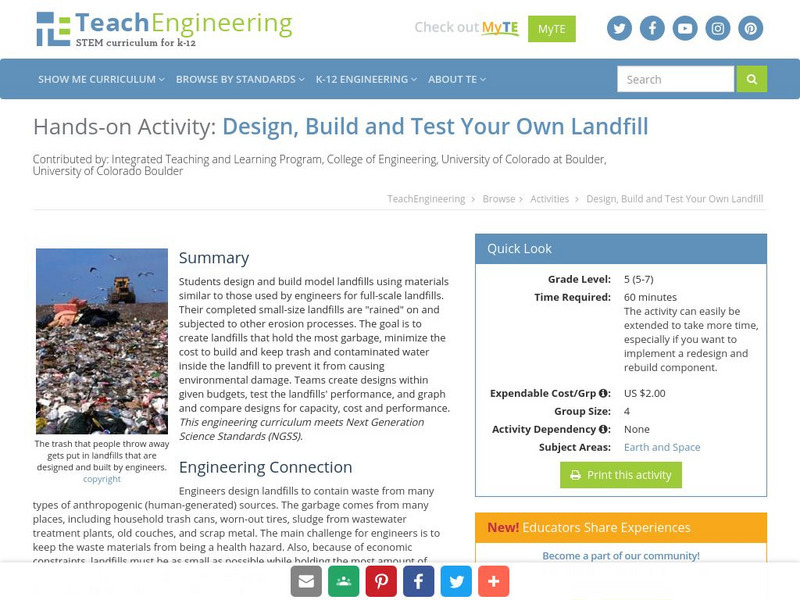
TeachEngineering
Teach Engineering: Design, Build and Test Your Own Landfill
Students design and build model landfills using materials similar to those used by engineers for full-scale landfills. Their completed small-size landfills are "rained" on and subjected to other erosion processes. The goal is to create...
US Environmental Protection Agency
Epa: A Kids Adventure Story
This cartoon describes what the EPA's Superfund is and how water can become polluted. A lab experiment with Q&A is included.
TeachEngineering
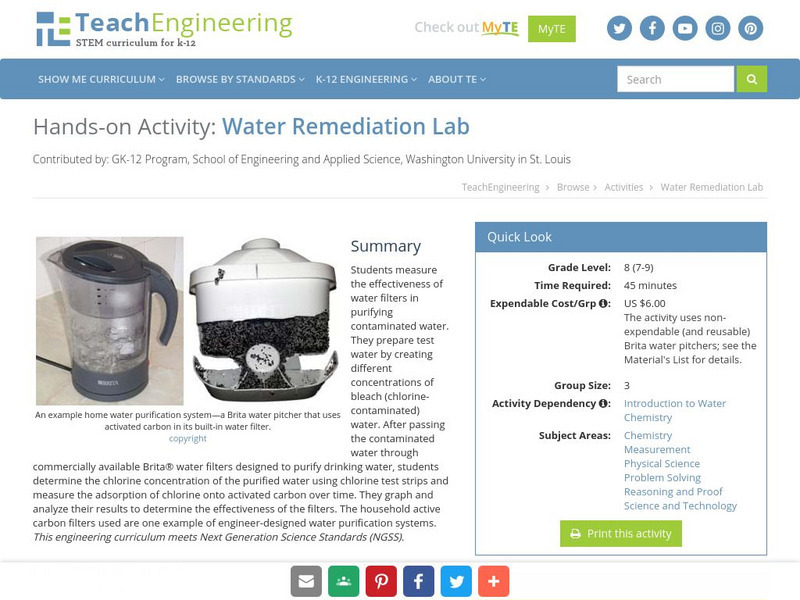
Teach Engineering: Water Remediation Lab
Students measure the effectiveness of water filters in purifying contaminated water. They prepare test water by creating different concentrations of bleach (chlorine-contaminated) water. After passing the contaminated water through...
Other
Science Projects: Fecal Contamination of Waters
Talks about history of public health and water systems and what kind of projects are being used to improve them.
Michigan Reach Out
Reach Out Michigan!: Contaminated Drinking Water
This site is provided for by Reach Out Michigan! Use the site to learn if our eyes and taste buds can detect contaminated drinking water by doing a simple experiment.