Hi, what do you want to do?






Other
Santa Rosa Library: How to Evaluate Information Resources
Tips and information about how to evaluate resources, both print and electronic. Includes information about source authority, purpose, objectivity, currency, completeness, and relevance. It includes a printable handout (top right)with...
Texas Education Agency
Texas Gateway: Evaluate Tone in Various Media for Audiences and Purposes
This lesson will help you evaluate changes in formality and tone within printed texts written for specific audiences and purposes. It focuses on writing produced during the Great Depression. RL.9-10.4 Word choice, Tone
Texas Education Agency
Texas Gateway: Evaluate Tone in Various Media for Different Audiences & Purposes
This lesson will help you evaluate changes in formality and tone within printed texts written for specific audiences and purposes. It focuses on writing produced during the Great Depression.

Texas Education Agency
Texas Gateway: Evaluate Graphics in Informational/procedural Text
You will learn how to evaluate graphics for their clarity in communicating meaning and achieving a specific purpose.
Thinkport Education
Thinkport: Research Simulation Task
Engage in a research process by analyzing a variety of print and non-print texts on the subject of bullying, identifying evidence regarding the topic, and using this new information to respond to questions about the text and the topic.
Austin Independent School District
Austin Independent School District: Graphic Organizers [Pdf]
A printable chart shows nine different types of graphic organizers and is followed by a blank copy of each type of organizer, ready to print and use in the classroom. RI.11-12.5 Evaluate text structure
Utah Education Network
Uen: Discovering Ourselves in Literature and Life
This lesson plan, provided by the International Society for Technology in Education (ISTE), encourages students to evaluate literature in a variety of multimedia formats and answer the question, "Who Am I?," Students are then asked to...
Sophia Learning
Sophia: How to Choose Credible Sources
This tutorial focuses on choosing credible sources for a research project. It offers two versions of a slideshow: a non-audio slideshow and an audio slideshow which explains the information as it is shown. They each define terms, offer...
ReadWriteThink
Read Write Think: A Picture's Worth a Thousand Words: Image to Narrative
This lesson, which can be adapted to fit with any picture you choose, works for students of all levels.
Indiana University
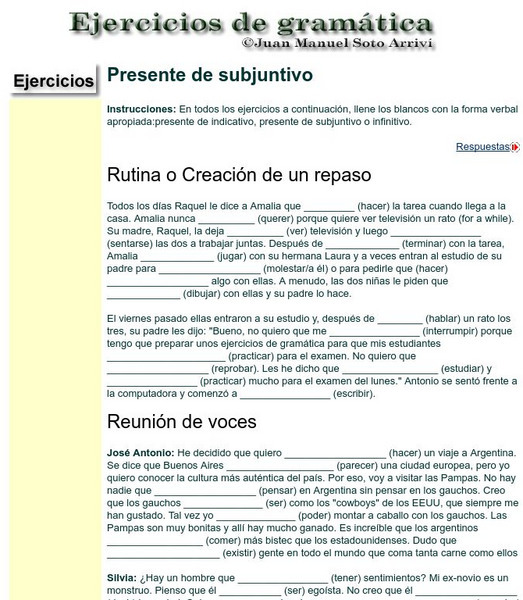
Juan M. Soto: Ejercicios Subjuntivo Presente Handout
Handout of three short exercises that may be printed for classroom use to practice the present subjunctive tense. Each exercise is also available for practice in interactive exercises that are linked to this site. This is a great...
Lumen Learning
Lumen: Using Sources: Building Credibility Through Source Integration
This lesson focuses on building credibility by properly integrating source materials. It discusses three ways of improving credibility through integration, provides an example, and a practice exercise. SL.9-10.2 eval & integrate...
Better Lesson
Better Lesson: Avoiding Plagiarism and Citing Sources
In this scaffolded lesson, students engage in practice with determining whether or not research has been plagiarized. A short video demonstration is included. [03:44] This lesson addresses all three College and Career Readiness Standards...
Pearson
Pearson Education: Reading Practice: Section 8
With this resource, students read two texts, "Ready for Anything" by Jean Lawler and "Jane Goodall" from What a Life by Milada Broukal, and answer the reading comprehension questions that follow. Students can print their answers for...