Hi, what do you want to do?






Exploratorium
Holding Charge
Slide paper over a plastic straws to generate static electricity, and then stick that straw to glass, a wall, or even your own hands! This is a science activity that students can use to show parents what they learn in school whenever...

101 Questions
Electric Bill
A brilliant resource is at your disposal. Future consumers investigate and discuss an electric bill. Given only partial information, they estimate the monthly bill. They then consider how tiered pricing will affect the bill.

Museum of Science
Static Cling
Cling to a lesson on static electricity. Pupils take part in experiments where they see how paper from hole punchers, packing peanuts, puffed rice cereal, and other items react when placed near a rubbed balloon. They learn how electrons...

American Chemical Society
Great Electron Ripoff
Create a charge in the classroom. Using pieces of cellophane tape, a plastic grocery bag, and a balloon, learners investigate the effects of static electricity. Pupils create different charges in the materials and observe whether they...

Exploratorium
Diamagnetism
If you are attracted to activities dealing with diamagnetism, here is a rare find that you will appreciate. With a neodymium magnet and a few common materials, move a pair of juicy grapes without touching them. Though the fruit is...

Teach Engineering
Gumdrop Atoms
There's nothing sticky about the resource, unless you count the gumdrops! Scholars create a model of a lithium atom, complete with protons, neutrons, and electrons. It's just that these models are made with gumdrops and toothpicks.

Massachusetts Institute of Technology
Nuclear Synthesis
Start this lesson with a bang! The eighth in a 13-part series of lessons explains the origin of elements beginning with the Big Bang Theory. The reading describes the formation of elements hydrogen through uranium.

University of Colorado
University of Colorado: Ph Et Interactive Simulations: Balloons and Static Electricity
An interactive simulation with balloons and a sweater that teaches about static electricity, electric charges, and electric force. This simulation can either be downloaded or played online and includes handouts, lesson plans, and...

Science Buddies
Science Buddies: How Do Different Materials React to Static Electricity?
Polyester clothing was generally accepted as a popular trend in fashion at one point in history. Now everybody wears cotton, which doesn't get static cling nearly as much. Why are some materials more susceptible to static cling than...
Interactive Mathematics
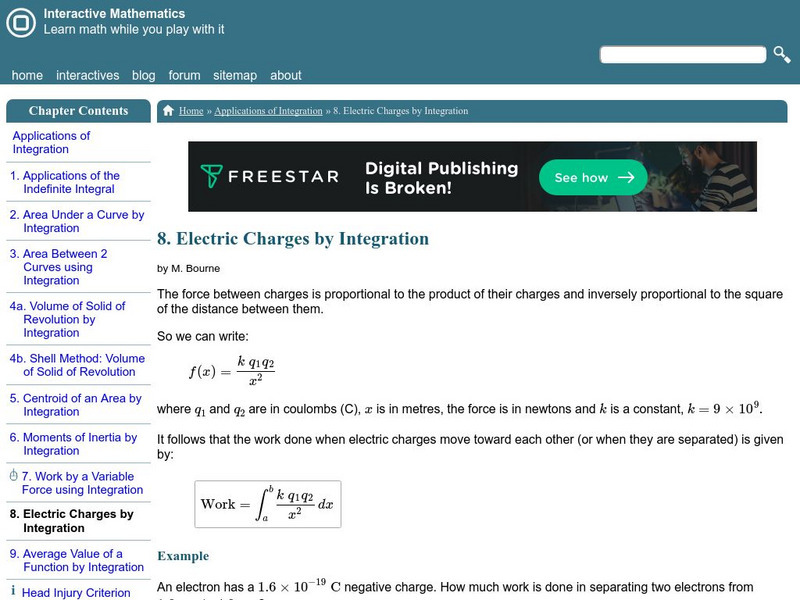
Interactive Mathematics: Electric Charges
An example is presented to show how integration is used to determine the force between electric charges. A detailed solution is provided.
Science Buddies
Science Buddies: Where There Is Charge, There Can Be Sparks!
In this short science project you will learn how to build a capacitor using common household items. By testing different charge cycles, you will work to discover how much charge is stored in a Leyden jar capacitor.

Exploratorium
Exploratorium: Science Snacks: Physics/electricity & Magnetism
Exploratorium Science Snacks are miniature science exhibits and experiments that can be made with common, inexpensive, easily available materials. These electricity snacks represent a set of devices that you can build and experiment with...
Science Buddies
Science Buddies: Rubbing Up Against Static Electricity
A tried and true balloon activity is to rub a balloon on your head to make your hair stand up. Learn how the rubbing builds up static electricity using this experiment to see if the number of rubs makes a difference.
TeachEngineering
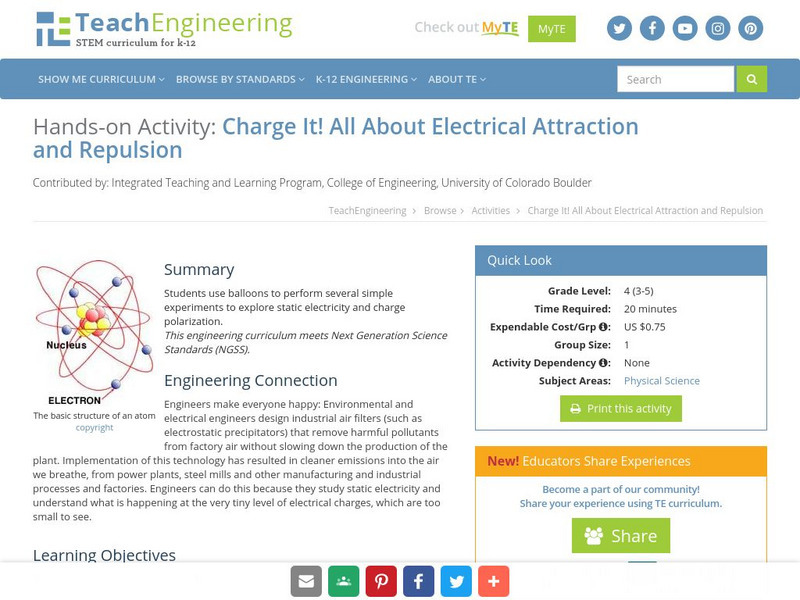
Teach Engineering: Charge It!
Students use a balloon to perform several simple experiments to explore static electricity and charge polarization.
TeachEngineering
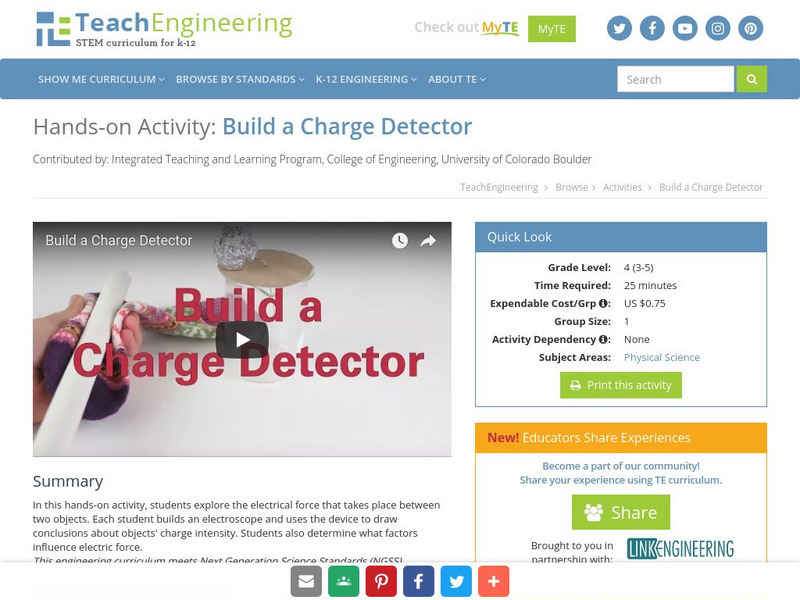
Teach Engineering: Build a Charge Detector
In this hands-on activity, students explore the electrical force that takes place between two objects. Each student builds an electroscope and uses the device to draw conclusions about objects' charge intensity. Students also determine...
University of Colorado
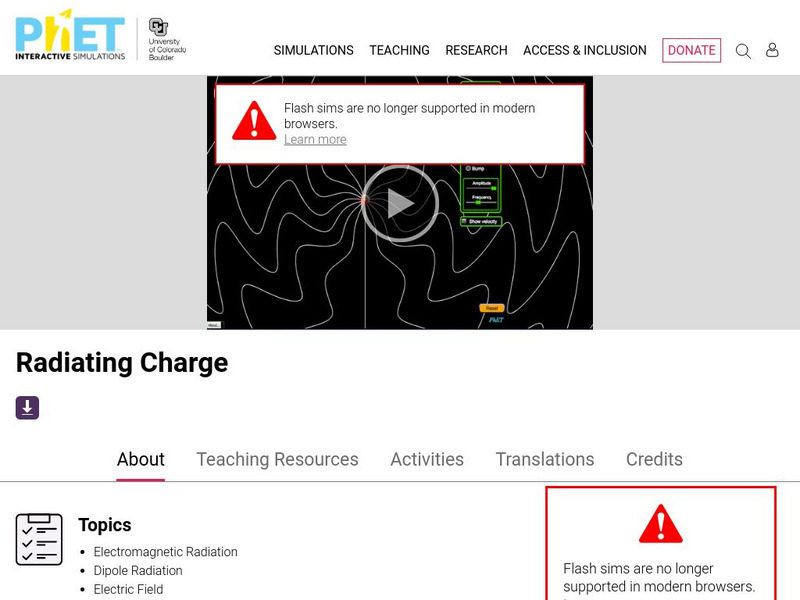
University of Colorado: Ph Et Interactive Simulations: Radiating Charge
An interactive simulation that teaches about electromagnetic radiation, dipole radiation, and electric fields by observing the effects of changes in sinusoidal, circular, and linear motion on the outward propagation of radiation. This...

Science Bob Pflugfelder
Science Bob: Bend Water With Static Electricity!
Contains a procedure for illustrating electrostatic attraction between opposite charges by causing a thin stream of water to bend. The site gives a brief discussion of static electricity, as well.
Exploratorium
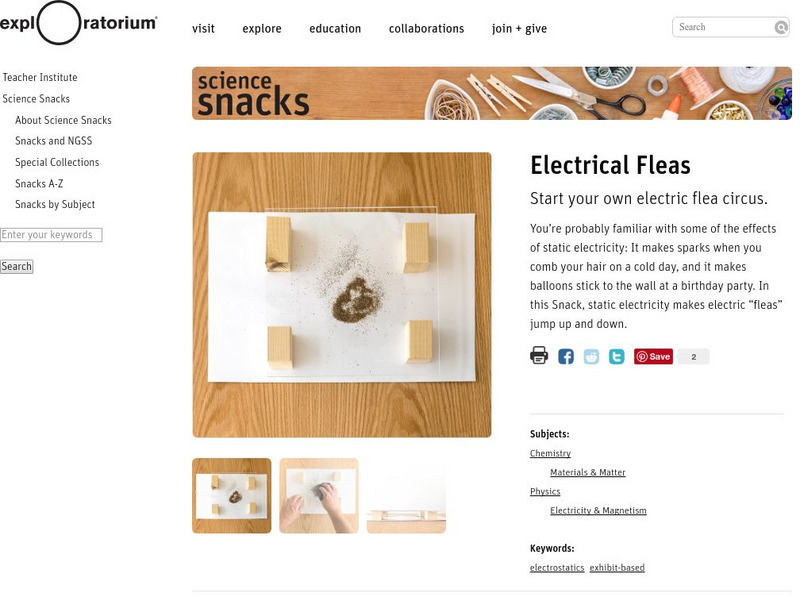
Exploratorium: Science Snacks: Electrical Fleas
Create your own "flea" circus in this activity by using the effects of static electricity. Students will observe a charged object attraction to the opposite charge causing the object to jump.
Miami University
The Atoms Family: Static Electricity
This site contains a simple experiment that you can do at home that explains static electricity.
University of Kentucky
Elecroscope Lab
This site is actually a lab from the University of Kentucky Electrical Engineering Department. It is an excellent experiment that can be done at the high school level.
Concord Consortium
Mobile Inquiry Technology: Decaying Batteries
This investigation has students investigating and measuring the decay of batteries as their electric charges are used up in circuits.
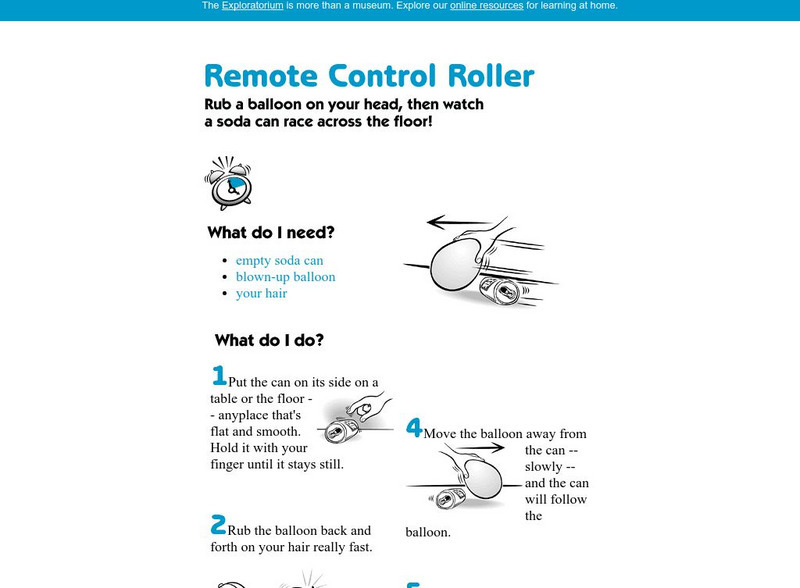
Exploratorium
Exploratorium: Remote Control Roller
Students can make a empty soda can roll with an electrically charged balloon.
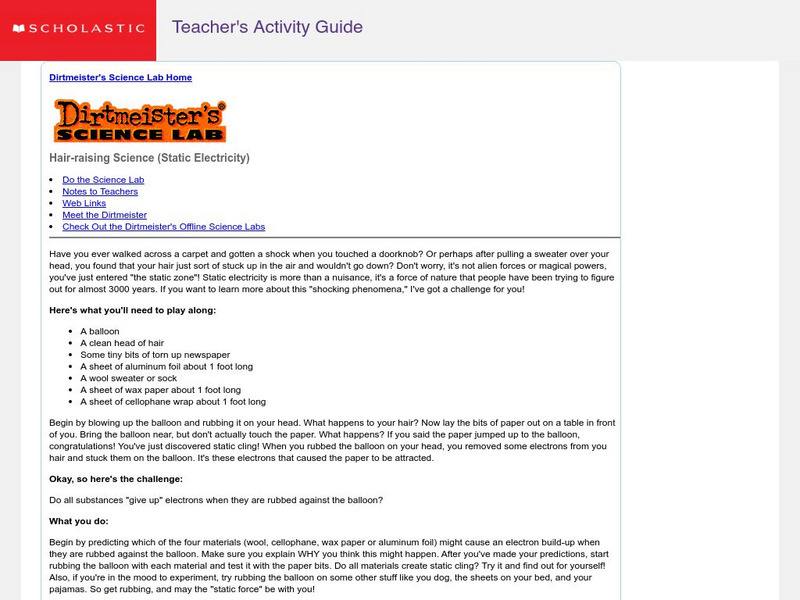
Scholastic
Scholastic: Dirtmeister's Science Lab: Hair Raising Science
A great experiment to show students how electrons move by static electricity. This site includes web links, a challenge question, and notes for the teacher.
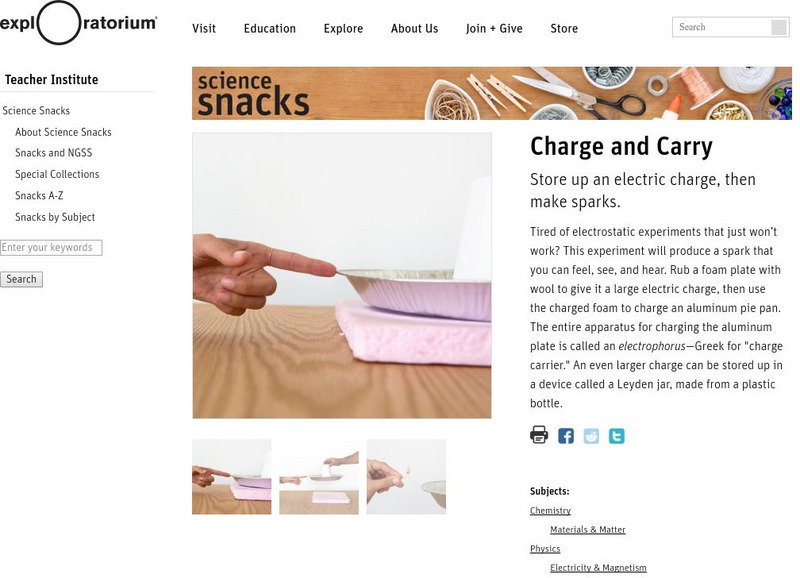
Exploratorium
Exploratorium: Science Snacks: Charge and Carry
This site from The Exploratorium Museum is a full description of a short activity. An electrophorus plate and a Leyden jar are made. The electrophorus is charged by induction. Its charge is transferred to the Leyden jar by conduction...
Other popular searches
- Electric Charge Behavior
- Electric Charge and Force
- Physics Electric Charges
- Electric Charges and Current
- Flow Electric Charges